
The University of Europe for Applied Sciences (UE) is a private university of applied sciences recognised by the state of Brandenburg, with campuses in Berlin, Hamburg and Iserlohn and an innovation hub in Potsdam. It was previously called the University of Applied Sciences Europe and absorbed the BiTS (Iserlohn) and BTK (Berlin) schools; today it belongs to the Global University Systems group. It teaches business, sport management, design, media, psychology and technology in English and German. Under the current offer a bachelor's starts at $7,530 (€6,662) a year, a master's at $9,220 (€8,158) a year, and the foundation year for school leavers costs $14,120 (€12,500) for nine months.
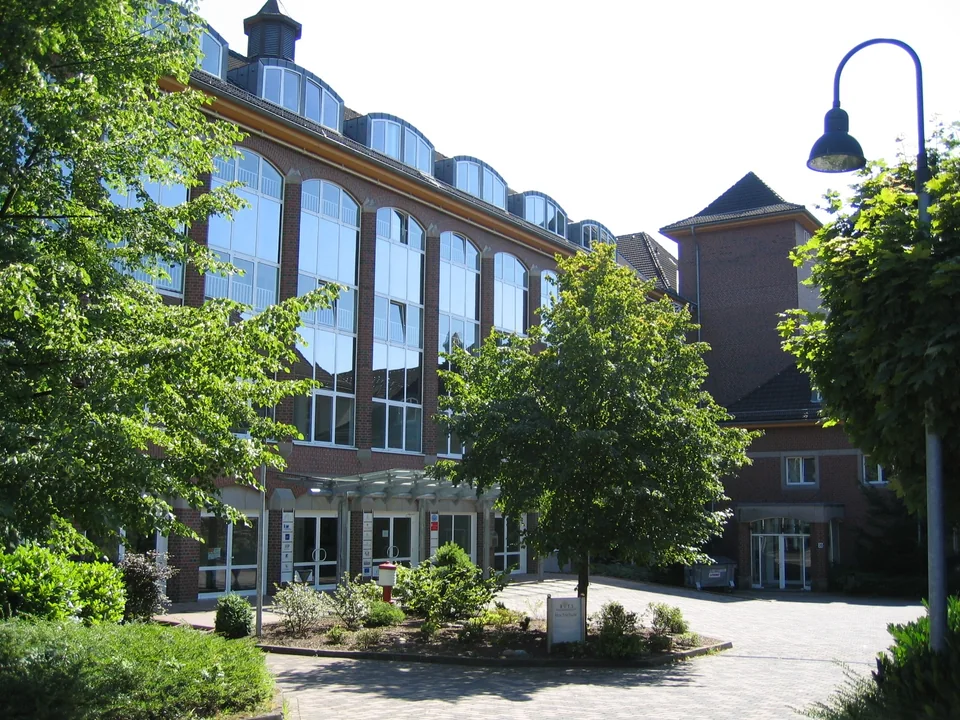
UE is not EU Business School, nor the public European University Viadrina in Frankfurt (Oder). UE's Dubai campus is a separate site with fees in dirhams; this page covers Germany only.
| At a glance | Details |
|---|---|
| Type | private university of applied sciences, state-recognised in Brandenburg |
| Legal seat | Potsdam (Think Campus, Konrad-Zuse-Ring 11); supervised by Brandenburg's science ministry |
| Campuses in Germany | Berlin, Hamburg, Iserlohn, UE Innovation Hub in Potsdam |
| Accreditation | system accreditation (FIBAA under Accreditation Council rules); programmes also accredited by ZEvA |
| Languages | English and German |
| Bachelor's | from $7,530 (€6,662) per year under the current offer |
| Master's | from $9,220 (€8,158) per year for 120 ECTS; from $10,470 (€9,263) per year for 60 ECTS |
| Foundation Year (Iserlohn) | $14,120 (€12,500) for 9 months; $16,500 (€14,600) for 12 months |
| English | bachelor's: IELTS 5.5 / TOEFL iBT 60; master's: IELTS 6.0 / TOEFL iBT 72 |
| Intakes | winter semester from 1 September, summer from 1 March; Berlin bachelor's also start in January and July |
What "state-recognised" means at UE
UE's accreditation page states that it is recognised by Brandenburg and that all its programmes are approved by Brandenburg's Ministry of Science, Research and Culture (MWFK), so its bachelor's and master's degrees are formally equal to those of public universities. The sequence is: the programme is accredited internally under a quality system audited by FIBAA, the file goes to the ministry, the ministry extends the state approval, and the accreditation report is published in the Accreditation Council's database. Look your programme up there before applying.
The German Science and Humanities Council (Wissenschaftsrat) accredited UE's predecessor, BiTS in Iserlohn, in 2014 for ten years. Its list of completed procedures shows no separate decision for UE under its current name; ask the university about the status of its institutional accreditation before you sign a contract.
Campuses
- Berlin is the main campus for international students. The Business and Management Studies bachelor's starts here four times a year: January, March, July and September.
- Hamburg is the second large city campus, with bachelor's starts in March and September.
- Iserlohn (North Rhine-Westphalia) is the former BiTS campus and hosts the preparatory Foundation Year; bachelor's start in March and September.
- UE Innovation Hub in Potsdam sits on the Think Campus, which is being developed as a technology centre involving SAP.
Each programme page shows where it runs; not every subject is offered at every campus. The city also drives your living costs: Hamburg and Berlin are more expensive than Iserlohn.
Who UE suits
| UE makes sense if | Consider other options if |
|---|---|
| you want design, media, sport management or practice-led business | you need engineering, medicine or a research career |
| you want a start with modest English requirements (IELTS 5.5) | you want a university that publishes full prices without promotions |
| internships and company projects matter to you | university-provided housing in the city is essential |
| you would like Hamburg or Iserlohn, not just Berlin | your budget is built around a tuition-free public university |
For comparison, see our profiles of Gisma, which has the same owner, IU International University and SRH University. Tuition-free options are in our guide to English-taught degrees in Germany.
Programmes
UE's catalogue has four areas:
- Art & Design. Bachelor's in Communication Design, Visual Communication, UX/UI Design, Film + Motion Design, Game Design, Illustration, Photography and Design & Management Studies; master's such as Design Leadership, New Media Design, Visual and Experience Design and Generative Design & AI.
- Business & Sport. Bachelor's in Business and Management Studies (BSc, six semesters, 180 ECTS), Sport and Event Management and Sport Science; master's in International Business Management, Marketing Management, International Logistics and Transportation Management and Asset Management. The Football Management and E-Sports specialisations cost $90 (€80) a month extra.
- Tech & Software. Bachelor's in Software Engineering, Digital Business and Data Science, and Digital Media and Marketing; master's in Data Science, Software Engineering, DevOps, Robotics Engineering, Smart Mobility, IoT Devices and Smart Services, and Digital Transformations.
- Health & Psychology. Bachelor's in Psychology, Applied Psychology, Business Psychology and Health Management; master's in clinical psychology, coaching and counselling, and public health.
There are also around twenty MBAs of 60 or 90 ECTS (for example Financial Management, Digital Technology, Diplomacy, Investment Banking, Sports Management) and dual programmes where an employer usually covers tuition. For non-EU applicants the dual format is available only in Hotel Management and Software Engineering and requires a contract with a company.
Fees
UE publishes "from" prices marked as a current offer; the standard rate without discount is not shown and comes from an adviser. Prices checked on 1 October 2026:
| Programme | Fee |
|---|---|
| Bachelor's | from $7,530 (€6,662) per year |
| Football Management and E-Sports specialisations | plus $90 (€80) per month |
| Master's, 120 ECTS (2 years) | from $9,220 (€8,158) per year |
| Master's, 90 ECTS (1.5 years) | from $9,420 (€8,341) per year |
| Master's, 60 ECTS (1 year) | from $10,470 (€9,263) per year |
| MBA, 90 ECTS (1.5 years) | from $9,700 (€8,590) per year |
| MBA, 60 ECTS (1 year) | from $10,890 (€9,636) per year |
| Foundation Year / Studienkolleg, 9 months | $14,120 (€12,500) |
| Foundation Year / Studienkolleg, 12 months | $16,500 (€14,600) per year |
- According to UE, fees include enrolment, examination and thesis charges. The same page's list of additional charges, however, shows a $550 (€490) registration fee and a $100 (€89) yearly technology fee, and paying in semester instalments costs $280 (€250) per semester, so ask for the contract to state which of these apply to you.
- After acceptance you pay a reservation fee of at least $1,690 (€1,500), which is deducted from the programme price.
- If you start with the Foundation Year, UE halves the fee for the last semester of your bachelor's.
- Discounts: an academic-merit saving based on your grades, 50% for UE and group bachelor's graduates, and $560 (€500) per referred friend. Discounts and scholarships cannot be combined.
- According to UE's FAQ, the study contract can be terminated at the end of any semester; the exact notice periods are in the contract, so read them before signing.
- On-campus German classes in Berlin, Potsdam and Hamburg cost about $85 (€75) per semester and are not offered online.
Living funds for the visa are separate: $13,450 (€11,904) for the first year. National averages are in our overview of the cost of studying in Germany.
Scholarships
UE awards partial scholarships each semester for one year; the university runs the selection, and you apply with a motivation letter or creative work depending on the programme. The list of scholarship schemes is on a separate UE page. UE does not offer full scholarships. Federal BAföG support is generally not available to students on a study visa: UE itself notes that holders of a Section 16b permit are not eligible unless they meet another condition.
Entry requirements
Bachelor's (BA, BSc):
- school-leaving certificate and transcript with official English or German translation;
- an admission test, mainly for non-EU applicants: a short essay on a topic related to the programme, plus maths for BSc programmes; UE says no special preparation is needed;
- English: IELTS 5.5, TOEFL iBT 60, TOEFL ITP 498, PTE Academic 56 or Cambridge 162;
- a dated and signed CV and passport scan; a portfolio for some design programmes (not for Digital Product Management, Design & Management Studies or UX/UI Design).
Many non-EU school certificates, including the Russian attestat, give only indirect access to German higher education. If UE does not consider your certificate sufficient for your programme, the route is the Foundation Year or a first year at university at home. Our Studienkolleg guide explains the preparatory stage.
Foundation Year in Iserlohn. UE calls it both a Foundation Year and a Studienkolleg. There are three courses: W-Course English (economics, 9 months, for English-taught programmes), W-Course German (economics, 9 or 12 months) and T-Course German (technical programmes). You need a school certificate recognised in anabin, English at B1, German at A2, entrance tests and an interview. The 12-month course starts in January and August, the 9-month course in April and November. UE says graduates will "likely" gain access to their chosen subject at German universities, including public ones; whether a particular public university accepts the final exam is for that university to decide.
Master's and MBA:
- a bachelor's or master's degree with an English or German translation;
- English: IELTS 6.0, TOEFL iBT 72, PTE Academic 59 or Cambridge 169;
- a CV and, for some programmes, a motivation letter of at least 500 words;
- for an MBA, at least one year of work experience after the first degree.
The 60-, 90- or 120-ECTS track depends on the credits in your degree and your work experience. UE makes the admission decision. The general process is in our guide to a master's in Germany in English.
Semester dates
| Semester | Starts | End of intake | Lectures |
|---|---|---|---|
| Winter 2026/27 | 01.09.2026 | 09.10.2026 | 28.09.2026–23.01.2027 |
| Summer 2027 | 01.03.2027 | 08.04.2027 | from late March 2027 |
"End of intake" is the last day you can join the semester, not an application deadline. Visa applicants should allow another two to three months for the embassy, so for September the realistic time to apply is spring.
Russian and Kazakh citizens
- Visa. Russian residents apply for the national study visa at the German Embassy in Moscow; the Consulate General in St Petersburg closed on 18 September 2026. The embassy checklist gives a usual processing time of 6–8 weeks, never less than four. UE helps with the visa file free of charge, and students at the Berlin and Potsdam campuses can use an online residence-permit service from the law firm SERS.
- On-campus format. A Section 16b study visa (Residence Act, AufenthG) requires full-time study. The Berlin Senate's answer of 29 January 2026 warned that online programmes without compulsory attendance usually do not qualify. Choose a programme taught on campus and check the timetable; for instance, MBA Financial Management classes usually run from Wednesday to Saturday.
- Passport. A biometric passport has been required since 1 January 2026.
- Living funds. $1,120 (€992) per month, $13,450 (€11,904) for the first year. The embassy says no Russian bank offers a suitable blocked account, and Russian bank statements are not accepted. See our blocked account guide.
- Documents. Acceptance letter, motivation letter and CV in German or translated into German; translations made in Russia must be notarised; under-18s need notarised parental consent.
- Payments. UE accepts payments via Flywire; from Russia, use legal routes only, as described in how to pay for studies abroad from Russia.
- Kazakhstan. Kazakh citizens apply at the German mission in Kazakhstan responsible for their place of residence.
The German embassy decides on the visa together with the immigration office. Step by step: our German student visa guide and studying in Germany for Russian citizens.
Housing
UE's website does not describe residences of its own; the university helps with the search. For Berlin students it offers places at Edge Student Hub in Zossen, about 45 minutes from Potsdamer Platz, where a place in a four-person room starts at $450 (€399) a month, a double room at $680 (€599) and a single room at $900 (€799), plus a refundable deposit of two months' rent (residence website, 2 October 2026). If you prefer to live in the city, start looking for a shared flat early; see our guides to student housing in Germany and universities in Berlin.
Common mistakes
- Comparing a "from" price with another university's full price. UE's table shows a promotional rate; ask for the standard price in writing.
- Confusing UE with EU Business School or with UE Dubai. They are different institutions with different visa regimes.
- Treating the Foundation Year as an automatic ticket to any public university. The receiving university decides whether to accept the final exam.
- Reading "end of intake" as the deadline. With a visa you need to apply months earlier.
- Not checking the campus. A subject offered in Berlin may not run in Iserlohn.
Timeline for September 2027
- October–December 2026. Choose the programme and campus, take IELTS 5.5–6.0, ask UE for the standard price and contract terms.
- January–March 2027. Apply, sit the admission test, receive the decision and contract.
- March–April 2027. Pay as agreed in the contract and receive the acceptance letter.
- April–May 2027. Open a blocked account and book the embassy appointment in Moscow.
- July–August 2027. Collect the visa and arrange housing; the semester starts on 1 September.
FAQ
Is a University of Europe for Applied Sciences degree recognised in Germany?
Yes. UE is state-recognised by Brandenburg, its programmes are approved by Brandenburg's science ministry and accredited under a system audited by FIBAA, so its degrees are formally equal to public-university degrees. Recognition abroad is decided by the receiving country or employer.
How much does UE cost?
Under the current offer, a bachelor's starts at $7,530 (€6,662) a year, a 120-ECTS master's at $9,220 (€8,158) a year and an MBA at $9,700 (€8,590) a year. Standard prices without discount are provided by advisers. A visa also requires $13,450 (€11,904) in a blocked account.
Can I apply to UE straight after secondary school?
Yes, with a translated school certificate, IELTS 5.5 and the admission test. But many non-EU certificates, including the Russian attestat, give only indirect access in Germany, so UE may direct you to the Foundation Year in Iserlohn ($14,120 for nine months). The university makes the admission decision.
Does UE's Foundation Year lead to a public university?
UE says graduates will likely gain access to their chosen subject at German universities, including public ones. That is not a commitment: whether a specific university accepts the final exam is decided by its admissions office, so ask it in advance.
Does UE have student residences?
UE's website does not describe residences of its own. The university helps with the search and offers Berlin students places at Edge Student Hub in Zossen, where a place in a shared room starts at $450 (€399) a month; other students rent rooms in shared flats.
How is UE different from Gisma?
Both are private, recognised in Brandenburg and part of the Global University Systems group. UE is broader, covering design, media, sport, psychology and technology in Berlin, Hamburg and Iserlohn. Gisma focuses on business and technology in Potsdam and Berlin and offers double degrees with Kingston University London.
Sources
- UE: accreditation and state recognition (German), quality management, legal notice (German), about, why UE, GUS Germany group
- UE: fees and finance, admission requirements, Foundation Year, semester dates, FAQ (German)
- UE programmes: Business and Management Studies, MBA Financial Management, Art & Design, Tech & Software, Health & Psychology
- Edge Student Hub Zossen: room prices
- Wissenschaftsrat: completed accreditation procedures (PDF)
- Berlin House of Representatives: Senate answer to written question 19/24 882, 29 January 2026 (PDF)
- German Embassy Moscow: study visa checklist (PDF, Russian), national visa, embassy news
- Federal Foreign Office: blocked accounts
Dollar figures use the ECB reference rate of 1 October 2026 (€1 = $1.1298), rounded to $1 below $100 and to $10 above. Facts checked on 1–2 October 2026. Other German universities are listed on our study in Germany page.
If you want to work through your route, send a request: document preparation and submission are provided under an agreement with StudyU, and the university makes the admission decision.
During the free initial consultation, we clarify your goal, profile, timing, and budget and identify the next realistic step.
Next steps
- Gisma University of Applied Sciences: Degrees, Fees and Admission
- IU International University: On-Campus Study in Germany, Fees and Visa
- SRH University: Campuses in Germany, Fees for International Students and Admission
- Studying in Germany for international applicants
- English-Taught Degrees in Germany: Bachelor's, Master's, Costs and Work After Graduation (2026–2027)
- Cost of Studying in Germany: A Full First-Year Student Budget for 2026–2027
