
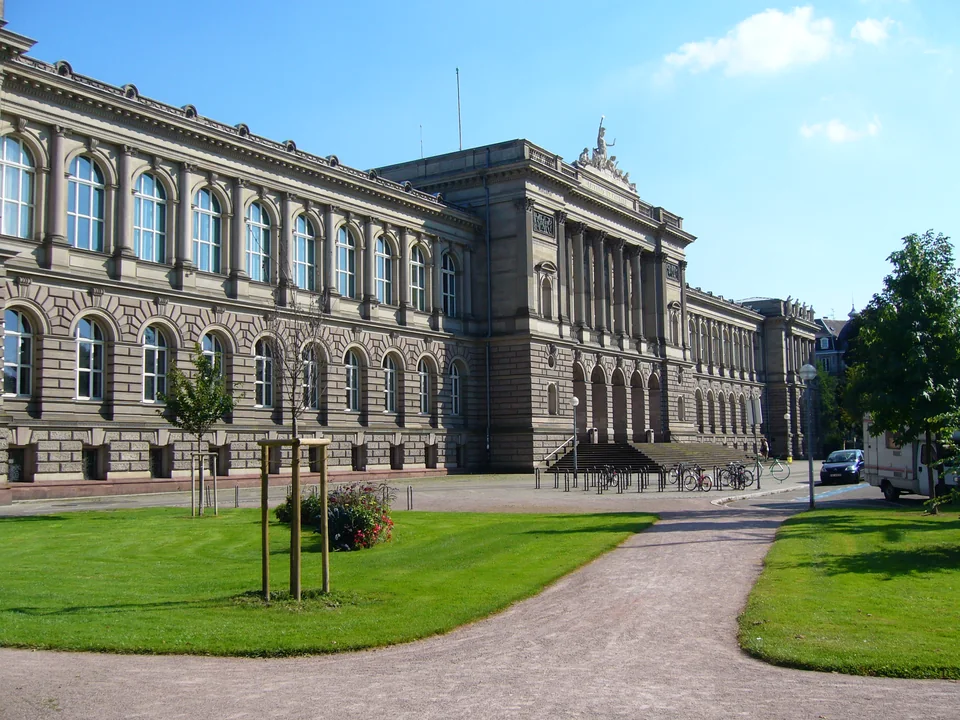
The University of Strasbourg (Unistra) is a public university in Alsace on the German border, with 56,000 students, including 13,000 international students, 35 faculties, schools and institutes, and 77 laboratories. Its current form dates from 2009, when three Strasbourg universities merged, but its roots go back to a Protestant gymnasium founded in 1538. Applicants in Études en France countries apply through Campus France; for 2027/28, residents of Russia face two cut-offs: 15 December 2026 for a first-year place and 30 January 2027 for a master's. In 2026/27, new non-EU licence students admitted through Études en France are exempt from the higher fee and pay $200 (€178) a year, while new master's students pay the differentiated $4,490 (€3,950) unless granted an individual exemption. Unistra has not yet published its rules for the 2027/28 intake, so budget at the differentiated rate. Most teaching is in French, but a long list of master's programmes is taught in English, from chemistry and biotechnology to international relations.
| At a glance | Details |
|---|---|
| Status | public university; member of the League of European Research Universities (LERU) and the Eucor trinational alliance |
| Location | Strasbourg, 10 campuses |
| Students | 56,000, including 13,000 international students |
| Programmes | 725 degrees and tracks across 35 faculties, schools and institutes |
| Research | 77 labs; 20 Nobel and Kavli laureates associated with the university |
| Ranking | ARWU 2026: 101–150 |
| Non-EU fees 2026/27 | licence: $200 (€178) for new students admitted via Études en France; master's: $4,490 (€3,950) without an exemption |
| CVEC contribution | $120 (€105) per year |
How the university is organised, and what makes it different
After the 1968 reforms, the University of Strasbourg was split into Université Louis Pasteur (sciences and medicine), Université Marc Bloch (humanities) and Université Robert Schuman (law, political science, social and technological subjects). They merged in 2009. Older agency listings still use all three names; today you apply only to Unistra.
Louis Pasteur had his office in the university building on rue de l'Académie, and Albert Schweitzer, later a Nobel Peace laureate, studied and began teaching at the German-era university.
Three features set Strasbourg apart:
- World-class chemistry and life sciences. Nobel chemistry laureates Jean-Marie Lehn (1987) and Jean-Pierre Sauvage (2016) worked here, and the university counts 20 Nobel and Kavli laureates among its community.
- A European capital. The Council of Europe and the European Court of Human Rights sit in Strasbourg, and the European Parliament holds its plenary sessions here, which is useful for law, political science and international relations students.
- A cross-border campus. Unistra belongs to Eucor – The European Campus with the universities of Basel, Freiburg and Haute-Alsace and the Karlsruhe Institute of Technology (KIT), and its Franco-German programmes lead to double or triple degrees.
Our overview of universities in France for international students compares Strasbourg with other options.
Who Strasbourg suits
| Good fit | Weigh carefully |
|---|---|
| A French-taught bachelor's at public-university cost: in 2026/27 new international first-cycle students were exempt from the higher fee (2027/28 rules not yet announced) | A master's costs a new international student much more: $4,490 (€3,950) in 2026/27 without an exemption |
| An English-taught master's in chemistry, physics, biotechnology, neuroscience or computer science | Almost no English-taught programmes at licence level |
| Careers in European institutions, law or international relations | A smaller city than Paris, and some internships require German |
| Lower living costs than Paris in a large student city | A continental climate with colder winters than southern France |
Faculties and programmes
Unistra's 35 components include faculties, engineering schools, institutes and institutes of technology (IUT). The main areas are:
- sciences: chemistry, physics, mathematics, computer science, life sciences, Earth and environmental sciences (EOST);
- health: medicine, pharmacy, dentistry and midwifery;
- law, economics and management: the law and economics faculties, EM Strasbourg business school and Sciences Po Strasbourg;
- humanities and social sciences: languages, literature, history, philosophy, psychology, sociology and theology (Strasbourg has both Catholic and Protestant theology faculties);
- engineering: engineering schools and IUTs.
English-taught master's programmes
The university publishes a dedicated list, including:
| Area | Examples |
|---|---|
| Chemistry and materials | Molecular and Supramolecular Chemistry; Chemistry, Biology and Drug Design; Green Chemistry; Polymer Engineering; International Master's in Polymer Science |
| Physics | Astrophysics and Data Science; Quantum Technologies; Subatomic and Astroparticle Physics; Cell Physics |
| Biotechnology and life sciences | Biopharmaceuticals; Biotechnology and Data Science; Immunology and Inflammation; Microbiology; Virology; several neuroscience tracks |
| Earth sciences | Continental Water Sustainability; Geosciences for the Energy System Transition |
| Computing and data | Knowledge, Data Science and AI (CODIA); Image and 3D; HealthTech |
| Health and pharmacy | International Master's in Biomedicine; Surgical Science and Innovation Technology; Pharmaceutical Regulation and Law |
| International relations | Defense, Intelligence and International Security; International Development and Cooperation; International Negotiations and Expertise |
Some tracks are bilingual, distance-learning or work-study, so check each programme page. For more options, see English-taught degrees in France.
Learning French first
The Pôle FLE-IIEF in the Faculty of Languages teaches French as a foreign language, awards DUEF university diplomas, runs courses for licence and master's students and hosts DELF exams. Our DELF, DALF and TCF guide compares the exams.
How to apply
Residents of Études en France countries apply through that procedure. Applicants resident in Russia follow these 2027/28 dates:
| Step | First year | L2, L3 and master's |
|---|---|---|
| Submit the file | by 15 December 2026 | by 30 January 2027 |
| Pay the Campus France fee | by 21 February 2027 | by 21 February 2027 |
| Interview | by 1 March 2027 | by 1 March 2027 |
| DELF/DALF or TCF result | by 1 March 2027 | as the programme requires |
| University replies | by 30 April 2027 | by 30 April 2027 |
| Final choice | by 31 May 2027 | by 31 May 2027 |
First year: non-EU school leavers submit a preliminary admission request (DAP, the "white file"), list no more than three universities and prove B2 French. See bachelor's degrees in France.
Master's: bachelor's graduates apply for M1 through Études en France, and the application is then handled internally through Unistra's eCandidat platform, whose windows differ by faculty. Panels compare your degree with the programme and review grades, statement and language level. See master's degrees in France.
Documents and translations
Documents in languages other than French or English must be translated into French (or into English for a fully English-taught programme) by a sworn or notarised translator; passports and language certificates need no translation. Campus France Russia notes that certificates from universities and employers are valid for one month, while a certified diploma translation does not expire, and warns against common errors such as rendering a Russian bachelor's degree as "Baccalauréat" instead of "Diplôme de Bachelor".
Doctoral study
There is no central doctoral admissions round. You first find a supervisor and a laboratory, then funding (a contract, grant or scholarship), and only then enrol in one of the university's doctoral schools. The differentiated fee does not apply to doctorates: the annual fee is $450 (€398).
The academic year has two semesters, and grades use a 0–20 scale with 10 as the pass mark.
Fees and living costs
Tuition in 2026/27
| Level | National rate | Non-EU differentiated rate |
|---|---|---|
| Licence and BUT | $200 (€178) | $3,300 (€2,902) |
| Master's | $290 (€255) | $4,490 (€3,950) |
| Engineering degree | $720 (€630) | no differentiated rate |
| Doctorate | $450 (€398) | no differentiated rate |
Who pays less in practice:
- New first-cycle students. If you are admitted to a licence through Études en France, Parcoursup or eCandidat, Unistra exempts you from the higher rate in 2026/27 until you complete the first cycle, provided you stay in the same programme.
- Continuing students. Students already exempt in 2025/26 keep the exemption until they graduate, including when moving from a Unistra licence to a Unistra master's.
- New master's students from abroad are not covered by the transitional rules and pay $4,490 (€3,950). They may request an individual exemption from the university presidency by 15 October 2026; the committee considers income, family situation, disability, the situation in the home country and other aid received.
- French Government scholars and reciprocal exchange students pay no tuition.
Unistra says it will complete its rules for 2027/28 as guidance on Decree 2026-385 of 19 May 2026 is clarified. The national framework is already set: exemptions are individual, based on resources and circumstances, and, according to the ministry, capped at 30% in 2026/27, 25% in 2027/28 and 20% from 2028. Budget both a licence and a master's for 2027/28 at the differentiated rate, and count an exemption only once you have it in writing.
Compulsory costs and living expenses
| Item | Amount |
|---|---|
| CVEC | $120 (€105) per year |
| Pass campus student card (optional) | $11 (€10) |
| Visa validation after arrival | $110 (€100) |
| CROUS residence, outside Paris (Campus France estimate) | $280–570 (€250–500) per month |
| Studio from a private landlord | $340–1,020 (€300–900) per month |
| Groceries | $190–240 (€170–210) per month |
Students on need-based French grants are exempt from national fees altogether. Visa applicants must show at least $1,000 (€877.50) a month.
Scholarships
- Eiffel Excellence Scholarship: the French foreign ministry's award for master's students aged up to 29 pays a monthly allowance, and Unistra nominates the candidates; for the 2026 round, universities sent their files to Campus France by 8 January 2026.
- Country-specific French Government scholarships offered through French embassies.
- Individual exemption from the differentiated fee, requested from the university presidency; for 2026/27 the deadline is 15 October 2026.
See scholarships in France for more.
Housing and settling in
International students are welcomed at the Maison universitaire internationale (MUI), a single point of help with housing, visas, insurance and banking. Unistra has held the maximum three-star "Bienvenue en France" label from Campus France since 2019. In Strasbourg, CROUS residence places are allocated in spring through the Dossier Social Étudiant (DSE), and since 1 July 2026 the APL housing allowance has been reserved, for non-EU students, for CROUS grant holders, working students and apprentices. Our student housing guide has practical advice.
Visa
After admission you record the university's decision in your Études en France file, then apply for a long-stay student visa (VLS-TS) at the French visa centre no earlier than three months before classes. You validate the visa online within three months of arrival. You can work up to 964 hours a year while studying, and master's graduates can apply for a one-year permit to look for work or start a business. For the full procedure, read our French student visa guide; Russian applicants should also see studying in France as a Russian citizen, which covers paying fees from Russia and having a French degree recognised at home.
Rankings
Strasbourg is in the 101–150 band of ARWU 2026. That ranking leans heavily on publications and major research awards, where Strasbourg's chemistry is strong, so it says little about any single programme. For a master's, look at the laboratory attached to the track, its partners and its internship topics.
Common mistakes
- Assuming the licence exemption also covers a new master's. New international master's students pay $4,490 (€3,950) in 2026/27 unless individually exempted.
- Assuming an exemption is automatic. For 2026/27 requests were due by 15 October and decided by a university committee; the 2027/28 dates and criteria have not been announced.
- Looking for Louis Pasteur or Marc Bloch universities. Since 2009 there has been one university.
- Expecting one eCandidat deadline. Windows vary by faculty and change each year.
- Treating bilingual programmes as fully English-taught. Some tracks teach half their courses in French.
- Forgetting German for Franco-German programmes. Double and triple degrees with German partners usually need both languages.
FAQ
Can I apply to the University of Strasbourg straight after high school?
Yes, to a first-year licence. For 2027/28, a Russian resident sends the DAP white file through Études en France by 15 December 2026, choosing up to three universities, and submits a DELF B2 or TCF result by 1 March 2027.
How much does Strasbourg cost for international students?
In 2026/27, a new licence student admitted through Études en France paid $200 (€178) a year under the transitional exemption, and a new international master's student paid $4,490 (€3,950) unless an individual exemption was approved. The 2027/28 rules are not yet published, so plan for the differentiated rate: $3,300 (€2,902) a year for a licence and $4,490 (€3,950) for a master's at 2026/27 prices, plus the $120 (€105) CVEC.
Are there programmes in English?
Yes, at master's level: chemistry and materials, physics, biotechnology, neuroscience, virology, computing and data, biomedicine and international relations. Bachelor's teaching is in French.
Do I need German to study in Strasbourg?
For most programmes, no; French or English is enough. German is needed for Franco-German double and triple degrees and helps with internships in the border region and within the Eucor alliance.
How do I get a master's fee exemption?
Submit an individual request to the university presidency: for 2026/27 the deadline is 15 October 2026, and the 2027/28 dates have not been announced. The committee weighs income, family circumstances, disability, the situation in your home country and other aid received; the decision rests with the university.
Why is Strasbourg good for law and politics students?
The Council of Europe and the European Court of Human Rights are based here and the European Parliament meets here in plenary. The university also offers master's programmes in international security, negotiation and development, which makes internships in European institutions easier to find.
Can StudyU help me apply?
Programme selection, requirement checks, documents, the statement of purpose, the Études en France file and the exemption request are provided under an agreement with StudyU. Admission and exemption decisions rest with Unistra; the visa decision rests with the French consulate.
Sources
- University of Strasbourg: key figures and 500 years of history
- University of Strasbourg: 2026/27 tuition, exemptions and transitional rules
- University of Strasbourg: admission procedures for international students and programmes, Franco-German degrees and summer schools
- University of Strasbourg: master's degrees taught in English
- University of Strasbourg: welcoming international students, MUI and "Bienvenue en France"
- Pôle FLE-IIEF and Eucor – The European Campus
- Campus France: non-EU rates for 2026/27, budget benchmarks, May 2026 and Eiffel
- French Ministry of Higher Education: FAQ on differentiated fees and exemption caps
- Campus France Russia: 2027/28 calendar and visa information
- Service-public.fr: CVEC, residence permit and validation fee, APL, work and post-master's permit
- Ranking: ARWU 2026
- ECB rate, 29.09.2026: $1.1355 per €1. Rounding: $1 below $100, $10 above.
For an overview of higher education in France, see Study in France. Finding a Strasbourg programme that fits your profile is provided under an agreement with StudyU; the university makes the admission decision. To start, send us a request.
During the free initial consultation, we clarify your goal, profile, timing, and budget and identify the next realistic step.
Next steps
- Studying in France for Russian Citizens: How to Apply from Russia in 2027
- English-Taught Degrees in France: Bachelor's, Master's and 2026/27 Costs
- Studying in France for international applicants
- Bachelor's in France: Licence, Private Bachelor Programmes and Admission After School
- DELF, DALF and TCF: Which French Test You Need to Study in France and Where to Take It
- Master's in France: Master, MSc and Grandes Écoles — How to Apply for 2027
