
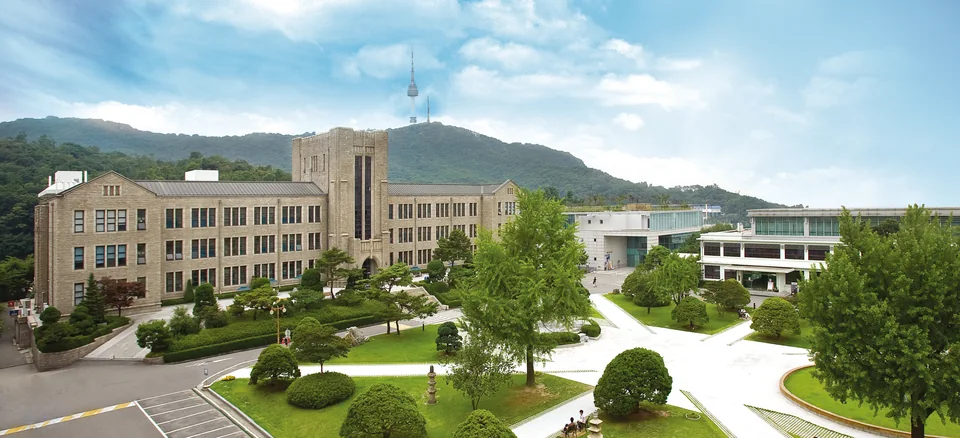
Dongguk University (동국대학교) is a private university of Buddhist heritage in Jung-gu, central Seoul, with a separate Bio-Medi Campus in Goyang. It has no fully English-taught bachelor's programme: you apply with TOPIK 3, and you can only register for major courses once you hold TOPIK 4. Round 1 of the spring 2027 intake takes online applications from 8 to 21 October 2026, with results on 7 December. In 2026 a semester cost $3,460 (KRW 4,689,000) in the humanities up to $4,520 (KRW 6,123,000) in engineering and the arts.
| At a glance | Details |
|---|---|
| Campuses in this intake | Seoul (Jung-gu, 30 Pildong-ro 1-gil) and Bio-Medi Campus in Goyang, Gyeonggi Province |
| WISE Campus, Gyeongju | separate international admission through web.dongguk.ac.kr |
| Teaching language | Korean; no fully English-taught undergraduate major |
| Language to apply | TOPIK 3, King Sejong Institute 3B, or Level 3 on Dongguk's own Korean test |
| Spring 2027, round 1 | application 8–21 Oct 2026, results 7 Dec, classes from 2 Mar 2027 |
| Application fee | $96 (KRW 130,000); theatre, fine arts and Korean traditional music $120–150 (KRW 160,000–200,000) |
| Tuition per semester, 2026 | $3,460–4,520 (KRW 4,689,000–6,123,000) |
| Namsan Residence | double room, $1,230 (KRW 1,661,280) for four months, autumn 2026 rate |
| QS 2027 | 520th (618th a year earlier) |
Who Dongguk suits
Dongguk is strongest in the humanities, media, film and theatre. In the QS subject rankings published in 2026, its religious studies placed 51–100 worldwide and linguistics 201–250. The list for international applicants includes less common options such as Buddhist studies, police administration and Korean traditional music.
| Good fit | Consider alternatives |
|---|---|
| Applicants with TOPIK 3 aiming at humanities, social science or creative majors in central Seoul | Anyone who needs English-taught classes: Sejong and Konkuk offer them |
| Actors, directors and artists: selection is by practical test, not documents | Students unable to reach TOPIK 4 in year one: major courses stay closed until then |
| Biology and biotechnology students happy with the Goyang campus | Engineers who want English options: compare Inha |
| Citizens of Uzbekistan and Mongolia, who qualify for a 50% nationality-based award | Those who choose by rankings: Dongguk is 520th in QS 2027, Kyung Hee 309th |
Programmes
Seoul campus: Buddhist studies and cultural heritage; Korean literature and creative writing, English language and translation, Japanese studies, Chinese literature, philosophy, history; mathematics, chemistry, statistics, physics; law, political science and diplomacy, public administration, North Korean studies, economics, international trade, sociology, media and communication, advertising and PR, food industry management, social welfare; police administration (freshmen only); a general business school for freshmen, with business administration, accounting and management information systems open to transfer students; a broad engineering list from electronics, civil and chemical engineering to computer science and AI, system semiconductors, medical AI and intelligent networks; and arts — Buddhist art, Korean painting, painting, sculpture, theatre, film and digital media, Korean traditional music.
Bio-Medi Campus, Goyang: life sciences, biotechnology, food bioscience, environmental science and biomedical engineering, with its own residence hall.
Rules that shape your choice: every applicant lists two admission units, a first and a second choice; media and communication, advertising and all arts majors can only be a first choice; Buddhist studies students cannot change major, though a double major is allowed.
Language requirements
You can apply with any one of: TOPIK or TOPIK IBT Level 3+; King Sejong Institute 3B; Level 3 plus at least four semesters at Dongguk's Institute of Korean Language; Level 4 plus four semesters at another Korean university's language centre; or Level 3 on Dongguk's own Korean test. Course-based options require attendance above 80% each semester, and students currently in their fourth semester of courses cannot apply yet. A TOPIK score counts if its validity ends between 13 November 2026 and 12 November 2028.
After admission, all freshmen follow the Dongguk Global Leaders Track: 16 credits of required courses and TOPIK 4. Until you submit TOPIK 4 you cannot register for major courses or graduate, so applicants with TOPIK 3 should plan to sit the exam in the first year. See our TOPIK guide.
Spring 2027 timeline, round 1
| Step | Dates |
|---|---|
| Online application (jinhakapply.com) | 8–21 Oct 2026 |
| Documents by post | 8–23 Oct 2026 |
| Documents in person | 21–23 Oct 2026 |
| Dongguk Korean test | 28 Oct 2026 |
| Practical test (arts, theatre, music) | 18 Nov 2026 |
| Results | 7 Dec 2026 |
| Enrolment deposit | 14–17 Dec 2026 |
| Tuition payment | late January 2027 |
| Semester starts | 2 Mar 2027 |
Changes are posted on the international students' notice board at dongguk.edu. The handbook is labelled round 1; any further spring round will be announced separately, and none had been dated as of 30 September 2026.
Selection and documents
Most units select on documents alone, looking at academic record, aptitude and personal qualities. Fine arts, theatre and Korean traditional music select only by practical test: still-life drawing, watercolour or ink on rice paper depending on the major, clay modelling for sculpture, a given scene plus a two-minute piece for theatre, and, for traditional music, an interview and a piece from your own country's tradition, with a Korean piece optional; the drawing and painting tests last three hours.
Documents: the application form, applicant record card and education verification consent (all printed after applying online); passport copies for you and both parents; an original birth or family relationship certificate with a notarised Korean or English translation; the diploma and full transcripts with apostille and translation; TOPIK or language course records; optionally an original recommendation letter. Notarised copies are valid for one year from the start of the application period and must be true copies of the original; a notarised translation does not count as one. Expected graduates must send the final diploma before February 2027. Documents are not returned.
Costs
| Item | Amount |
|---|---|
| Humanities and social sciences, per semester (2026 rate) | $3,460 (KRW 4,689,000) |
| Natural sciences, per semester | $3,990 (KRW 5,406,000) |
| Engineering and arts, per semester | $4,520 (KRW 6,123,000) |
| Application fee | $96 (KRW 130,000); theatre $120 (KRW 160,000), fine arts $130 (KRW 180,000), Korean traditional music $150 (KRW 200,000) |
| Namsan Residence (Seoul), double, 4 / 6 months | $1,230 (KRW 1,661,280) / $1,820 (KRW 2,461,600) |
| Goyang Residence, double, 4 / 6 months | $1,080 (KRW 1,464,000) / $1,530 (KRW 2,069,000) |
| Institute of Korean Language, 10-week term (rate as of September 2026) | $1,330 (KRW 1,800,000) + $74 (KRW 100,000) fee |
Tuition may rise for 2027; residence fees are autumn 2026 rates for new residents, and you apply for housing after the results. National health insurance is mandatory for international students. Cancellation and refund requests are due by 19 February 2027, and refunds go only to a Korean bank account. For living costs, see the cost of studying in Korea.
Scholarships
| Scholarship | Requirement | Award |
|---|---|---|
| Korean proficiency at entry | TOPIK 4 / 5 / 6 | 30% / 50% / 100% of first-semester tuition |
| Institute of Korean Language graduates | two or more semesters and the director's recommendation | $220 (KRW 300,000) |
| Global Diversification | citizens of Taiwan, Malaysia, Mongolia, Myanmar, Uzbekistan, India, Indonesia, Japan, Pakistan, Hong Kong | 50% of tuition |
| Buddhist monks in Buddhist studies | monastic status | 50% of tuition |
| Improved TOPIK while enrolled | TOPIK 4–6, 15 credits, GPA 3.0+ | $520 (KRW 700,000), up to three times |
| Academic excellence | GPA 4.0–4.5 / 3.5–3.99 / 3.0–3.49 | 60% / 40% / 20% of tuition |
Entry scholarships cannot be combined, and government-sponsored students (including GKS) are excluded from these awards. Read about GKS in our scholarship guide.
Institute of Korean Language
The regular course runs 10 weeks, five days a week, four hours a day, with a four-hour cultural programme three times a term. Two terms bring a small entry scholarship; four terms with Level 3 are a route to apply in their own right. Compare options in Korean language programmes in Korea.
Bank balance and visa
Only admitted students submit a bank certificate, after paying tuition: at least $14,780 (KRW 20,000,000; Dongguk quotes USD 15,000) in the applicant's or parents' name, issued within one month. The Certificate of Admission arrives by email in February 2027 once tuition and all documents are in. The D-2 visa is issued by the Korean embassy in your country, which makes the decision; admission is cancelled if the visa or a status change is refused. See our student visa guide.
Dongguk for applicants from Russia and the CIS
- Uzbek citizens gain most here: the Global Diversification award halves tuition. Russia and Kazakhstan are not on the list.
- You and both parents must have held foreign nationality before you entered high school; dual Korean citizens cannot apply.
- A school system shorter than 12 years is accepted if you completed full secondary education at home.
- Plan payment routes early: how to pay for studies abroad from Russia.
Common mistakes
- Listing only one major instead of two.
- Putting media, advertising or an arts major as the second choice.
- Submitting a notarised translation instead of a certified true copy.
- Applying with a TOPIK score that expires before 13 November 2026.
- Mixing up campuses: WISE in Gyeongju runs its own admission and deadlines.
- Registering at two Korean universities at once: international admits may enrol at only one, or the Dongguk place is cancelled.
FAQ
Are Dongguk, Donguk and Tonguk the same university?
Yes. The official name is Dongguk University (동국대학교); Russian-language sources spell it both Donguk and Tonguk. Its Seoul and Goyang campuses share one international admission, while the WISE Campus in Gyeongju has its own website and application process.
Can I study at Dongguk in English?
Not at bachelor's level. Dongguk states that none of its majors teach all courses in English. You need at least TOPIK 3 to apply and TOPIK 4 after admission to open major courses, so Korean study continues through the first year.
How much does Dongguk cost?
In 2026 a semester cost $3,460 (KRW 4,689,000) in the humanities and social sciences, $3,990 (KRW 5,406,000) in the natural sciences and $4,520 (KRW 6,123,000) in engineering and the arts. A double room at Namsan Residence cost $1,230 (KRW 1,661,280) for four months at the autumn 2026 rate.
When do I apply for spring 2027?
Round 1 online applications run from 8 to 21 October 2026, with posted documents accepted until 23 October. Results come out on 7 December and classes begin on 2 March 2027. Any later round will be announced on the Dongguk website.
What scholarships are available to freshmen?
TOPIK 4, 5 or 6 brings 30%, 50% or 100% off the first semester. Citizens of ten listed countries and territories, including Uzbekistan and Mongolia, get 50% under Global Diversification. From the second semester, awards depend on GPA and improved TOPIK levels.
Can StudyU help me apply to Dongguk?
Choosing the two majors, a TOPIK plan, checking apostilles and certified copies, and preparing the application and visa documents are provided under an agreement with StudyU. Dongguk decides on admission and scholarships, the residence office on housing, and the Korean embassy or consulate on the visa.
Sources
- Dongguk International Admissions: Spring 2027 Undergraduate Admission Guide, round 1 (PDF)
- Dongguk International Admissions: Application info
- Dongguk Institute of Korean Language: tuition and regular course
- Dongguk University news on the QS World University Rankings 2027
Dollar figures are based on the ECB reference rate of 29.09.2026: EUR 1 = USD 1.1355 = KRW 1,536.74, which puts USD 1 at about KRW 1,353. Sums under $100 are rounded to the dollar, larger ones to $10. For comparisons, see Study in South Korea and universities in Seoul. To check whether round 1 is still realistic and which two majors to list, send an application.
During the free initial consultation, we clarify your goal, profile, timing, and budget and identify the next realistic step.
Next steps
- Sejong University: Admission, Tuition and English-Taught Programmes
- Konkuk University: Admission, Tuition and Scholarships for International Students
- Inha University: Admission, Tuition and Scholarships for International Students
- Studying in South Korea for international applicants
- Kyung Hee University
- TOPIK Exam Guide 2026–2027: Levels, Scores, Test Dates and Where to Sit It
