
Inside the program
Nanotechnology Engineering is a field on technologies at the level of atoms and molecules. Universities across Turkey run up-to-date programs in this field in English and Turkish, built around practice, projects and internships. A bachelor's program typically runs for 4 years.
Curious what discount you can get?
During the free initial consultation, we clarify your goal, profile, timing, and budget and identify the next realistic step. A personal strategy, requirement checks, selection of agreed options, document preparation, applications, and support are provided under an agreement with StudyU.
Inside the curriculum
Study progresses from core foundations to specialised subjects and hands-on work.
- Chemistry
- Physics
- Quantum mechanics (basics)
- Materials science
- Introduction to nanotechnology
- Nanomaterials
- Nanochemistry
- Nano-analysis methods
- Surface phenomena
- Lab practice
- Nanoelectronics
- Nanobiotechnology
- Nanostructures
- Applications of nanotechnology
- Project work
A professional internship in the field, preparation and defence of a graduation project, and advanced specialization in a chosen track. The exact set of courses and timeline depend on the university - we will share the details in a consultation.
Where graduates work
- Nanotechnology engineer
- Laboratory researcher
- R&D specialist
- Electronics, medicine, materials
Job market and salary benchmarks
The Turkish market. Turkey's industry, energy, construction and defence companies hire engineers constantly; demand is strongest in Istanbul, Ankara, Izmir and the industrial centres of Anatolia. International contractors pay noticeably more than local firms. Because ranges are re-indexed annually with the minimum wage, treat any salary figure as valid for its year only.
Abroad. An engineering degree is recognized in Europe under the Bologna system; some countries additionally require professional registration. Turkish engineers are traditionally in demand on projects in the Gulf and Central Asia.
What raises income: CAD/BIM and specialist software, internships in industry, English (German is a plus). A personalised comparison of current salary ranges by city and employer is provided under an agreement with StudyU.
Should you choose Nanotechnology Engineering?
It suits you if you…
- You are interested in Nanotechnology Engineering and related subjects.
- Combining theory with practice - projects and internships - appeals to you.
- You want a degree valued internationally and the experience of study abroad.
Think it over if…
- You haven't settled on a field yet - a consultation is a good first step.
- You'll only study in your native language - check the language of instruction at the university.
Additional guide to programme language
For Nanotechnology Engineering, students should compare links to biomedical engineering, molecular biology and electronics. Bahcesehir lists Biomedical Engineering, Molecular Biology and Genetics and Electrical and Electronics Engineering in English.
Examples to check with StudyU: Bahcesehir University: Biomedical Engineering (Bachelor, English); Bahcesehir University: Molecular Biology and Genetics (Bachelor, English); Bahcesehir University: Electrical and Electronics Engineering (Bachelor, English).
Universities offering Nanotechnology Engineering
Compare universities - tuition, language and degree side by side.
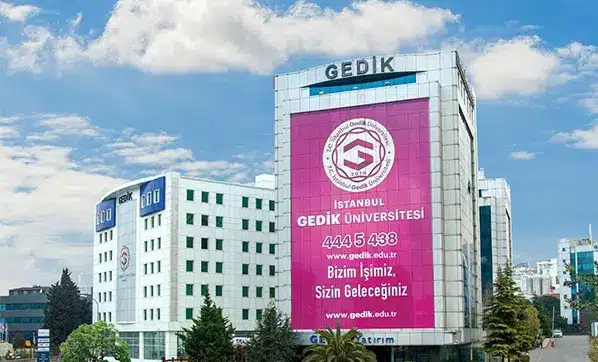
| University | Degree | Language | Tuition |
|---|---|---|---|
| Gedik University | Bachelor | Turkish | $4 600/yr |
Real data on universities and prices (full tuition, 2026). During the free initial consultation, we clarify your goal, profile, timing, and budget and identify the next realistic step.
How to apply for Nanotechnology Engineering in Turkey
Admission to Nanotechnology Engineering programs at private Turkish universities runs on your school record: an 11-year certificate is accepted directly, and most universities skip entrance exams. Two prerequisites: a language certificate (TOEFL for English tracks, TÖMER for Turkish) and the denklik equivalence - we process the latter alongside your application. State universities may ask for the YÖS or SAT.
Start 6-9 months before the intake so there is time to compare current terms. We shortlist universities for Nanotechnology Engineering; discount or scholarship terms are confirmed in writing by the university or funding body.
Common questions
Yes - an 11-year school certificate is accepted directly, and most private universities admit to Nanotechnology Engineering without entrance exams. Public universities may ask for YÖS or SAT.
The listed programmes are available in Turkish. Confirm the exact teaching language, certificate rules, and any preparatory-year requirement for the chosen university and intake.
Tuition starts from $4 600 per year (full price before any discount). The university confirms its current tuition and available discount; a personalised cost comparison is provided under an agreement with StudyU.
A bachelor's program typically runs for 4 years. Medicine and some engineering programs run longer - we'll confirm for your program.
Under an agreement with StudyU, we check requirements, prepare documents, submit the application, and support the agreed steps. The university makes the admission decision; the relevant authority decides the visa, and the university or provider confirms housing availability. During the free initial consultation, we clarify your goal, profile, timing, and budget and identify the next realistic step.
The range depends on the city (higher in Istanbul and Ankara), the type of employer and languages: international companies pay noticeably more than local ones. Engineering salaries grow with access to international projects. We will share current ranges during a consultation.
Ready to study Nanotechnology Engineering in Turkey?
During the free initial consultation, we clarify your goal, profile, timing, and budget and identify the next realistic step.
Official sources
- YÖK Atlas: official program catalogue — program availability, institution and stated language of instruction. International quotas and tuition require the university's own current source.
- YÖK: official international-student information — the official university search route and general international-student guidance. The chosen university still owns its admission requirements.
- ÖSYM: official TR-YÖS exam (2026) — the official calendar and application route for TR-YÖS/1 in 2026. Each university publishes whether the result is required for the selected program.
Confirm language, curriculum, quota, tuition and exams in the selected university's active intake before applying or paying. .
