
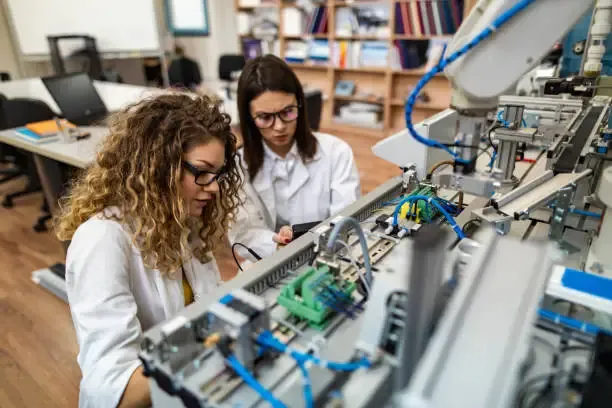
Mechanical Engineering in Turkey
Mechanical Engineering examines mechanical systems through mechanics, materials, thermodynamics and design. Check how mathematics and physics connect to CAD, thermodynamics and mechanical design, then ask how practical projects are assessed.
The program in brief
Compare mechanics and dynamics with fluid mechanics, materials and manufacturing. Review how calculations, modelling and laboratory results support the design of a mechanical component or system.
Use the curriculum and university options below to build a shortlist. Confirm the exact degree level, teaching language, course sequence and practical requirements with each university; similar programme names do not make the courses interchangeable.
Want to find out your discount?
A personal strategy, requirement checks, selection of agreed options, document preparation, applications, and support are provided under an agreement with StudyU.
Study to Become a Mechanical Engineer in Turkey
Turkish universities teach mechanical engineering in English and Turkish. You need a high-school diploma and a language certificate; YÖS is not required everywhere. The degree usually takes 4 years. StudyU helps you choose a university, handle documents and check scholarship terms confirmed by the university or funding body.
How the course is built
The degree takes four years. The list below shows a typical sequence from foundation courses to electives and a graduation project; course titles, order and credits differ by university, so compare it with the published curriculum of each programme you shortlist.
- Calculus and linear algebra
- Physics
- Chemistry or introduction to materials
- Programming
- Technical drawing and CAD
- Statics and dynamics
- Strength of materials
- Thermodynamics and fluid mechanics
- Heat transfer and machine elements
- Control, manufacturing processes and numerical methods
- Technical electives such as HVAC, energy systems, automotive or FEA/CFD
- Summer internship (staj) in industry
- Team capstone project: requirements, calculation, prototype, test and report
Graduate career paths
Roles graduates commonly move into are listed below. Signing off designs as a chartered or licensed engineer requires registration in the country where you work.
Design engineer: models parts and assemblies in CAD and checks them by calculation or FEA before they are built.
Manufacturing or production engineer: sets up machining and assembly processes, tolerances and quality checks on the shop floor.
HVAC or energy-systems engineer: sizes heating, cooling and power equipment for buildings and plants.
Quality or maintenance engineer: tests parts, traces failures and keeps production lines and equipment running.
Automotive or machinery engineer: works on vehicle components, powertrains or industrial equipment, usually after choosing electives and a capstone in that area.
Technical sales engineer: explains and quotes equipment for industrial clients, which in Turkey usually means working in Turkish.
Is this program right for you?
It clicks if you…
- did well in maths and physics at school and like checking an idea by calculation
- want to know how machines work and enjoy taking a mechanism apart and drawing it
- are patient with repeated design iterations and careful with workshop safety rules
- want a broad engineering base and are happy to choose energy, automotive or manufacturing later
Think twice if you…
- only want to write software without physical systems: compare computer engineering
- are set on robots and electronics: mechatronics adds electronics, control and embedded software
- have a weak maths base and no time to revise vectors, derivatives and integrals before the first semester
- expect the diploma to give you the right to sign off designs abroad: that depends on registration in the country where you work
Campus and community
What happens outside lectures depends on the university, so ask the department what it actually runs: student teams that build vehicles or robots for engineering competitions, laboratory projects and engineering clubs.
Turkish engineering curricula usually include compulsory summer internships (staj): ask how many working days are required, whether the university helps find a placement and whether a placement in your home country counts. For a semester abroad, ask which Erasmus+ partner universities the department has and whether international degree students can apply; a visa for the host country is a separate step.
Pay and demand in Turkey and beyond
The Turkish market. Mechanical engineers work in industry, energy, construction and defence companies, which are concentrated in Istanbul, Ankara, Izmir and the industrial centres of Anatolia. Income benchmarks shift quickly: pay ranges are revised annually along with minimum-wage indexation, so always check the current year.
What raises income: CAD/BIM and specialist software, internships in industry, English (German is a plus). A personalised comparison of current salary ranges by city and employer is provided under an agreement with StudyU.
Additional guide to programme language
For Mechanical Engineering, students should check how closely a programme connects to mechatronics, industrial engineering or energy systems. Bahcesehir lists Mechatronics Engineering, Energy Systems Engineering and Industrial Engineering in English.
Examples to check with StudyU: Bahcesehir University: Mechatronics Engineering (Bachelor, English); Bahcesehir University: Energy Systems Engineering (Bachelor, English); Bahcesehir University: Industrial Engineering (Bachelor, English).
Universities offering Mechanical Engineering
Compare listed universities by degree, teaching language and annual tuition shown below.
| University | Degree | Language | Tuition |
|---|---|---|---|
| Isik University | Bachelor | English | $4 800/yr |
| Okan University | Bachelor | English | $5 000/yr |
| Halic University | Bachelor | English | $5 200/yr |
| Altinbas University | Bachelor | English | $6 000/yr |
| Istinye University | Bachelor | English | $8 000/yr |
| Yasar University | Bachelor | English | $8 000/yr |
| Antalya Bilim University | Bachelor | English | $8 300/yr |
| TED University | Bachelor | English | $11 800/yr |
| Bilgi University | Bachelor | English | $12 000/yr |
| TOBB University of Economics and Technology | Bachelor | Turkish | $12 000/yr |
| Ozyegin University | Bachelor | English | $25 000/yr |
| Gedik University | Master | Turkish | $6 000/yr |
| Altinbas University | Master | English | $6 900/yr |
| Halic University | Master | Turkish | $7 500/yr |
| TED University | Master | English | $8 000/yr |
| Isik University | Master | English | $10 200/yr |
| Gedik University | PhD | Turkish | $12 000/yr |
Ready to study mechanical engineering in Turkey?
During the free initial consultation, we clarify your goal, profile, timing, and budget and identify the next realistic step.
Get a consultationQuestions and answers
To become a mechanical engineer in Turkey you need a high-school diploma, a language certificate and denklik (recognition of your previous education). Some universities ask for the YÖS or SAT exam. Under an agreement with StudyU, a consultant can compare universities within budget, help prepare documents and check published scholarship terms. Each university decides admission and confirms individual scholarship terms; funding bodies decide their awards.
Many Turkish universities offer programs in English. Programs in Turkish require a TÖMER certificate. Exact requirements depend on the university.