
International students in Singapore choose between three different kinds of institution. The six autonomous universities — NUS, NTU, SMU, SUTD, SIT and SUSS — award their own Singapore degrees, expect 12 years of schooling or additional exams and let students work part-time during term. Private education institutions (PEIs) teach programmes of British or Australian partner universities, which award the degree, and only EduTrust-certified PEIs may enrol foreign students. The third group consists of Singapore campuses of overseas schools such as INSEAD, ESSEC and TUM Asia. The category decides your cost, study length, work rights and whether you can stay on to look for a job after graduation.
This guide explains how the three groups differ, who belongs to each, what each autonomous university asks of applicants from 11-year school systems (Russia, Kazakhstan and most of the CIS), and how to match the choice to your goal. All fees are for the 2026/27 academic year and come from the universities' own pages; USD conversions use the ECB reference rate of 28 September 2026 (1 USD ≈ 1.2777 SGD), rounded to the nearest ten. For a country overview, see studying in Singapore.
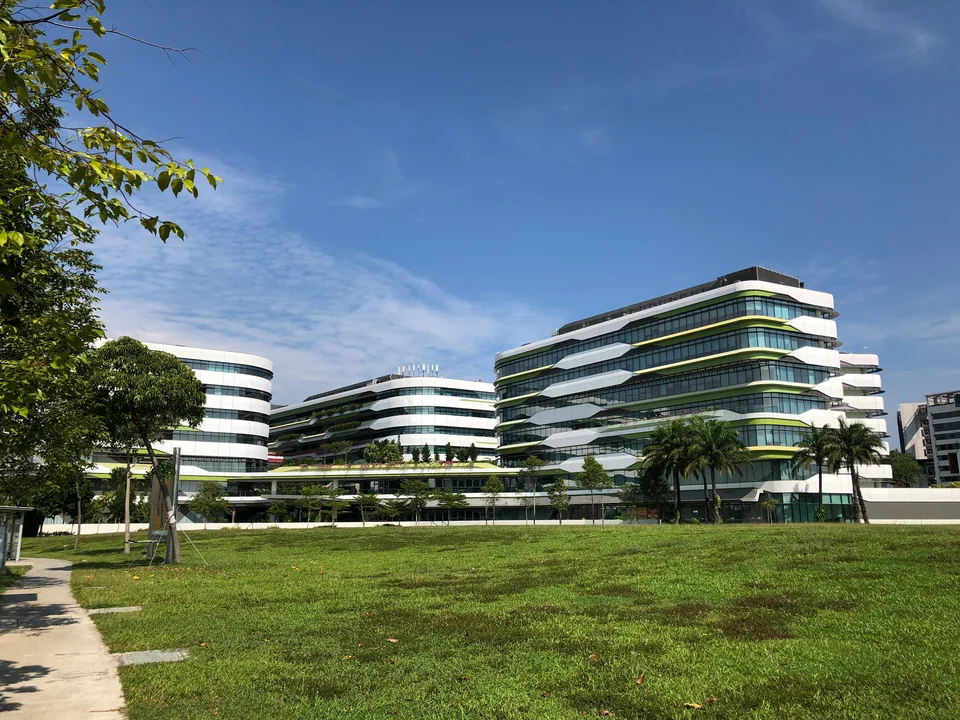
Three types of institution and what each gives you
The key difference is legal status, not ranking. Status determines whose degree you receive and which rights you have in the country.
| Criterion | Autonomous universities (6) | EduTrust-certified private institutions | Overseas campuses |
|---|---|---|---|
| Examples | NUS, NTU, SMU, SUTD, SIT, SUSS | SIM, Curtin Singapore, LSBF Singapore | INSEAD, ESSEC, SP Jain, DigiPen, TUM Asia, Sorbonne-Assas |
| Degree awarded by | the university itself | an overseas partner university | the home institution |
| Entry after an 11-year school system | NUS and NTU: certificate plus AP or A-levels; SMU: only a qualification on its own list (IB, A-levels, US diploma) | usually via a foundation or diploma | school's own rules; mostly master's and MBA |
| MOE Tuition Grant | undergraduate only, applied for after enrolment, with a 3-year work bond | no | no |
| Part-time work during term | up to 16 hours a week without a work pass | not permitted | permitted (schools are on the MOM list) |
| Job-search pass after graduation (LTVP) | available | no: PEIs are not on ICA's list | available |
The last two rows often settle the decision. The Ministry of Manpower (MOM) lets students work without a work pass only at institutions on its list. That list includes the six autonomous universities, the polytechnics, the arts institutions and campuses such as INSEAD or DigiPen, but not private institutions like SIM or Curtin. Likewise, the Immigration & Checkpoints Authority (ICA) considers the job-search Long-Term Visit Pass (LTVP) only for graduates of institutions on its Institutes of Higher Learning list, and PEIs are not on it.
The six autonomous universities: focus and fees
"Autonomous" means publicly funded but self-governing in admissions and curriculum. These are the only universities where an international undergraduate can receive the MOE Tuition Grant, a subsidy that roughly halves tuition in exchange for three years of work for a Singapore entity after graduation.
| University | Focus | Undergraduate 2026/27, international, no grant | With grant (non-ASEAN) |
|---|---|---|---|
| National University of Singapore (NUS) | comprehensive research university: engineering, computing, business, law, medicine, music | Computing — $31,070 (S$39,700); Business — $26,140 (S$33,400) | $16,750 (S$21,400); Business — $17,370 (S$22,200) |
| Nanyang Technological University (NTU) | engineering, computing and data science, sciences, business, medicine | lab-based — $31,780 (S$40,600); non-lab — $28,450 (S$36,350) | $16,750 (S$21,400) |
| Singapore Management University (SMU) | business, accountancy, economics, computing, law, social sciences | most degrees — $37,330 (S$47,700); law — $43,950 (S$56,150) | $20,510 (S$26,200); law — $23,830 (S$30,450) |
| Singapore University of Technology and Design (SUTD) | engineering, architecture, design and AI | $48,580 (S$62,076) | $24,730 (S$31,600) |
| Singapore Institute of Technology (SIT) | applied, industry-linked degrees, including health sciences | published through an online fee checker | — |
| Singapore University of Social Sciences (SUSS) | social sciences, business, applied subjects; full-time and part-time programmes | check per programme | — |
Figures are annual tuition for new 2026/27 students, including Singapore's 9% GST. NUS, NTU, SMU and SUTD fix the annual fee for each intake for the normal length of the degree, so your first-year price holds until graduation. For a full budget with housing and fees, see our guide to the cost of studying in Singapore.
What the table does not show:
- NUS is the largest and highest-ranked: 10th in the QS World University Rankings 2027 and 17th in THE 2026. Medicine and dentistry are the most expensive degrees at $148,820 (S$190,150) a year without the grant. See our NUS profile.
- NTU is 12th in QS 2027. International medical students at NTU can only study with the grant: there is no non-subsidised fee for medicine. Medallists of international science olympiads receive favourable consideration. See NTU Singapore.
- SMU is a city-centre university with seminar-style classes and interviews for shortlisted applicants; it is 411th in QS 2027. Its strengths are business and law. See SMU.
- SUTD is a focused technology university built around engineering, architecture and design, with the highest non-subsidised fee among the technical universities.
- SIT is an applied-learning university that considers international applicants with 12 years of schooling case by case, and only for some programmes.
- SUSS is on ICA's list of local universities and on MOM's list, but it runs part-time programmes alongside full-time ones. A Student's Pass is only issued for full-time study, so confirm the format before applying.
Private institutions: whose degree do you actually get?
Private education institutions (PEIs) are registered and inspected by the Skills and Workforce Development Agency (SWDA), formed by merging SkillsFuture Singapore and Workforce Singapore. Older articles call the regulator SSG or the Council for Private Education (CPE); these are earlier names for the same function.
For an international student one rule matters most: only PEIs holding EduTrust certification may enrol students on a Student's Pass. Without it, the institution cannot support your pass application, however attractive the course.
How a PEI degree works, using Singapore Institute of Management (SIM) as an example: the BSc (Honours) in Economics and Finance takes three years, is awarded by the University of London and is taught on the SIM campus. For international students SIM puts the full three-year route at S$46,155 ($36,120), or S$30,545 ($23,910) over two years with four modules exempted; part is paid to SIM and part to the University of London in pounds, and the London portion can rise each year. More in our profiles of SIM, Curtin Singapore and LSBF Singapore.
A private institution makes sense if:
- you finished an 11-year school and do not want to spend a year on AP exams or A-levels;
- you want a British or Australian degree while living in Asia;
- you value a shorter route, since many programmes run for three years or on accelerated calendars.
It is the wrong choice if you plan to work part-time during your studies or to stay in Singapore on a job-search pass after graduating. Both rights depend on the MOM and ICA lists, which do not include PEIs.
Overseas campuses and specialist schools
ICA groups "offshore institutes with local campuses" separately: ESSEC Business School, INSEAD, SP Jain School of Global Management, DigiPen Institute of Technology, TUM Asia (the Technical University of Munich's Singapore arm) and the Sorbonne-Assas International Law School. Their students obtain a Student's Pass on the same terms as university students, may work part-time and can apply for the graduate job-search pass.
Most of these schools focus on master's, MBA and professional programmes: INSEAD and ESSEC in business, DigiPen in game development and computer graphics, TUM Asia in engineering master's degrees, some of them joint degrees with NTU. Not all offer bachelor's degrees, so check the programme list of the specific school.
Arts education is a separate branch: LASALLE College of the Arts, Nanyang Academy of Fine Arts (NAFA) and the University of the Arts Singapore. The Ministry of Education includes them among institutions where the Tuition Grant applies, but only for selected courses, so eligibility is checked course by course.
Which type fits your goal
| Your goal | Best fit | Why |
|---|---|---|
| Build a career in Singapore | autonomous university | term-time work rights, job-search pass, strong employer recognition |
| Lowest tuition with a strong profile | autonomous university with the grant | most degrees cost about $16,750–24,730 a year with the grant, but three years of work in Singapore are compulsory |
| British or Australian degree without a 12th school year | EduTrust-certified private institution | entry via foundation or diploma; the overseas partner awards the degree |
| Business master's or MBA with Asian exposure | overseas campus, or NUS, NTU, SMU | 1–2-year programmes, work experience often expected |
| Creative career | LASALLE, NAFA | portfolio-based entry, art and design programmes |
If your profile does not meet autonomous-university requirements, a PEI is a workable option, but do not treat it as a stepping stone into NUS or NTU. Moving from a PEI to an autonomous university is assessed as a new application with no guaranteed credit.
What the autonomous universities ask of 11-year school graduates
All autonomous universities expect 12 years of schooling, so an 11-year certificate of secondary education alone does not make you eligible. NUS and NTU accept it together with international exams; SMU does not consider it at all.
| University | What you need in addition to an 11-year school certificate |
|---|---|
| NUS | good school-leaving results plus compulsory tests: SAT with at least 3 AP exams, ACT with Writing with 3 AP, or at least 5 AP exams; AP Calculus BC is required for every programme except Law |
| NTU | at least three AP exams scored 4–5, or three UK A-level subjects; AP Calculus BC is compulsory for engineering and most sciences |
| SMU | considers only qualifications on its own list, which includes no Russian, Kazakh or other CIS certificates — so you need the IB, UK A-levels or an American high school diploma, plus one test such as SAT, ACT, IELTS or TOEFL |
| SIT | 12 years of education; applications assessed case by case, for some programmes only |
NTU lists the Russian, Kazakh, Kyrgyz, Uzbek and other CIS school certificates as requiring an additional qualification, but accepts the Nazarbayev Intellectual Schools Grade 12 Certificate directly with A grades in all subjects. Deadlines, test scores and the step-by-step plan are in our guide to applying to Singapore universities; for the test choice, see SAT or ACT.
Common mistakes when choosing
- Confusing an autonomous university with a private institution. "Singapore Institute of Management" sounds like "Singapore Institute of Technology", but the first is a PEI and the second an autonomous university.
- Skipping the EduTrust check. Without certification a PEI cannot enrol you on a Student's Pass.
- Counting on part-time work at a PEI. PEI students may not work during their studies.
- Comparing subsidised and unsubsidised fees as if they were the same product. The grant is a contract with the Ministry of Education: three years of work in Singapore and two sureties. Breaking it costs the full grant plus interest.
- Choosing by overall ranking alone. For engineering NTU and NUS are comparable; for business in the city centre, SMU deserves a look; for design and architecture, consider SUTD or the arts institutions.
FAQ
Six autonomous universities: NUS, NTU, SMU, SUTD, SIT and SUSS. They are publicly funded, and the Ministry of Education and ICA list them as Singapore's local universities.
Not NUS or NTU without extra qualifications: they need AP exams, A-levels or SAT in the combination each university specifies. SMU does not consider the Russian certificate even with exams; it needs the IB, A-levels or a US diploma. Private institutions accept 11-year school leavers through foundation programmes.
At a PEI the degree is awarded by the overseas partner, for example the University of London at SIM. Recognition therefore depends on that university and on the country where you plan to work, not on the institution's Singapore status.
Of the four universities that publish full fee tables (NUS, NTU, SMU and SUTD), NUS Business is the lowest without the grant at $26,140 (S$33,400) a year; for SIT and SUSS you look up the fee for the specific programme. With the grant the gap narrows to roughly $16,750–24,730 a year for most degrees.
No. MOM only exempts students from needing a work pass if their institution is on its list, and private institutions are not.
NUS (10th) and NTU (12th) in the QS World University Rankings 2027. In THE 2026, NUS is 17th and NTU 31st.
Sources
- MOE: Tuition Grant Scheme overview — checked 28 September 2026
- ICA: Student's Pass for Institutes of Higher Learning and for private institutions (EduTrust) — checked 28 September 2026
- ICA: list of Institutes of Higher Learning for graduate LTVP — checked 28 September 2026
- MOM: work pass exemption for foreign students — checked 28 September 2026
- NUS: undergraduate tuition 2026/27 (PDF) and international qualifications — checked 28 September 2026
- NTU: fees for 2026 intake and other international qualifications — checked 28 September 2026
- SMU: tuition fees and grant 2026/27 and international qualifications — checked 28 September 2026
- SUTD: tuition fees 2026 — checked 28 September 2026
- SIT: international qualifications — checked 28 September 2026
- SIM: BSc Economics and Finance, University of London — checked 28 September 2026
- Curtin Singapore: EduTrust and SWDA — checked 28 September 2026
- QS World University Rankings 2027: NUS, NTU, SMU; THE 2026: NUS, NTU — checked 28 September 2026
- USD conversions use ECB reference rates of 28 September 2026: EUR/USD 1.1378 and EUR/SGD 1.4538, i.e. 1 USD ≈ 1.2777 SGD.
Shortlisting universities and programmes for your profile, requirement checks and preparation of application documents are provided under an agreement with StudyU. Admission decisions are made by the university, Tuition Grant decisions by Singapore's Ministry of Education, and Student's Pass decisions by ICA.
Next steps
- Cost of Studying in Singapore in 2026/27: University Fees, the MOE Tuition Grant and Living Costs
- National University of Singapore (NUS): Admission, Fees and the MOE Tuition Grant
- Nanyang Technological University (NTU Singapore): Admission and Fees
- Singapore Management University (SMU): Admission and Fees
- Studying in Singapore for international applicants
- Singapore Institute of Management (SIM)
