
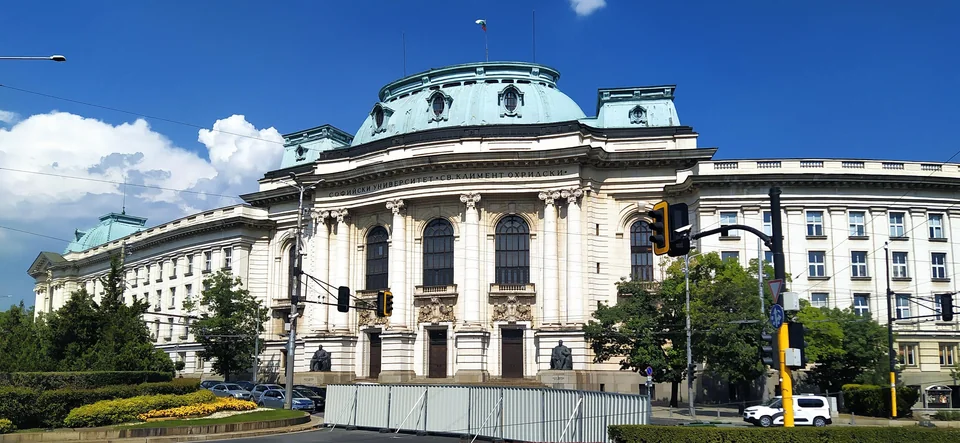
Sofia University is Bulgaria's oldest and largest university, with 16 faculties, a branch in Burgas and its main building in central Sofia. Applicants from outside the EU pay tuition: in 2026/27 most bachelor's programmes cost $3,750 (€3,300) a year, informatics $4,560 (€4,020), and medicine in English or Bulgarian $9,080 (€8,000). You can study in English on nine degree programmes, or in Bulgarian after a preparatory language year priced at $3,970 (€3,500). For the 2026/27 intake, non-EU applications were accepted from 27 July to 11 September.
| At a glance | Details |
|---|---|
| Type | public university, founded in 1888 |
| Size | 16 faculties plus a branch in Burgas |
| Ranking | QS World University Rankings 2027: 751–760 |
| Teaching languages | mainly Bulgarian; English on selected programmes |
| Non-EU tuition, 2026/27 | from $3,750 (€3,300) a year; medicine $9,080 (€8,000) |
| Bulgarian preparatory year, 2026/27 | $3,970 (€3,500), at least nine months |
| Application window (2026/27 cycle) | 27 July – 11 September; some master's programmes until 15 January 2027 |
| Academic year starts | 1 October |
Who Sofia University suits
Sofia University makes sense if you want a public EU degree in the humanities, social sciences, natural sciences, law, economics or computing at a moderate fee, and you are ready either to learn Bulgarian or to choose from a short list of English-taught programmes. Its strength is breadth: rare-language philologies, physics, chemistry, mathematics, philosophy, law and economics sit inside one institution, and students can spend a semester abroad through Erasmus+.
It is a weaker fit in three situations:
- You want many English-taught bachelor's options. The English list is short and mostly specialised: the 2026/27 fee order (RD-19-297) marks ten programmes as taught in English or another foreign language, including medicine and pharmacy; Climate Change and Management appears there under an English title, and the international admissions page adds European Union and European Integration. If you need business, computing or engineering taught entirely in English, compare this list with the programmes of other Bulgarian universities.
- You only want medicine. Sofia University has a medical faculty with an English programme, but a future doctor should compare it with the dedicated medical universities, MU-Sofia and MU-Varna. The comparison is below.
- Your plan depends on free tuition. Third-country nationals outside the special categories pay at every level.
English or Bulgarian: two routes
The teaching language decides your timeline, budget and choice of subjects.
English. You enter the first year directly if you meet the programme's conditions. Accounting, Finance and Digital Applications asks for English at B2 or above and good school mathematics; without a certificate you sit the university's own English exam before final acceptance. International Trade and Investment also expects B2. European Union and European Integration admits students after an English exam. Medicine and pharmacy in English use chemistry and biology entrance tests. Bulgarian will still be on your timetable: international students in every faculty and programme take a compulsory parallel Bulgarian course in their first and second years, taught by the Faculty of Slavic Studies.
Bulgarian. Almost every Sofia University programme is taught in Bulgarian, and non-EU applicants need a standardised Bulgarian exam at B2. The B2 certificate is issued after the university's preparatory course, or after passing its exams without attending. The course lasts at least nine months in groups of up to ten. Humanities students take 800 academic hours of Bulgarian; everyone else takes 650 hours of language plus 350 hours of subject teaching. The course ends with written and oral exams, and the resulting certificate, approved by the Minister of Education, is mandatory for enrolment.
Bulgarian is a Slavic language written in Cyrillic, which gives Russian speakers a head start, but the preparatory year still adds a year of living costs in Sofia. Budget for it as seriously as for tuition.
English-taught first degrees, 2026/27
| Programme | Faculty | Length | Annual non-EU fee |
|---|---|---|---|
| European Union and European Integration (English per the admissions page; not marked in the fee order) | Classical and Modern Philology | 4 years | $3,750 (€3,300) |
| Philosophy (in English) | Philosophy | 4 years | $3,750 (€3,300) |
| African Studies | Classical and Modern Philology | 4 years | $3,750 (€3,300) |
| Accounting, Finance and Digital Applications | Economics and Business Administration | 4 years | $3,750 (€3,300) |
| International Trade and Investment | Economics and Business Administration | 4 years | $3,750 (€3,300) |
| Media Pedagogy and Artistic Communication | Educational Studies and the Arts | 4 years | $3,750 (€3,300) |
| Informatics (in a foreign language) | Mathematics and Informatics | 4 years | $4,560 (€4,020) |
| Climate Change and Management (English title in the order; confirm the teaching language) | Geology and Geography | 4 years | $4,370 (€3,850) |
| Nuclear and Particle Physics | Physics | 4 years | $5,620 (€4,950) |
| Quantum Physics and Nuclear and Particle Physics | Physics | 4 years | $5,620 (€4,950) |
| Pharmacy (in English) | Chemistry and Pharmacy | 5 years | $6,810 (€6,000) |
| Medicine (in English) | Medicine | 6 years | $9,080 (€8,000) |
The accounting programme is accredited by ICAEW, the UK professional body, which is a practical advantage for future accountants and auditors. The university offers many more English-taught master's programmes; each faculty publishes its own list.
Tuition fees for 2026/27
Non-EU fees are set by a rector's order issued under Council of Ministers Decision No. 438 of 3 June 2026. For 2026/27 this is order No. RD-19-297 of 8 July 2026. Bulgaria adopted the euro on 1 January 2026, so all fees are in euros.
| Field (full-time first degree) | Annual fee |
|---|---|
| Economics, law, psychology, political science, journalism, history, philologies, education | $3,750 (€3,300) |
| Mathematics, statistics, data analysis | $4,040 (€3,560) |
| Informatics, computer science, software engineering, information systems | $4,560 (€4,020) |
| Earth sciences, geography, geology, climate | $4,370 (€3,850) |
| Biology, molecular biology, ecology | $5,000 (€4,400) |
| Biotechnology | $4,070 (€3,580) |
| Physics, including the English programme | $5,620 (€4,950) |
| Chemistry | $5,960 (€5,250) |
| Nursing | $4,490 (€3,950) |
| Pharmacy (Bulgarian and English) | $6,810 (€6,000) |
| Medicine (Bulgarian and English) | $9,080 (€8,000) |
| Preparatory language course | $3,970 (€3,500) |
A master's degree after a bachelor's costs non-EU students the same as a first degree in the same field: $3,750 (€3,300) a year in economics, law, philologies and political science, $4,560 (€4,020) in informatics, $5,620 (€4,950) in physics and $5,960 (€5,250) in chemistry. A foreign bachelor's degree must first go through Sofia University's own recognition procedure.
How payment works:
- The annual fee is paid in two equal instalments at the start of each semester; for full-time students in 2026/27 the deadlines are 30 September 2026 and 14 February 2027. You transfer the money from any commercial bank to the university's account at the Bulgarian National Bank; the BNB itself does not take cash, and the sender covers bank charges.
- If you withdraw before the academic year begins, the university refunds 80% of the semester fee on a written request to the rector with proof of payment. Once the year has started, fees are not refunded for any reason.
- For the preparatory course, half of the annual fee is due before the language department issues your enrolment certificate.
- Dual nationals with Bulgarian citizenship admitted under the Council of Ministers' conditions pay half of the international fee, but never less than the fee set for Bulgarian citizens in that specialty.
Tuition is only one line of the budget. Add document legalisation and translation, the visa fee, health insurance, housing and living costs in Sofia; our guide to the cost of studying in Bulgaria builds the full picture. Families paying from Russia can check legal transfer routes in our guide to paying for studies abroad from Russia.
Medicine and pharmacy in English
The six-year Medicine in English programme has run since 2013/14. Its curriculum follows Bulgaria's state requirements for the medical degree and EU Directive 2005/36/EC on the recognition of professional qualifications.
This is how the 2026/27 intake ran. The faculty posts the next calendar on the same page, and on this year's pattern you should be ready by late summer:
- Applications: 10 August – 4 September 2026. The application fee of $57 (€50) was paid by bank transfer before the exam; the exam fee is separate, and receipts for both go into the file.
- Entrance exam: a written chemistry and biology test in English lasting three hours, mixing multiple-choice and short written answers. Each subject counts for 50%, and only candidates who pass both parts are ranked.
- Two sittings: 10 and 16 September 2026, with results on 14 and 21 September. You may sit once or twice; if you sit twice, the higher result counts.
- Ranking and enrolment: the ranking came out on 23 September, enrolment ran 24–28 September, and the academic year starts on 1 October.
- Preparation: before the first sitting, on 8–9 September, the medical faculty ran a two-day biology and chemistry course for $340 (€300) at Lozenets Hospital.
Pharmacy in English lasts five years: nine semesters at the university and a six-month pharmacy placement. Its entrance exam has three parts: chemistry (40%), biology (40%) and English (20%).
| Medicine in English, 2026/27 | Sofia University | MU-Sofia | MU-Varna |
|---|---|---|---|
| First-year fee | $9,080 (€8,000) | $11,300 (€9,950) | $11,360 (€10,000) |
| Entrance exams | chemistry and biology in English | English, biology, chemistry; remote | online biology and chemistry; English by certificate or university test |
| Non-EU exam dates (2026) | 10 and 16 September | 9 September, plus 2 October after the extension | 4 April, 16 May, 13 June |
Sofia University's first-year fee is $2,200–2,300 lower. Price alone should not decide it: compare clinical training, exam calendars and how each university handles documents. Our guide to medicine in Bulgaria goes further.
Is free study possible?
For most applicants from Russia and other CIS countries, no. The university lists four admission routes for foreigners:
- Intergovernmental agreements on educational, scientific and cultural exchange, with candidates nominated by Bulgaria's Ministry of Education and Science.
- Council of Ministers Decrees No. 103/1993 and No. 228/1997, also with candidates nominated by the ministry.
- The rules for Bulgarian applicants, which apply to EU citizens, permanent residents of Bulgaria, refugees and foreign citizens of Bulgarian origin.
- Everyone else applies under Article 95(8) of the Higher Education Act and pays the international fee.
The first three routes give access to the terms for Bulgarian students, but Sofia University's admissions office does not decide who uses them: the ministry nominates candidates under agreements and decrees, and Bulgarian origin is confirmed by the State Agency for Bulgarians Abroad. Eligibility and proof of Bulgarian origin are covered in our guide to free education in Bulgaria.
Documents and recognition of your school certificate
The key document is the certificate of recognised secondary education from NACID, Bulgaria's National Centre for Information and Documentation. It converts your school grades into the Bulgarian six-point scale, and those converted grades are what the university ranks.
For Medicine in English, the university asks for:
- the application form, completed and signed;
- a legalised copy of the school-leaving certificate and transcript, including biology and chemistry grades, with an official Bulgarian translation;
- the NACID certificate with converted grades;
- a document from a competent authority confirming your right to enter higher education in the country where you finished school, legalised and translated;
- a copy of your ID showing your photo, name in Latin letters, place and date of birth;
- two passport photos;
- receipts for the application fee and the exam fee.
Documents are handed in at the university's central building, in person or by a representative with a notarised power of attorney. For non-EU applicants in general, the university also requires the original certificate and transcript with translation and legalisation.
Bulgarian universities require legalisation "under Bulgaria's international treaties with the issuing country". For countries party to the Hague Apostille Convention, including Russia and Kazakhstan, that means an apostille, as MU-Varna, for example, spells out. The apostille comes first; the Bulgarian translation is then made by a consular officer or an agency authorised by Bulgaria's foreign ministry. A translation made before the apostille has to be redone.
Timeline and steps
The sequence below is for a non-EU bachelor's applicant. Dates refer to the 2026/27 cycle; the university publishes the 2027/28 calendar in summer.
- December – March. Choose the programme and language. On the Bulgarian track, plan for the preparatory year first.
- February – May. Obtain your school certificate or current grades, the eligibility document and apostilles.
- May – July. Have everything translated into Bulgarian and apply to NACID for recognition.
- 27 July – 11 September. Submit your application. The university advises applying early because processing takes time.
- After approval. The university has two weeks to send your file to the Ministry of Education and Science. The ministry now issues the document for the type D visa online; the admissions office no longer hands it out on paper. The faculty issues the acceptance notice after enrolment.
- Type D visa. Russian citizens, and foreigners with permanent residence in Russia, apply at the consular section of the Bulgarian Embassy in Moscow after booking by email. The consulate charges $110 (€100) in cash in euros for a type D visa covering a full degree; for full-time students under Article 24v of the Foreigners Act the embassy decides within 15 calendar days of submission, while the general 35-working-day limit covers other grounds. Citizens of Kazakhstan, Uzbekistan and other countries apply at the Bulgarian embassy or consulate in their country of residence.
- By 1 October. Initial enrolment must be completed before the academic year starts.
Each stage is explained in our guides on applying to Bulgarian universities and the Bulgaria student visa.
After arrival: residence, work and insurance
Once registered at the faculty, full-time students apply to the Migration Directorate of the Ministry of Interior for a Bulgarian ID card for long-term residence. The Bulgarian Embassy in Moscow specifies the timing: as a rule, after arrival and no later than 14 days before your type D visa expires. According to the EU Immigration Portal, the permit matches the programme length but is issued for up to one year at a time and can be renewed; your address must be declared within five days of arrival.
Non-EU students may work without a work permit for up to 20 hours a week during the academic year and holidays. After graduating, you have nine months to look for and start a job; to use the Employment Agency's brokerage services, register within seven working days.
The university recommends arranging health insurance at home before travelling: doctor visits in Bulgaria are paid, and your insurer reimburses you afterwards.
Housing
Student residences are run by a separate unit of the university for student services (uni-campus.net). It manages 10 blocks with 17 entrances in the Studentski Grad district. Places are meant for full-time students whose families do not own a home in Sofia, and the unit publishes the allocation order and lists every summer.
The main building is on Tsar Osvoboditel Boulevard in the centre, but the university lists more than ten teaching sites, including Lozenets, the IV km campus and separate buildings for journalism, biology, medicine, theology and the language department. Choose housing according to where your faculty is, not the rectorate. Residence rates are set by rector's orders published in Bulgarian, so confirm this year's amount for international students with the housing unit before moving in. If no residence place is available, you will rent privately, and the price depends on the district and the commute to your building.
Common mistakes
- Choosing a Bulgarian-taught degree without budgeting for the language year. Without a B2 certificate you cannot enrol, and the preparatory year is charged separately.
- Applying in the last days of the window. The university may take up to two weeks to send your file to the ministry, and the visa takes its own time. A September application can easily miss the 1 October start.
- Confusing translation with recognition. A translation is not a NACID certificate, and without converted grades you will not be ranked.
- Assuming medicine at Sofia University and at MU-Sofia is the same thing. They are separate universities with different exams, dates and fees.
- Counting on a funded place through general admission. Preferential routes exist, but state bodies decide on them.
How StudyU helps
In the free initial consultation we look at your goal, profile and budget. Shortlisting Sofia University programmes and alternatives, checking requirements against your school certificate, preparing the document set, and planning NACID recognition and the visa application are provided under an agreement with StudyU. The university decides on admission, the Ministry of Education and Science on the visa document, the Bulgarian consulate on the visa and the Migration Directorate on residence.
Other institutions are listed in our Bulgaria catalogue and our overview of universities in Bulgaria.
FAQ
Can I enter Sofia University straight after school?
Yes. A complete secondary school certificate from Russia, Kazakhstan or another country qualifies for a bachelor's degree once NACID has recognised it and you add the document confirming your right to university entry at home. The next hurdle depends on the programme: Bulgarian-taught degrees need a B2 Bulgarian certificate, and English-taught ones have their own requirements or entrance tests.
Do I need IELTS for English-taught programmes?
The two economics programmes name B2 English. Without a certificate you take the university's English exam before final acceptance. The medicine rules do not ask for a separate language certificate; the chemistry and biology test is set in English and tests your English along the way.
How much does medicine cost at Sofia University?
For 2026/27 it is $9,080 (€8,000) a year for non-EU students, the same in Bulgarian and English. If the fee stayed unchanged, six years would total about $54,500 (€48,000), but fees are approved every year, so treat that figure as an estimate.
Who runs the Bulgarian preparatory course?
The Faculty of Slavic Studies prepares future humanities students, and the Department for Language and Specialised Training prepares future science students. If your Bulgarian is already good, you can take the final course exams without attending classes and still receive the certificate.
Can I apply online?
Not for Medicine in English as an international applicant: documents go in person or through a representative with a notarised power of attorney. Only the ministry's visa document arrives online.
Can I do a master's with a bachelor's degree from outside Bulgaria?
Yes, but the university first runs a mandatory recognition procedure on your degree. Some master's programmes starting in the summer semester accept applications until 15 January.
Is a Sofia University degree recognised at home?
EU recognition of the medical qualification rests on Directive 2005/36/EC. Outside the EU, including in Russia and Kazakhstan, employers or universities may ask for recognition under national rules, and regulated professions such as medicine usually add a separate licence to practise. That decision belongs to the competent authority of the country where you plan to work.
Sources
- Sofia University: general admission rules for international students, non-EU application dates, non-EU procedure
- Sofia University: 2026/27 fees, order RD-19-297 of 8 July 2026 and language-course order, payment and refund rules
- Sofia University: English-taught bachelor's programmes, Medicine in English 2026/27, integrated and master's programmes in foreign languages
- Sofia University: Bulgarian as a foreign language, visa and ID card, student life and insurance, history and structure
- Sofia University: 2026/27 non-EU fee schedule, annex to order RD-19-297 (PDF, in Bulgarian)
- Sofia University: student residences, university campuses
- Bulgarian Embassy in Russia: type D visa
- Bulgarian foreign ministry: kinds of type D visa under the Foreigners Act (PDF)
- EU Immigration Portal: student in Bulgaria
- QS: Sofia University
ECB rate of 29.09.2026: €1 = $1.1355. Rounding step: $1 below $100, otherwise $10. Dates and fees refer to the 2026/27 intake.
If you want to know which Sofia University route is realistic for your grades and budget, send us a request.
During the free initial consultation, we clarify your goal, profile, timing, and budget and identify the next realistic step.
Next steps
- Free Education in Bulgaria for International Students: Who Qualifies for Lower Fees
- Medicine in Bulgaria: Medical Universities, English-Taught Programmes, Fees and Exams
- Applying to Bulgarian Universities: Documents, Recognition, Exams and Deadlines
- Cost of Studying in Bulgaria: Tuition, Living Costs and a First-Year Budget
- How to Pay for Studies Abroad from Russia: What Works in 2026
- Studying in Bulgaria for international applicants
