
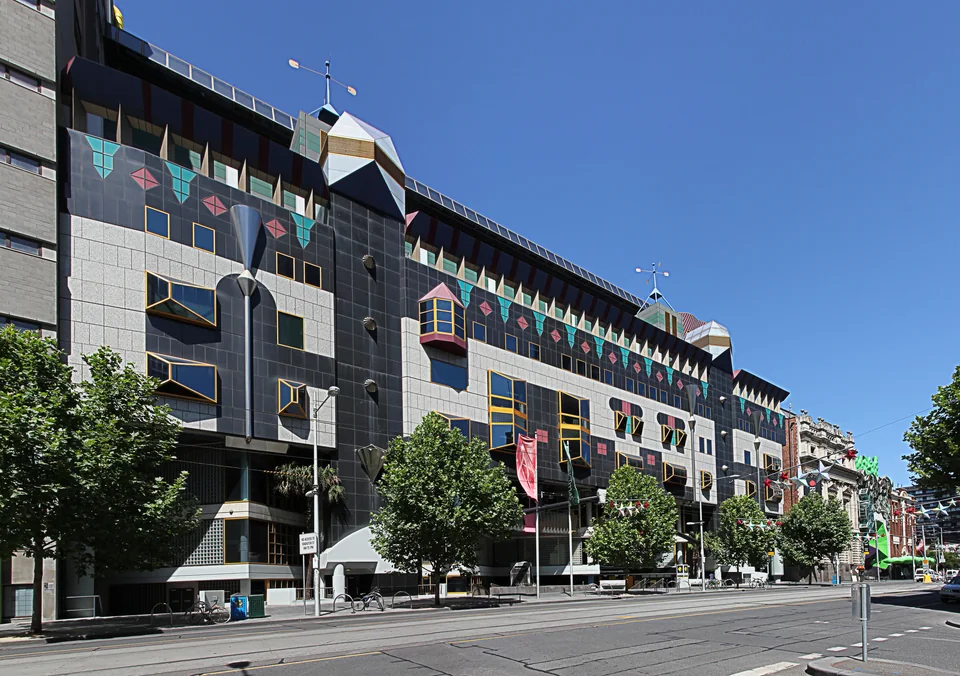
RMIT is a public university in central Melbourne with an applied focus on design, architecture, IT, engineering, business and media. Russia does not appear in RMIT's school-certificate equivalency table, so Russian school leavers usually start with RMIT Foundation Studies, which costs $24,060 (AUD 34,250) for the 2027 program. Bachelor's tuition for 2027 is $30,340–37,090 (AUD 43,200–52,800) a year, and IT and data master's degrees cost $33,040 (AUD 47,040) a year. Russian citizens pay no application fee.
| At a glance | Details |
|---|---|
| City | Melbourne; most programs at the Melbourne City campus |
| Rankings | QS 2027: equal 119th in the world, 10th in Australia; THE 2026: 251–300 |
| Subject rankings | QS 2026: 15th for architecture and built environment, equal 19th for art and design |
| Russian certificate | Russia is not in the equivalency table; the main route is RMIT Foundation Studies |
| Foundation Studies, 2027 | $24,060 (AUD 34,250) per program; January and July starts |
| 2027 tuition | bachelor's $30,340–37,090 (AUD 43,200–52,800) a year; master's from $33,040 (AUD 47,040) |
| Fee increases | capped at 7.5% a year, plus rounding |
| English | IELTS Academic 6.5, no band below 6.0; Foundation 5.5 |
| Application fee | AUD 100 only for listed African and South Asian countries; Russia and the CIS are not listed |
| Foundation scholarship | $3,510 (AUD 5,000) one-off, 40 awards for 2027 |
How RMIT differs from research-led universities
RMIT is a dual-sector university: alongside bachelor's and master's degrees it runs vocational education, including diplomas in IT, business and other fields that can lead into a bachelor's with credit. That gives more entry points and more practice-based learning.
Its strengths show in subject rankings. In the QS Rankings by Subject 2026 RMIT is 15th for architecture and built environment, equal 19th for art and design and 29th for library and information management. In the ShanghaiRanking Global Ranking of Academic Subjects 2026 it is 23rd for business administration, 26th for civil engineering, 32nd for food science and 34th for aerospace engineering.
Overall it sits below the Group of Eight: equal 119th in QS 2027 and in the 251–300 band in THE 2026. If research reputation matters more than applied training, compare it with the University of Melbourne and Monash University.
Entry after a Russian or CIS school
For Foundation, diplomas and bachelor's degrees RMIT requires a school qualification recognised as equivalent in its country table. The table covers Germany, Norway, the UK, China, India, Vietnam and around thirty other systems, but not Russia, Kazakhstan or other CIS countries, so admissions staff assess how a Russian certificate compares with Australian Year 11.
The main route is Foundation Studies (FS022), delivered by the university's subsidiary RMIT University Pathways (RMIT UP):
| Item | Foundation Studies |
|---|---|
| Who | students with a senior secondary qualification equal to Australian Year 11 and an overall average of at least 50% or a pass; minimum age 16 at commencement |
| Length | one year full-time at Melbourne City |
| Intakes | January and July |
| 2027 fee | $24,060 (AUD 34,250) per program |
| English | IELTS Academic 5.5 (no band below 5.0), TOEFL iBT 50, PTE Academic 42 or C1 Advanced 162 |
| Streams | art, design and architecture; communication and social context; engineering and science; IT; business |
| Outcome | entry to first year of an RMIT bachelor's after successful completion and meeting prerequisites |
High achievers can take Fast Track, an accelerated one-semester pathway with STEM and art, design and architecture streams, plus communication and social context from Semester 1 2027. RMIT does not accept online or at-home English tests. Other routes are compared in studying in Australia after Year 11.
Degrees and 2027 tuition
RMIT publishes annual fees for students commencing between 1 January and 31 December of the selected year. Fees stay fixed within a calendar year and may rise by up to 7.5% at the start of the next (rounded up to the nearest AUD 10 per credit point).
| Degree | Length | Tuition per year, 2027 | Intakes |
|---|---|---|---|
| Bachelor of Media | 3 years (or 2.5) | $30,340 (AUD 43,200) | February, July |
| Bachelor of Computer Science (Professional) | 4 years | $31,690 (AUD 45,120) | February |
| Bachelor of Information Technology (Professional) | 4 years | $31,690 (AUD 45,120) | February |
| Bachelor of Accounting | 3 years | $33,040 (AUD 47,040) | February, July |
| Bachelor of Business (Professional Practice) | 4 years | $33,040 (AUD 47,040) | February, July |
| Bachelor of Games | 3 years | $33,710 (AUD 48,000) | February, July |
| Bachelor of Fashion (Design) | 3 years | $34,390 (AUD 48,960) | February, July |
| Bachelor of Engineering (Aerospace Engineering) (Honours) | 4 years | $34,390 (AUD 48,960) | February, July |
| Bachelor of Architectural Design | 3 years | $37,090 (AUD 52,800) | February, July |
| Master of Information Technology | 2 years | $33,040 (AUD 47,040) | February, July |
| Master of Artificial Intelligence | 2 years | $33,040 (AUD 47,040) | February, July |
| Master of Data Science | 2 years | $33,040 (AUD 47,040) | February, July |
| Master of Fashion (Design) | 2 years | $31,690 (AUD 45,120) | February |
| Master of Business Administration | 1.5–2 years | $37,090 (AUD 52,800) | February, July, October |
| Master of Architecture | 2 years | $38,430 (AUD 54,720) | February, July |
Also budget for:
- SSAF: up to $270 (AUD 386) for 2027.
- Materials and activities: equipment, textbooks and compulsory field trips where relevant.
- Semester invoicing by enrolled load; Foundation is charged a flat semester fee.
The four-year "Professional" versions of business, IT and computer science include compulsory work placement, so plan for four years of fees. Payment routes from Russia are covered in how to pay for studies abroad from Russia; comparisons are in the cost of studying in Australia.
English for degrees
Every program above requires IELTS Academic 6.5 with no band below 6.0. For the Master of Data Science RMIT lists TOEFL iBT 79 (reading 13, listening 12, speaking 18, writing 21). If your English is short, RMIT UP offers English courses packaged with Foundation or a degree.
Scholarships for Russian applicants
Most RMIT international scholarships are regional: India and South Asia, Africa, Southeast Asia, Vietnam, China and Latin America. None targets Russia or the CIS. Realistic options:
| Scholarship | Value | Conditions |
|---|---|---|
| Foundation Academic Scholarship | $3,510 (AUD 5,000) once, credited to later tuition | 40 awards for 2027; offer for Foundation Studies starting 28 January or 14 July 2027; no other tuition-covering scholarship |
| Medibank Excellence Scholarship | $8,430 (AUD 12,000), paid in two instalments | international students completing Australian Year 12 or the IB in Australia; applications from 31 July 2026 |
| Faculty and industry awards | various | see each scholarship page |
RMIT awards more than 2,000 scholarships a year, but most target domestic students or specific countries. See also scholarships in Australia.
How to apply
- Choose the program and check requirements, English and intakes on its page.
- Secure an academic basis: Foundation Studies or Fast Track for school leavers, direct master's entry for graduates.
- Prepare documents: certificates and transcripts, translations, English results, passport; design, architecture and fashion often need a portfolio.
- Write a Genuine Student statement. RMIT publishes guidance on the statement of purpose.
- Apply directly or via an authorised agent. Incomplete applications are not assessed.
- Accept your offer at least 4–8 weeks before the start, as RMIT recommends for visa processing.
- Receive your CoE and apply for the subclass 500 student visa.
Students under 18 need RMIT to confirm accommodation and welfare arrangements for the visa (a CAAW letter) and must arrive on the dates RMIT specifies.
Where to live and what Melbourne costs
RMIT offers student accommodation at all three Melbourne campuses — City, Brunswick and Bundoora — at all-inclusive rates that cover utilities and internet. The university also describes two other routes: a room in a shared house, usually the cheapest option, and homestay with a local family, often with meals.
| RMIT guide for Melbourne | Amount |
|---|---|
| Median rent, one-bedroom flat | $350 (AUD 500) a week |
| Two-bedroom flat | $420 (AUD 600) a week |
| Living costs per year, 2026 estimate | $21,070–31,610 (AUD 30,000–45,000) |
RMIT's living-cost estimate is above the visa minimum of AUD 29,710, so it is the safer basis for a budget. Before signing with a residence, compare its weekly price with renting a room near campus.
Visa and work
- Student visa (subclass 500): online via ImmiAccount after your CoE; charge from $1,760 (AUD 2,500) since 1 July 2026. Home Affairs tells you whether and where to give biometrics.
- Funds: first-year tuition, travel and $20,870 (AUD 29,710) for a year of living costs for one student.
- Work: up to 48 hours per fortnight during study; no limit for research master's and PhD students once their course starts.
- 485 visa: 2 years after a bachelor's or coursework master's and 3 years after a research master's or PhD, for applicants aged 35 or under (under 50 for research degrees); charge $4,040 (AUD 5,750).
Visa decisions belong to Home Affairs. See the Australian student visa guide and working while studying and the 485 visa.
Who RMIT suits
| Pros | Cons |
|---|---|
| Strong design, architecture, fashion, media and games | Lower overall ranking than the Group of Eight |
| Lower fees than Melbourne or UNSW | Russia is not in the certificate equivalency table |
| Own Foundation at AUD 34,250 with two intakes | Almost no scholarships aimed at Russia or the CIS |
| Central Melbourne campus | "Professional" degrees take four years |
| Fee increases capped at 7.5% a year | Creative programs often require a portfolio |
RMIT suits students heading into design, architecture, fashion, media, games, IT or engineering who want practice-based study. Compare it with Monash University, the University of Melbourne, our guide to universities in Melbourne and studying in Australia.
Costly mistakes
- Confusing vocational diplomas with degrees. A Diploma is a separate level, and the 485 Post-Higher Education Work stream is only for bachelor's graduates and above.
- Budgeting three years for a four-year Professional degree.
- Applying to creative programs without a portfolio.
- Taking English tests online. RMIT does not accept them.
- Accepting the offer at the last minute. RMIT advises 4–8 weeks before the start.
FAQ
Does RMIT accept a Russian school certificate directly?
Russia is not in RMIT's equivalency table. School leavers usually need Foundation Studies or Fast Track, and admissions staff assess the certificate.
How much is RMIT Foundation?
AUD 34,250 for the one-year 2027 program, starting in January or July, with IELTS 5.5 and no band below 5.0.
How much is a bachelor's degree at RMIT in 2027?
From AUD 43,200 a year (Bachelor of Media) to AUD 52,800 (Bachelor of Architectural Design); business and accounting cost AUD 47,040 and computer science and IT AUD 45,120.
Can fees rise during my degree?
Yes, at the start of each calendar year, by no more than 7.5% plus rounding.
Do I pay an application fee?
Not as a Russian or CIS citizen. The AUD 100 fee applies to listed African countries, Pakistan and certain regions of India.
How does StudyU help with RMIT?
Under a service agreement we help choose the program and Foundation route, prepare the application, portfolio requirements, Genuine Student statement and visa file. RMIT decides on admission; Home Affairs decides on the visa.
Sources
- RMIT: Country or region equivalency, Fees for international students, Application fee, Application dates
- RMIT: Foundation Studies, Foundation Studies FS022
- 2027 program pages: Bachelor of Accounting, Bachelor of Computer Science (Professional), Bachelor of Architectural Design, Bachelor of Fashion (Design), Bachelor of Games, Master of Data Science, Master of IT, MBA, Master of Architecture
- RMIT: Reputation and rankings
- RMIT: Cost of studying in Australia
- RMIT: Foundation Academic Scholarships, Medibank Excellence Scholarship
- Home Affairs: Student visa (subclass 500), Temporary Graduate visa (subclass 485), Study Australia: visa charge increase
Dollar amounts are converted at the ECB reference rate of 28.09.2026 (AUD 1 = $0.7024) and rounded to the nearest $10.
If you want to know which route into RMIT — Foundation, Fast Track or a master's — is realistic for you, send us an application.
During the free initial consultation, we clarify your goal, profile, timing, and budget and identify the next realistic step.
Next steps
- Australian University Entry After 11 Years of School: Foundation, Diploma or a Year at a Home University
- Working While Studying in Australia and the 485 Graduate Visa in 2026: Hours, Pay, Tax and Post-Study Stay
- Scholarships in Australia for International Students in 2026–2027: What Is Actually Available
- Cost of Studying in Australia in 2026–2027: University Fees, Living Costs, Visa and a First-Year Budget
- How to Pay for Studies Abroad from Russia: What Works in 2026
- Studying in Australia for international applicants
