
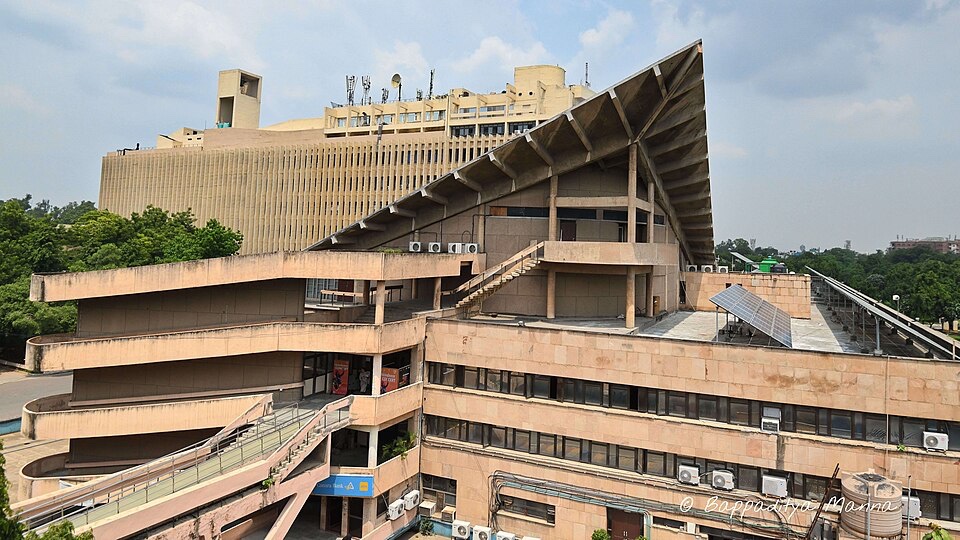
IIT Delhi is a public university in Hauz Khas, New Delhi. Alongside engineering, it offers graduate study in economics, cognitive science, design and the humanities. International applicants should separate undergraduate and postgraduate pricing: the 2026/27 prospectus lists US$2,000 per semester for undergraduates from non-SAARC countries, while foreign postgraduate students pay on the same basis as Indian students.
What you can study
Established in 1961, IIT Delhi offers several distinct graduate routes. The most useful comparison is the type of work: advanced subject courses, a substantial research project or interdisciplinary analysis.
| Programme | Content and format |
|---|---|
| M.Tech | Usually two years of engineering specialisation, including a semester-long thesis and elective courses. |
| MS (Research) | Less required coursework and greater emphasis on independent research and a substantial thesis. |
| MSc | Two-year programmes including Physics, Chemistry, Mathematics, Biological Sciences, Economics and Cognitive Science. |
| MA Culture, Society, and Thought | A two-year full-time degree combining sociology, literature and philosophy. |
| M.Des and MBA | Two-year design and management routes; international MBA candidates also need GMAT. |
A humanities graduate can start with the MA; an engineer considering a research career should compare M.Tech with MS(R). Other useful comparisons are IIT Bombay for SJMSOM’s MBA and IIT Madras for separate MA programmes in development, economics and English studies.
International postgraduate admission
For foreign applicants with qualifications earned outside India, the international office describes a separate application process based on academic documents and an interview. The domestic GATE/COAP engineering route or CAT-based MBA route should not automatically be assumed to apply.
| Route | Minimum academic background |
|---|---|
| M.Tech / MS(R) | A relevant engineering degree of at least four years with 60%, or a relevant MSc of at least two years with 60%. |
| MA Culture, Society, and Thought | A BA in any discipline with 55% or equivalent CGPA; graduates from other streams need First Division. |
| M.Des | At least four years in engineering, technology, architecture or design, with 60%. |
| MBA | A bachelor’s degree of at least three years with 60%; international selection also requires GMAT. |
Departments can set higher thresholds or an additional test. Do not convert a Russian five-point transcript into Indian percentages by a simple arithmetic formula. Include the awarding institution’s grading explanation so the receiving department can assess the qualification.
The international application requires two referees and a statement of English proficiency. The office asks for GATE, GRE, GMAT and language-test results wherever available; programme-specific mandatory conditions, such as GMAT for the MBA, still apply. Candidates with strong academic records are invited to an interview with faculty in the relevant discipline.
Undergraduate entry and school equivalence
B.Tech entry uses JEE Advanced followed by JoSAA allocation. Under the 2026 rules, foreign citizens without OCI/PIO status can register directly for Advanced without taking JEE Main. Their places are supernumerary, up to 10% per programme, and their rank must reach the programme’s OPEN, gender-neutral closing rank.
An overseas school examination must satisfy Class XII equivalence. The JEE 2026 brochure requires AIU certification for foreign school qualifications. Holders of an eleven-year Russian school certificate should resolve this before assuming direct entry. Physics, chemistry and mathematics are required, together with the 75% or top-20-percentile school-results condition. Age, the year of the first school-leaving examination and the number of attempts are also limited by the particular admission cycle.
This describes the engineering route. B.Des uses a separate design-admission route; JEE rules should not be applied to it.
2026/27 tuition: the category matters
The following amounts in IIT Delhi’s 2026/27 prospectus are per semester. Its footnote puts foreign PG/PhD fees on a par with Indian students. The study and funding category still matters.
| Programme / category | Semester tuition |
|---|---|
| Foreign undergraduate, non-SAARC countries | US$2,000 |
| Foreign undergraduate, SAARC countries | US$1,000 |
| MSc / MA | ₹7,500 |
| M.Tech / MS(R) / M.Des / MPP with institute/project assistantship or teaching position | ₹17,500 |
| M.Tech / MS(R) / MPP: sponsored, FT/PT, non-teaching | ₹75,000 |
| MBA, full-time, self-financing | ₹300,000 |
Russia is a non-SAARC country. Additional charges are ₹5,750 per semester, ₹500 annual insurance, ₹8,150 in one-time non-refundable fees and ₹8,000 in refundable deposits. For example, these items give a new MA/MSc student a starting institute bill of ₹29,900, excluding accommodation, meals, travel and visa costs.
The ₹17,500 amount is not a universal engineering master’s rate: the prospectus attaches it to a funding category. It also cannot be compared directly with a complete international undergraduate budget.
Assistantships and campus accommodation
The international office lists a limited number of competitive Teaching Assistantships for foreign M.Tech, M.Des and MS(R) students, paying ₹12,400 per month. They require eight hours of teaching support each week, with continuation dependent on satisfactory academic performance and research progress. Treat the income as available only once the position is awarded. IIT Delhi also describes the ICCR route through the Indian diplomatic mission in an applicant’s country.
The Hauz Khas campus is in South Delhi. The prospectus describes library and sports facilities, student activities and counselling support. Hostels are available to full-time students subject to capacity. The 2026/27 prospectus lists ₹8,600 per semester as hostel seat rent; meals, electricity and other hostel charges are separate. That rent component is not a complete Delhi living budget.
An application and arrival plan
- Match your previous qualification to a particular degree. MA, MSc, M.Tech and MBA do not accept identical backgrounds.
- For a master’s application, prepare the grading explanation, English statement and two referees. For undergraduate entry, start with school equivalence and JEE eligibility.
- Separate tuition, recurring charges, deposits and accommodation. Count assistantship income after an award is confirmed.
- Before applying for a student visa, register with Study in India for an SII ID. Use that identifier and your admission offer in the visa application.
The government SII FAQ explains that graduation does not automatically provide a work visa. The India study guide connects this institution-level plan with the wider destination choice.
These fees and JEE rules cover the published 2026/27 cycle. For a later intake, match your school-leaving year, age and previous attempts to its conditions before paying an examination fee.
Frequently asked questions
Does IIT Delhi offer degrees for humanities graduates?
Yes. The two-year full-time MA Culture, Society, and Thought combines sociology, literature and philosophy. International eligibility includes a BA with 55% or equivalent CGPA; graduates of other streams need First Division.
Do all foreign master’s applicants need GATE?
There is no single rule requiring it for every applicant. International admission for foreign candidates with degrees from outside India involves academic assessment and an interview. Programme-specific requirements, such as GMAT for MBA, remain applicable.
What is the international undergraduate tuition fee?
The 2026/27 prospectus lists US$2,000 per semester for applicants from non-SAARC countries, including Russia, and US$1,000 for SAARC countries. Other fees, deposits and accommodation are additional.
Can a master’s student receive a paid assistantship?
Foreign M.Tech, M.Des and MS(R) students can be considered for a limited number of competitive Teaching Assistantships paying ₹12,400 per month. They require eight hours of teaching support weekly and satisfactory academic performance.
If you are choosing between a taught and a research master’s, discuss your background with StudyU. An initial consultation can clarify your previous subject, goal and budget; programme selection and application preparation follow an agreed service contract. The institution or relevant scholarship body decides admission and funding.