
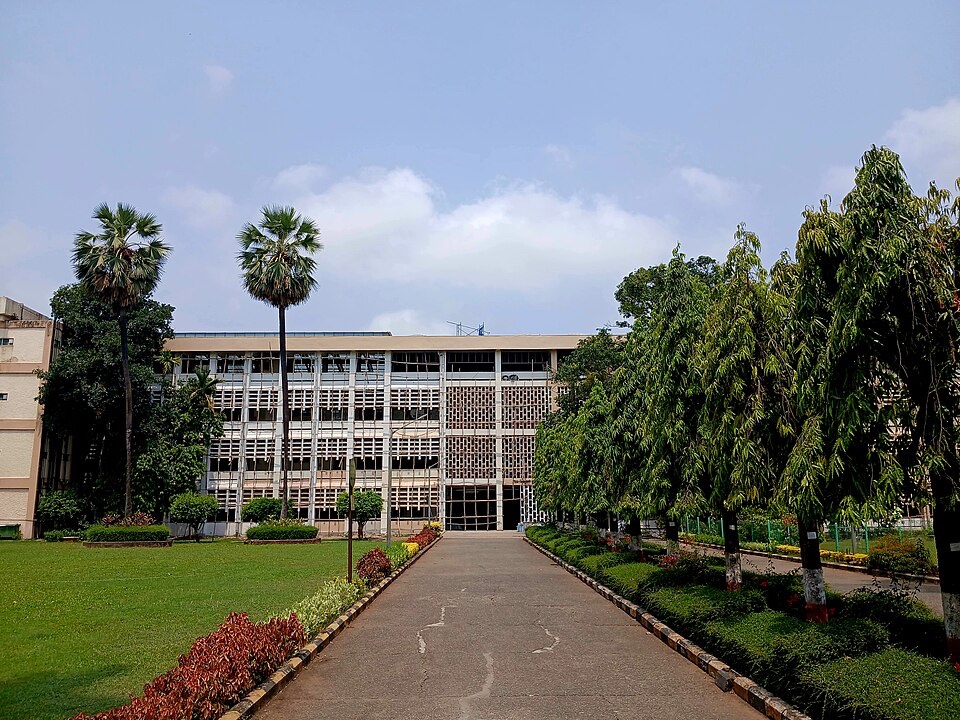
IIT Bombay is a public technical institution in Mumbai’s Powai district. Its undergraduate, research master’s and MBA routes serve different goals and use different selection procedures. For a foreign undergraduate allocated a supernumerary seat, tuition in 2026/27 is ₹300,000 per semester. The frequently quoted ₹100,000 figure belongs to a different student category.
Choosing a degree route
B.Tech and BS degrees run for four years; Dual Degree programmes run for five. The undergraduate route suits applicants prepared for a competitive examination in mathematics, physics and chemistry.
| Route | What to compare |
|---|---|
| M.Tech | Advanced engineering specialisation. The international office lists 60%, First Class as defined by the awarding university, or CPI 6.0/10, followed by department-specific requirements. |
| MS by Research | Research-focused study, with options including Computer Science and Engineering and Data Science and Artificial Intelligence. |
| SJMSOM MBA | A two-year residential management degree open to graduates across disciplines, with GMAT for international candidates. |
For M.Tech, accepted backgrounds include relevant engineering qualifications and several other degrees, including MSc and MCA; the department determines the precise fit. Compare the coursework and research topic before choosing between M.Tech and MS. For humanities options, also consider IIT Delhi; for interdisciplinary engineering, compare IIT Madras.
Undergraduate admission as a foreign national
Under JEE Advanced 2026 rules, a foreign citizen without OCI/PIO status can register directly for Advanced without first taking JEE Main. The examination and other eligibility conditions still apply. Foreign places are supernumerary, capped at 10% of each programme; the applicant’s rank must meet or exceed the OPEN, gender-neutral closing rank for the chosen programme.
A school qualification earned outside India must satisfy Class XII equivalence. The 2026 information brochure requires an Association of Indian Universities (AIU) equivalence certificate for an overseas school examination. In particular, an eleven-year Russian school certificate should not be treated as automatically equivalent. Prepare the certificate, transcript and details of the school curriculum before committing to examination preparation.
Physics, chemistry and mathematics are required. School results must meet the 75% aggregate or top-20-percentile route under the JEE rules. The 2026 cycle also limits age, the year of the first school-leaving examination and the number of attempts. Successful candidates then enter JoSAA seat allocation and rank their programme choices. OCI/PIO holders have separate classifications, so a foreign passport alone does not establish the correct route.
Master’s applications and English
Foreign master’s candidates apply through IIT Bombay’s international admission portal. Prepare the degree certificate, transcripts with the grading scale, CV, statement of purpose, passport and two or three recommendations, including an academic reference. Documents in another language need a certified English translation.
English can be evidenced by a home-university letter confirming the language of instruction or another document accepted by the international office. The document list also asks self-financed applicants for a two-year postgraduate programme to show a bank balance of at least US$10,000. This is evidence of funds, not the programme’s tuition price.
MBA 2026–28: international applicants need a bachelor’s degree with at least 60% or CPI 6.5/10 and a valid GMAT score. Graduates of English-medium degrees do not need TOEFL/IELTS if they provide the university letter specified by SJMSOM. Do not apply these MBA thresholds to M.Tech: its academic baseline and departmental selection are different.
The first undergraduate semester: a concrete budget
The 10 July 2026 fee schedule gives the following amounts for new foreign undergraduates on supernumerary seats in Autumn 2026/27:
| Charge | Amount in INR |
|---|---|
| Tuition | ₹300,000 per semester |
| Other academic and student fees | ₹8,150 per semester |
| One-time non-refundable admission charges | ₹16,000 |
| Refundable institute and library deposits | ₹10,000 |
| First institute payment | ₹334,150 |
The separate new-undergraduate hostel circular for that semester lists ₹19,950 in housing-related charges, including a one-time ₹5,000 deposit, plus a ₹22,500 mess advance. Housing and the meal advance therefore total ₹42,450. Combined with the institute payment, the starting amount is ₹376,600, excluding travel, visa and personal expenses. A mess advance is not a fixed promise covering every future food expense.
This is a first-semester calculation, not a four-year package price. One-time charges do not recur every semester, and the institute may revise future rates. The India study guide provides a starting point for comparing destinations and institutions.
Funding and life on the Powai campus
The international office describes the ICCR scholarship route through the Indian diplomatic mission in an applicant’s country. Admission and scholarship selection are separate decisions. The limited tuition waivers mentioned for exceptional doctoral applicants should not be read as a general undergraduate discount.
Powai functions as a self-contained student neighbourhood, with medical facilities, banks, shops, sports spaces and a Student Activity Centre. For a new undergraduate, adding the academic bill, hostel charges and meal advance is more useful than comparing room rent alone.
Before arrival and after graduation
Student visa applicants need an SII identifier. Register with the government’s Study in India portal, then use the ID and admission offer in the visa application. SII also states that graduation does not automatically provide a work visa. Build the essential study budget around funding already available to you.
Begin your application plan with two decisions: undergraduate entry through JEE Advanced or postgraduate entry through the international office; self-financing or a scholarship application. Then gather the documents for that route before paying application and examination charges.
The fee calculation and JEE rules here describe the published 2026/27 cycle. For a later intake, match your age, school-leaving year and previous attempts to that intake’s rules before paying an examination fee.
Frequently asked questions
Does a foreign applicant need JEE Main for IIT Bombay?
Under the 2026 rules, foreign citizens without OCI/PIO status can register directly for JEE Advanced. Other eligibility conditions, the required competitive rank and seat allocation still apply.
How much is the first undergraduate semester?
For a new foreign undergraduate on a supernumerary seat in Autumn 2026/27, the first institute bill is ₹334,150. Including hostel charges and the mess advance, the total is ₹376,600, excluding travel, visa and personal expenses.
Can a non-engineering graduate apply for the MBA?
Yes. SJMSOM’s MBA accepts graduates across disciplines. International applicants for 2026–28 need a bachelor’s degree with at least 60% or CPI 6.5/10 and a valid GMAT score.
Is an eleven-year Russian school certificate enough?
The number of school years alone does not establish eligibility. For an overseas school examination, the JEE 2026 brochure requires AIU confirmation of Class XII equivalence; JEE subject and academic-result conditions also apply.
At an initial StudyU consultation, we can review your educational background, identify an application route and outline the budget. Document preparation and application support are provided under an agreed service contract; the institution or scholarship body decides admission and funding.