
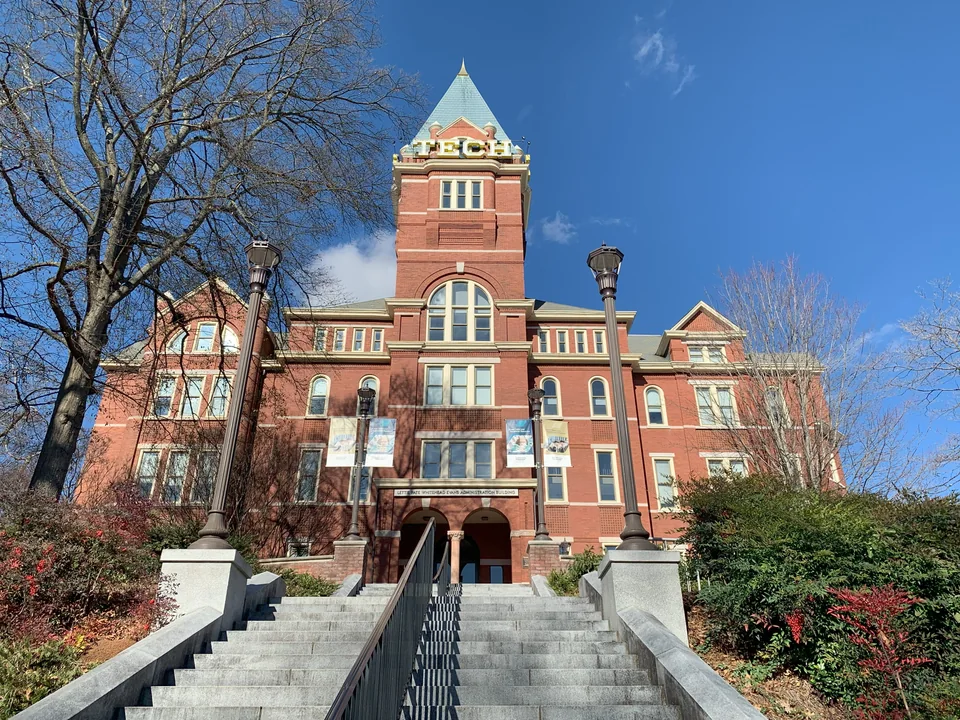
The Georgia Institute of Technology, known as Georgia Tech, is a public technological research university in Atlanta, the capital of the US state of Georgia. It is joint 142nd in the QS World University Rankings 2027, 49th in the THE World University Rankings 2027 and in the 151–200 band of ARWU 2026. For international students it costs far less than private technical universities: the 2026–27 first-year cost for out-of-country students living on campus is $56,520, including $35,610 tuition. The trade-offs are clear, too: there is almost no aid for international students, the SAT or ACT is required, and the international admit rate was 7.3% in fall 2025, against 29.5% for Georgia residents. International applicants apply by November 2, 2026 (non-binding Early Action 2) or January 6, 2027.
| At a glance | Details |
|---|---|
| Location | Atlanta, Georgia, USA |
| Type | public; part of the University System of Georgia (USG) |
| Students (fall 2025) | 56,715, including 21,028 undergraduates |
| Rankings | QS 2027: =142; THE 2027: 49; ARWU 2026: 151–200 |
| Colleges | six: Engineering, Computing, Sciences, Design, Ivan Allen College of Liberal Arts, Scheller College of Business |
| Application | Common App only; $85 fee for international applicants |
| Deadlines for international applicants | Early Action 2: November 2, 2026; Regular Decision: January 6, 2027 |
| SAT/ACT | required |
| English | USG rules: TOEFL iBT 3.5 minimum (new scale), IELTS 6.0; 4.0 and 6.5 recommended |
| First-year cost, 2026–27 | $56,520 (out-of-country, on campus) |
| Aid for international students | no institutional grants; merit scholarships consider Early Action applicants only and are rarely awarded to international students |
| International admit rate (fall 2025) | 7.3%: 716 of 9,758 applicants |
Who Georgia Tech suits
| Reasons to apply | Reasons to pause |
|---|---|
| The annual budget is $37,000–43,000 lower than at private CMU and Northwestern | No need-based aid and, per the Common Data Set, no institutional grants for international undergraduates |
| Strong engineering and computing, plus BS/MS options that count graduate courses toward both degrees | As a public university, Georgia Tech prioritizes Georgia residents |
| Early Action is non-binding, so you can hold a late-January offer while comparing others | International applicants face a 7.3% admit rate, below the 13.3% overall |
| Recommendations are optional and interviews are voluntary | The SAT or ACT is required, and Duolingo does not satisfy the English requirement |
| Atlanta is a major business hub with internships and employers | Four years of tuition alone still exceeds $140,000 |
Georgia Tech makes sense for students heading into engineering or computing who can pay their own way and want a reasonable budget by US standards. If you need aid, compare it with private universities that fund international students, such as Johns Hopkins. If budget is not a constraint and you want a technical focus, look at Carnegie Mellon.
Colleges and programs
Georgia Tech weighs the major you choose. The admission office says the major on your application, and evidence of your interest in it, shows how you would fit into the incoming class — so treat this choice as part of your case.
- College of Engineering: eleven engineering programs, including aerospace, biomedical and industrial and systems engineering.
- College of Computing: computer science built on the Threads curriculum, in which students combine several thematic areas into a specialization.
- College of Sciences: mathematics, physics, chemistry, biology, earth sciences and neuroscience.
- College of Design: architecture, industrial design and music technology.
- Ivan Allen College of Liberal Arts: economics, international affairs, public policy and other programs with a technology angle.
- Scheller College of Business: business at the intersection with technology.
Many schools offer BS/MS options that let eligible students count up to 6 credit hours of graduate coursework toward both degrees.
How to apply
Georgia Tech uses only the Common App for first-year applicants. International students go through the same process, but applications are read in the context of where you attend school: a citizen of another country studying in Illinois, for example, is reviewed alongside Illinois applicants.
A complete application
- Common App with essay and activities.
- Application fee of $85 for international applicants ($75 for US applicants). Fee waivers follow Common App criteria.
- Transcripts for every year of secondary school, translated into English. If your system's upper secondary stage is shorter than four years, you will need to send one more year of records before enrolling.
- SAT or ACT scores, self-reported in the Common App or the applicant portal. Georgia Tech uses your highest ACT English, Math and Reading section scores and your highest SAT section scores.
- English proficiency under University System of Georgia rules.
- Recommendations from counselors and teachers are optional.
Georgia Tech expects applicants to complete the level of education that allows entry to a competitive university in their home country. If your national curriculum has fewer than 12 years or no calculus, the university encourages extra evidence through free Schoolhouse.world certifications, particularly in calculus. For graduates of 11-year systems such as Russia's, that advice applies directly.
English under USG rules
The University System of Georgia requires every international applicant to demonstrate English proficiency through an approved method. Institutions may set higher bars, but the published minimums are:
| Test | Minimum | Recommended |
|---|---|---|
| TOEFL iBT (new 1–6 scale) | 3.5 | 4.0 |
| TOEFL iBT taken before 2026 | 69 | 79 |
| IELTS Academic | 6.0 | 6.5 |
| Cambridge (B2 First, C1 Advanced, C2 Proficiency) | 169 | 177 |
| PTE Academic | 53 | 58 |
| SAT Evidence-Based Reading and Writing | 480 | — |
| ACT English | 17 | — |
The Duolingo English Test is not on the USG list. You can add it as supplementary evidence, but it does not satisfy the requirement. Non-native speakers may also submit an unscripted InitialView or Vericant interview by the document deadline; Georgia Tech does not run staff or alumni interviews.
2026–27 deadlines
| Early Action 1 | Early Action 2 | Regular Decision | |
|---|---|---|---|
| Who | Georgia residents and Georgia high school students | everyone else, including international applicants | all applicants |
| Application | October 15, 2026 | November 2, 2026 | January 6, 2027 |
| Documents | October 30, 2026 | November 16, 2026 | January 22, 2027 |
| Self-reported test scores | November 16, 2026 | December 8, 2026 | January 22, 2027 |
| Decision | early December | late January | mid-March |
| Deposit | May 1, 2027 | May 1, 2027 | May 1, 2027 |
Early Action at Georgia Tech is non-binding: students admitted in Early Action 2 can wait for other decisions until May 1. Only Early Action applicants are considered for merit scholarships such as the Stamps President's Scholars Program and the Scheller Dean's Scholarship, with no separate application. Each scholarship's terms state whether international students are eligible, and the financial aid office notes that institutional scholarships are often not awarded to them. Incomplete Early Action files can move into Regular Decision. Admitted students are assigned a summer or fall start term.
A timeline for international applicants:
- By September 2026: take the SAT or ACT and a USG-approved English test.
- September–October: choose your major and shape your essay around it; order translated transcripts.
- By November 2: submit the Common App under Early Action 2.
- By November 16 and December 8: send documents and self-report test scores.
- Late January 2027: decision; reply and deposit by May 1.
- After admission: lawful presence and visa documents, Form I-20 and the F-1 visa.
Admission statistics
According to the Common Data Set 2025–26, Georgia Tech received 66,881 first-year applications, admitted 8,921 (13.3%) and enrolled 4,071. Residency makes a large difference:
| Group | Applied | Admitted | Rate |
|---|---|---|---|
| Georgia residents | 12,527 | 3,691 | 29.5% |
| Out-of-state | 44,596 | 4,513 | 10.1% |
| International | 9,758 | 716 | 7.3% |
Of the admitted international students, 248 enrolled. The middle SAT range of enrolled students was 1370–1530 and ACT 31–35. The admission office itself names residency as one of the biggest influences on an applicant's likelihood of admission. These figures describe the pool, not individual chances.
Cost of attendance
| First year, out-of-country, 2026–27 | On campus | Off campus |
|---|---|---|
| Tuition | $35,610 | $35,610 |
| Mandatory fees | $1,716 | $1,716 |
| Books and supplies | $800 | $800 |
| Housing | $8,318 | $12,084 |
| Food | $6,310 | $6,310 |
| Personal expenses | $2,800 | $2,800 |
| Transportation | $966 | $966 |
| Total for two semesters | $56,520 | $60,286 |
Georgia residents pay $10,618 in tuition and students from other US states pay $34,604, so international students pay roughly the out-of-state rate. Health insurance and international flights are not shown in this budget, so add them separately. Our guide to the cost of studying in the USA explains how to compare budgets.
Financial aid and paying for Georgia Tech
International students are not eligible for federal or state aid. The Office of Scholarships and Financial Aid says institutional scholarships are often not awarded to international students, and in its Common Data Set 2025–26 Georgia Tech reported no institutional grant aid for international undergraduates. What remains:
- external scholarships offered by foundations, companies or government programs at home;
- private loans, which usually require a creditworthy US citizen or permanent resident co-signer;
- an emergency tuition loan for unforeseen situations, offered first come, first served;
- a Bursar payment plan if, for example, an international wire transfer is delayed.
The university and lenders make these decisions. Compare other universities' policies in our guide to financial aid for international students in the USA, and read about legal payment routes in our guide on how to pay for studies abroad from Russia.
Campus life and housing
First-year students join the First-Year Residential Experience, which includes Living Learning Communities built around shared interests. The campus sits in central Atlanta, where major employers offer internships. Off-campus housing is budgeted higher than on-campus housing: $12,084 versus $8,318 a year. See our guide to student housing in the USA for renting after first year.
Visa and work
The University System of Georgia verifies the lawful presence of all admitted students before enrollment, and international students upload visa documents to the portal. Georgia Tech issues Form I-20 once you document your funding. You then pay the $350 SEVIS fee and the $185 visa fee; these are the amounts as of September 30, 2026, so check them on the embassy site before paying. Russian citizens interview at the US embassies in Warsaw or Astana, because the embassy in Moscow does not issue routine visas, and must set their social media profiles to public first. The consulate decides on the visa. Our F-1 visa guide walks through the process.
Engineering, computing and science degrees are STEM fields, so graduates can extend OPT by 24 months. See our guide to working while studying and OPT.
Advice for applicants from Russia and Kazakhstan
- Georgia is a US state. Search for "Georgia Tech, Atlanta" to avoid confusion with universities in the country of Georgia.
- Eleven years of school are not a barrier, but Georgia Tech explicitly recommends showing extra preparation, such as a Schoolhouse.world calculus certification.
- Duolingo will not replace TOEFL or IELTS for the USG requirement.
- Apply under Early Action 2. It is the only route to merit-scholarship consideration, although such awards rarely go to international students, and it brings a decision by late January.
- Budget without aid: about $56,500 a year, plus insurance and flights.
Major and university selection, SAT and English planning, essay work, I-20 documents and visa preparation are provided under an agreement with StudyU. Georgia Tech decides on admission, and the US consulate decides on the visa.
Common mistakes
- Sending Duolingo instead of TOEFL or IELTS. It does not meet the USG rule.
- Missing the document deadline. Each application plan has separate deadlines for documents and self-reported scores, and missing the Regular Decision ones closes your file.
- Applying Regular Decision and hoping for merit aid. Merit scholarships are considered only in Early Action.
- Choosing a major at random. Your major and your evidence of interest are part of the review.
- Expecting in-state tuition. International students pay the out-of-country rate; USG policy, not the admission office, sets tuition classification.
Rankings
| Ranking | Position |
|---|---|
| QS World University Rankings 2027 | =142 |
| THE World University Rankings 2027 | 49 |
| ARWU 2026 | 151–200 |
Overall rankings score a university across all fields, including medicine and the humanities, and lean on reputation surveys, so a technical institute tends to look stronger in engineering tables. For engineering and computing, subject rankings tell you more.
FAQ
Where is the Georgia Institute of Technology?
In Atlanta, the capital of the state of Georgia in the southeastern United States. The university has no connection to the country of Georgia, and its campus sits in central Atlanta.
How much does Georgia Tech cost for international students?
The 2026–27 first-year cost is $56,520 on campus, including $35,610 tuition and $1,716 fees. Off campus the budget is $60,286; add health insurance and flights separately.
Does Georgia Tech require the SAT?
Yes. Every first-year applicant must submit SAT or ACT results. You can self-report scores and send official reports after admission, before orientation.
What English test score do I need for Georgia Tech?
Under University System of Georgia rules, the minimum is TOEFL iBT 3.5 on the new scale or IELTS 6.0, with 4.0 and 6.5 recommended. Duolingo does not satisfy the requirement.
Can international students get scholarships at Georgia Tech?
No institutional aid went to international undergraduates in 2025–26. Merit scholarships are considered only for Early Action applicants, so most international students fund their studies through family money, outside scholarships or private loans.
When should international students apply to Georgia Tech?
Apply under Early Action 2 by November 2, 2026 for a late-January decision, or by January 6, 2027 for Regular Decision with a mid-March decision.
Are recommendations and interviews required?
No. Recommendations are optional, and an InitialView or Vericant interview is an extra way to show your English and motivation before the document deadline.
Sources
- Georgia Tech Admission: First-Year Application Plans and Deadlines
- Georgia Tech Admission: International First-Year Admission
- Georgia Tech Admission: Standardized Tests
- Georgia Tech Admission: Application Review Process
- Georgia Tech Admission: Application Fees
- Georgia Tech Admission: Interview
- Georgia Tech Admission: Document Submission
- Georgia Tech Admission: Academics
- University System of Georgia: English Proficiency Requirements
- Georgia Tech Scholarships and Financial Aid: Undergraduate Costs 2026–27
- Georgia Tech Scholarships and Financial Aid: International Students
- Georgia Tech Common Data Set 2025–2026
- Georgia Tech Housing: First-Year Communities
- US Embassy in Russia: Visas
- ICE: I-901 SEVIS Fee
- US Department of State: Visa Fees
- QS World University Rankings 2027
- THE World University Rankings 2027
- ShanghaiRanking ARWU 2026
Amounts are in US dollars as published by Georgia Tech; checked on September 30, 2026. More universities are listed on our study in the USA page. To work out which college and deadline suit you, and how to fund your studies without university aid, send us a request.
During the free initial consultation, we clarify your goal, profile, timing, and budget and identify the next realistic step.
Next steps
- Johns Hopkins University
- Carnegie Mellon University
- Studying in the USA for international applicants
- Cost of Studying in the USA in 2026: Tuition, Living Costs and a Realistic First-Year Budget
- Financial Aid for International Students in the USA: Need-Based Grants, Merit Scholarships and Assistantships
- How to Pay for Studies Abroad from Russia: What Works in 2026
