
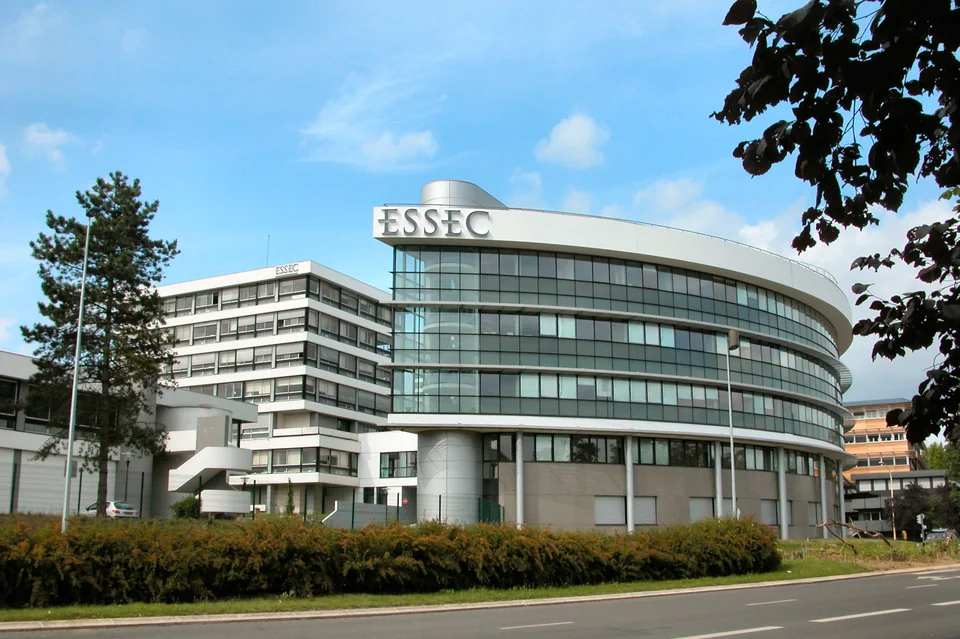
ESSEC Business School is a non-profit French business school founded in 1907. Its historic campus is in Cergy, north-west of Paris, with further sites in the La Défense business district, Singapore and Rabat. Unlike many grandes écoles, it admits international school leavers directly to a four-year Global BBA; graduates can apply to the Master in Management (MiM), a specialised MSc or the Global MBA, and every level has English-taught options. For the 2026 intake a non-EU student paid $91,230 (€80,340) for the four-year BBA and $65,000 (€57,240) for the two-year MiM track, while the Global MBA for the 2027 intake costs $62,450 (€55,000).
| At a glance | Details |
|---|---|
| Legal status | non-profit association under the French law of 1901, affiliated with CCI Paris Île-de-France |
| Campuses | Cergy (historic), Paris–La Défense, Singapore (current campus opened in 2015), Rabat (since 2017) |
| Students | 8,543 in bachelor's and master's programmes, about 38% international |
| Accreditations | AACSB, EQUIS and AMBA; the MiM confers the French state master's degree (grade de master) |
| Global BBA, non-EU | $19,740 (€17,383) tuition per year plus fees; $91,230 (€80,340) for four years |
| MiM Flexible Track, non-EU | $65,000 (€57,240) for the programme |
| Global MBA, September 2027 intake | $62,450 (€55,000); 12 months, extendable to 16 |
| ESSEC Scholarship | $11,360 (€10,000) for outstanding international applicants |
What ESSEC is
ESSEC is a grande école of management rather than a university. It runs its own selection and awards its own degrees, several of them state-recognised: the MiM carries the grade de master, and the Global BBA is registered in France's national qualifications register (RNCP, level 6) with bachelor's-degree accreditation. Its board of overseers includes representatives of the Paris regional Chamber of Commerce and the Catholic University of Paris, and alumni, students and faculty take part in governance.
Cergy is a separate town north-west of Paris, not a Paris district: ESSEC puts it about 35 minutes from the city centre, next to the Cergy-Préfecture RER station. La Défense, just outside the city limits, hosts the MBA and executive programmes. For context, compare ESSEC with HEC Paris and other schools in our guide to business schools in France.
Who ESSEC suits
| Strength | Trade-off |
|---|---|
| Direct entry after high school to an English-taught Global BBA | Four years cost more than $80,000, with few discounts beyond scholarships |
| The MiM accepts graduates without work experience and offers 50+ specialisation tracks | You need a GMAT, GRE or TAGE MAGE score and at least IELTS 6.5 |
| Study on three continents: a Singapore or Rabat term is built into the curriculum | Each campus has its own immigration rules |
| Strong finance offering: the Master in Finance ranks in the FT top five | MiM students without French take a compulsory French course |
| MiM apprenticeship contracts, where the employer pays tuition | Only on the Flexible Track, and finding an employer as a non-EU student is hard |
If you are comparing undergraduate options, see bachelor's degrees in France; graduates should read master's degrees in France.
Programme overview
| Programme | Level and length | Campuses | Language |
|---|---|---|---|
| Global BBA | bachelor's, 4 years, 240 ECTS | start in Cergy, Singapore or Rabat | English or French track |
| Master in Management (Grande École) | Flexible Track (2–3 years) or Intensive Track (1 year) | start in France or Singapore; tracks in Rabat | English or French |
| Master in Finance, Data Sciences & Business Analytics, Strategy & Management of International Business, Luxury Management, Hospitality Management and other MSc degrees | 1–2 years | mainly France and Singapore | English |
| Global MBA | 12–16 months, September intake | Paris–La Défense and Singapore | English |
| Executive MBA, executive education, PhD | various | mostly La Défense | English and French |
The Global BBA
Years one and two build foundations in management, economics and law. You choose one of five tracks: French or English in Cergy, English in Singapore, French or English in Rabat. A one-month field experience follows year one and a three-month operational placement follows year two, and first-year students can apply for a semester on another ESSEC campus during year two. With 240 ECTS, graduates can enter the second year of a master's (M2) at ESSEC or elsewhere.
The Master in Management
Flexible Track (2–3 years) is for graduates with little or no experience. It opens with refresher courses, after which you design up to two-thirds of the curriculum from 200+ electives and 50+ tracks, including a CFA-linked finance track, actuarial science, analytics, consulting, RICS-accredited real estate, luxury and entrepreneurship.
Intensive Track (1 year) requires at least six months of professional experience. The eight months of experience needed to graduate can be completed with a final internship, and apprenticeship contracts are not available on this track.
Applying to the Global BBA
Selection is based on your school record, English level, motivation and an interview; there is no subject entrance exam.
- Take an English test. English-track minimums: IELTS Academic 6.5, TOEFL iBT 90, TOEIC 850 or Cambridge B2 First 175 (Duolingo 120 for Rabat only). The French track in Rabat requires DELF or TCF B2. Scores must be under two years old at the deadline.
- Create a portal account. One application per programme per year, and no more than two attempts at the same programme overall.
- Upload documents: transcripts for the last three years of high school, an enrolment certificate with your expected graduation date (or your diploma), the test score and a one-page CV. An academic reference is optional; SAT scores may be added.
- Pay the 2027-intake application fee: $110 (€100) for Cergy and Singapore, $85 (€75) for Rabat.
- Interview: shortlisted applicants have a 30-minute motivational interview with two examiners, on campus or by video.
- Confirm your place with a $6,250 (€5,500) deposit within two weeks; it is deducted from tuition.
Documents must be in English or French, and Singapore applicants need official English translations.
Global BBA rounds for the 2027 intake
| Round | Deadline | Shortlist | Interviews | Final results by |
|---|---|---|---|---|
| 1 | 28 October 2026 | 20 November 2026 | 25 November–1 December 2026 | 7 December 2026 |
| 2 | 12 January 2027 | 3 February 2027 | 10–17 February 2027 | 26 February 2027 |
| 3 | 10 March 2027 | 1 April 2027 | 7–13 April 2027 | 21 April 2027 |
| 4 | 22 April 2027 | 13 May 2027 | 20–26 May 2027 | 2 June 2027 |
Applying to the MiM
You need at least a three-year bachelor's degree in any field, or to be in your final year. The file includes:
- a one-page CV, your high-school diploma, degree certificates or an enrolment certificate (the final diploma is due by mid-December of your first year);
- authenticated transcripts from every university attended, exchanges included, with an explanation of the grading system;
- two recommendations, ideally one academic and one professional, submitted online by your referees;
- proof of employment for the Intensive Track;
- a management test: GMAT or GRE (valid five years) or TAGE MAGE (two years); GMAT Quiz results are not accepted;
- English: TOEIC 850, IELTS Academic 6.5, TOEFL iBT 95 or Cambridge B2 First 175, under two years old at the deadline, unless at least three years of full-time university study were entirely in English.
For the 2027 intake ESSEC has published three deadlines so far: 7 October 2026, 26 November 2026 and 17 February 2027 (noon, Paris time); round 4 and interview dates are still to be announced. Interviews take place online. Our GMAT guide and GRE guide help you choose a test.
The Master in Finance runs four rounds: 14 October 2026, then 6 January, 15 February and 26 April 2027, with results five to seven weeks later.
Applying to the Global MBA
The Global MBA runs for a year, with an option to extend to 16 months, and starts each September in La Défense or Singapore. Requirements are stricter than at HEC: you must be at least 25 when applying, have three years of post-university experience (internships excluded), international work exposure and a four-year bachelor's degree. Holders of a three-year degree can be considered through a recognition-of-experience procedure (VAPP) with at least five years of experience.
The current cohort's average age is 30. The preferred minimum GMAT Focus score is 585 and the class average is 615; the Executive Assessment, GRE and TAGE MAGE are also accepted. English minimums are IELTS 7, TOEFL 100, TOEIC 800 or Duolingo 135. Applications for the 2027 intake run from September 2026 to June 2027, and you may submit test scores after applying but before enrolment and any scholarship award.
Fees
Global BBA (2026 intake rates)
| Item | Non-EU, Cergy & Singapore | EU, Cergy & Singapore |
|---|---|---|
| Tuition per year | $19,740 (€17,383) | $17,490 (€15,400) |
| Registration fee per year | $2,270 (€2,000) | $2,270 (€2,000) |
| Service fee (whole programme) | $3,190 (€2,810) | $3,010 (€2,653) |
| Total for four years | $91,230 (€80,340) | $82,040 (€72,253) |
Rabat fees are set in Moroccan dirhams. ESSEC labels this table as applicable to the 2026 intake, so 2027 figures may be higher.
Master in Management (2026 intake rates)
| Track | Non-EU | EU |
|---|---|---|
| Flexible, 2 years: tuition per year | $28,730 (€25,300) | $24,410 (€21,500) |
| Flexible: programme total | $65,000 (€57,240) | $56,140 (€49,440) |
| Intensive, 1 year: programme total | $48,000 (€42,270) | $47,880 (€42,170) |
The deposit is $6,810 (€6,000). Apprentices pay no tuition, because the employer covers it, but other fees remain payable.
Other programmes
| Programme | Cost |
|---|---|
| Master in Finance, 1 year, non-EU (2026 intake) | $40,130 (€35,340) |
| Global MBA, September 2027 intake (fee published in the current admissions cycle) | $62,450 (€55,000), plus a $150 (€130) application fee and $2,070 (€1,820) lifetime alumni membership |
| Global MBA early-bird reduction, September 2027 | $9,080 (€8,000) for applications by 26 October 2026; the earlier 28 September deadline has passed |
ESSEC advises budgeting $1,480–2,270 (€1,300–2,000) a month for living costs.
Scholarships
- ESSEC Scholarship: $11,360 (€10,000) for outstanding international Global BBA and MiM applicants, decided during selection with no separate application.
- Eiffel Excellence Scholarship: a French government award with a monthly allowance for master's students up to 29; ESSEC nominates candidates. In the 2026 cycle institutions submitted files to Campus France by 8 January 2026, and Campus France publishes the next call.
- Global MBA scholarships: merit-based, weighing career progression and test results; amounts are set by the committee.
- French Embassy in Russia scholarship: for Russian citizens admitted to a master's; in 2026/27 it paid $980 (€860) a month and covered the visa and Campus France fees.
See our guide to scholarships in France for more options.
Housing
In Cergy, ESSEC has four residences next to the campus with about 1,100 rooms, studios and flats, booked online. The Rabat campus has separate women's and men's residences with single and double rooms, and in Singapore the school helps you find private accommodation. General advice on renting and CROUS housing is in our student housing guide.
Visas
Studying on a French campus requires a long-stay student visa, preceded in Campus France countries by an Études en France file. ESSEC admits through its own portal, so an applicant living in Russia completes this procedure after ESSEC's decision, as a candidate who is already admitted. The Campus France calendar ending on 30 January 2027 applies to applications made through the platform, not to students who already hold an ESSEC place. You create the file with your admission details no earlier than three months before classes, pay the registration fee, attend the Campus France interview and then apply at the French visa centre; without the admission recorded in the file, the visa request is not processed.
The consulate expects evidence of at least $1,000 (€877.50) per month. After arrival you validate the visa online within three months and pay $110 (€100), and you may work up to 964 hours a year. Our student visa guide walks through each step, and studying in France as a Russian citizen covers specific points for Russian applicants.
Starting in Singapore or Rabat means applying for that country's student permission instead; a later term in France then requires a French visa.
Rankings
- Financial Times European Business Schools 2025: 7th;
- FT Masters in Management 2025: 10th;
- FT Masters in Finance (pre-experience) 2025: 4th;
- FT Global MBA 2026: 24th; QS Global MBA 2026: 29th worldwide;
- French national rankings: MiM 2nd (Le Point and Le Figaro Etudiant, 2026); Global BBA 1st among business-school bachelor's degrees (Le Point, 2026).
Rankings assess individual programmes; a strong MiM position says little about a particular MSc.
Common mistakes
- Treating Cergy as Paris. Central Paris is about 35 minutes away by RER; factor this into housing and transport.
- Leaving the campus choice open. You choose your starting campus when applying, and once the application is validated that choice is final.
- Applying to the MiM without a test. An official GMAT, GRE or TAGE MAGE score is required for a complete file.
- Budgeting tuition only. Registration and service fees add more than $12,000 to the four-year BBA.
- Ignoring the French requirement. Non-French speakers in the MiM must take French, which takes up timetable space.
- Mixing up the two Campus France routes. The 30 January deadline is for applications made through the platform; after an ESSEC offer you open the file three months before the start, so prepare translations and proof of funds early.
FAQ
Can I apply to ESSEC straight after high school?
Yes, to the Global BBA. ESSEC accepts international school diplomas and final-year enrolment certificates. You need grades from the last three years, an English score such as IELTS 6.5, a CV and an interview, and there are four rounds between October and April.
How much does ESSEC cost for an international student?
For the 2026 intake: $91,230 (€80,340) for the four-year Global BBA, $65,000 (€57,240) for the two-year MiM and $48,000 (€42,270) for the one-year Intensive MiM. The Global MBA costs $62,450 (€55,000), and living costs are $1,480–2,270 (€1,300–2,000) a month.
Can I study at ESSEC in English?
Yes. The Global BBA has English tracks on all three campuses, the MSc programmes and the Global MBA are in English, and MiM students can build an English-taught curriculum. If you do not speak French, the MiM adds compulsory French classes.
What GMAT score does ESSEC expect?
For the MiM there is no published minimum, but a competitive score is required. For the Global MBA the preferred minimum GMAT Focus is 585 and the class average 615; the GRE, Executive Assessment and TAGE MAGE are also accepted.
How is ESSEC different from HEC Paris?
ESSEC has its own bachelor's for school leavers, campuses in Singapore and Rabat, a one-year Intensive MiM and apprenticeship options. Its Global MBA costs roughly half as much as HEC's ($62,450 versus $115,820) and has a single September intake, but requires three years of experience and a minimum age of 25.
Does ESSEC have student residences?
Yes: about 1,100 places in four residences near the Cergy campus and on-campus residences in Rabat. ESSEC does not list its own residences in Singapore, but helps with private rentals. Rooms are not assigned automatically; you apply online.
Can StudyU help with an ESSEC application?
Programme and campus selection, requirement checks, documents, essays, interview practice and the Études en France file are provided under an agreement with StudyU. ESSEC decides on admission and its own scholarships; the French consulate or the host country's immigration authority decides on the visa.
Sources
- ESSEC Global BBA: international-diploma admission, rounds, requirements and fees
- ESSEC Master in Management: admission with a degree, tracks, 2027 rounds and fees
- ESSEC Master in Finance: rounds and fees and list of MSc programmes
- ESSEC Global MBA: requirements, tests and fees
- ESSEC: about and key figures, governance, rankings and housing
- Campus France Russia: Études en France for students already admitted, visa rules and French Embassy scholarship 2026/27
- Campus France: Eiffel 2026 cycle
- Service-public.fr: resources required for a student residence permit and its validation fee and working while studying
- ECB rate, 29.09.2026: $1.1355 per €1. Rounding: $1 below $100, $10 above.
For an overview of higher education in France, see Study in France and universities in Paris. Choosing ESSEC programmes for your profile is provided under an agreement with StudyU; ESSEC makes the admission decision. To start, send us a request.
During the free initial consultation, we clarify your goal, profile, timing, and budget and identify the next realistic step.
Next steps
- Business Schools in France: Programmes, Rankings, Fees and Admission for 2027
- Studying in France for Russian Citizens: How to Apply from Russia in 2027
- HEC Paris: Admission, Programmes and Tuition Fees
- Studying in France for international applicants
- Bachelor's in France: Licence, Private Bachelor Programmes and Admission After School
- GMAT Exam Guide 2026: Format, Scores, Fees and Online Testing
