
The University of Bern is the public university of the Swiss capital, founded in 1834, with eight faculties ranging from theology and law to medicine and the natural sciences. Its bachelor's programmes are taught almost entirely in German, so a C1 certificate or the university's own German test is part of every first-year application. Many school-leaving certificates from outside Europe are not enough on their own: for Russia, Kazakhstan and Belarus, Bern asks for two years of full-time study at a recognised university (120 ECTS) plus confirmation of admission to the same subject at home. From the autumn 2026 semester, students who earned their school certificate outside Switzerland pay $3,130 (CHF 2,609) per semester.
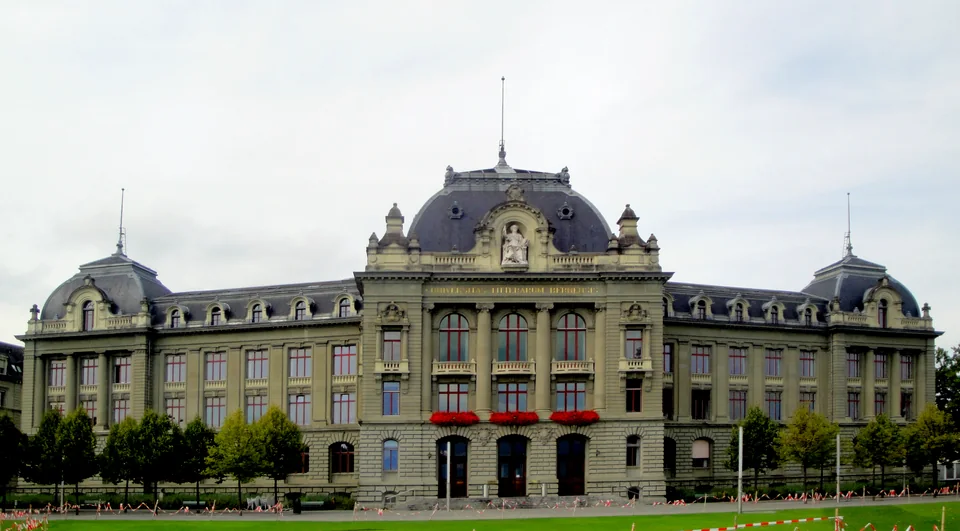
Do not confuse Universität Bern with Bern University of Applied Sciences (Berner Fachhochschule, BFH) or the teacher-training university PHBern: each has its own admission rules. For the national picture, see our Switzerland study guide.
| At a glance | 2026/27 academic year |
|---|---|
| Status | public cantonal university; listed by swissuniversities as accredited, institutional accreditation dated 24.09.2021 |
| Location | Bern, canton of Bern, German-speaking Switzerland |
| Ranking | QS World University Rankings 2027: =191 |
| Bachelor's language | German; C1 proof (Goethe, telc, TestDaF 4 in all parts, DSH-2 and others) or Bern's own test |
| Russian, Kazakh or Belarusian certificate | plus 2 years of full-time university study (120 ECTS) and proof of admission to the same subject |
| Fees for international students | $3,130 (CHF 2,609) per semester, about $6,250 (CHF 5,218) a year |
| Autumn deadline | 30 April; the late window to 31 August is closed to visa-required nationals |
| Funds for the permit | $21,560 (CHF 18,000) per year in a FINMA-approved Swiss bank |
Who Bern suits
Bern makes sense for students who want a public Swiss degree at a moderate price by Swiss standards and who are ready to study in German at bachelor's level. Its English-taught master's programmes cluster in economics, business, climate science, computer science and biomedical engineering.
| A good fit if | Look elsewhere if |
|---|---|
| You are already in your second year of a university degree in the same field | You want to start straight after secondary school with a non-European certificate |
| Your German is B2 or better and you can reach C1 | You will only study in English at bachelor's level |
| You want an English-taught master's in economics, climate or data | You want medicine: non-Swiss applicants face special access rules |
| Your living budget is about $1,800–2,640 (CHF 1,500–2,200) a month | You expect university-run halls: Bern has none |
If German is not an option, compare Bern with ETH Zürich, where entrance exams are an alternative route, or with French-speaking Geneva.
Bachelor's admission with a foreign school certificate
Bern's 2026/27 admission rules list requirements country by country. A few examples:
| Country of certificate | What Bern requires |
|---|---|
| Russia | Attestat o srednem (polnom) obshchem obrazovanii + 2 years of recognised full-time university study (120 ECTS) + proof of admission to the chosen subject |
| Kazakhstan | Attestat + the same 2 years + proof of admission |
| Belarus | Attestat + the same 2 years + proof of admission |
| Uzbekistan | a completed first university degree of at least 3 years |
Proof of admission (Studienplatznachweis). A letter from a state or state-recognised university with doctoral-degree rights in the country that issued your certificate, confirming admission to the same subject. Distance-learning universities do not count, and the letter must be less than a year old. The rules tie the two years of study to a recognised university (120 ECTS) but do not separately require them to be in the same subject; the Admissions Office decides how your studies are assessed.
Subject check. Over the last three school years the certificate must show six general subjects: first language, a second language, mathematics, a natural science, history, geography or economics/law, and one more subject. Certificates from evening or distance schools, vocational colleges and foreign university entrance tests are not accepted.
German. Applicants whose first language or school language is not German need Goethe C1 or C2, telc Deutsch C1, TestDaF with at least 4 in all four parts, DSH-2 or DSH-3, ÖSD C1 or DSD II. Other tests are not recognised; Bern also runs its own German test. Law, business and social sciences, medicine, the sciences and human sciences grant no exemption.
Medicine and sport. Human, dental and veterinary medicine and sport science have separate rules and an earlier deadline, 15 February.
Our guides to applying to Swiss universities and German tests: TestDaF, DSH and Goethe explain both requirements in more depth.
Master's programmes taught in English
At master's level the language depends on the programme. Bern's 2026/27 list shows fully English-taught options such as:
- Applied Economic Analysis, Economics, International and Monetary Economics;
- Business Administration with specialisations including Corporate Finance, Marketing, Business Analytics and Information Systems;
- Climate Sciences, Earth Sciences, Ecology and Evolution;
- Computer Science, Artificial Intelligence in Medicine, Bioinformatics and Computational Biology;
- Biomedical Engineering and Biomedical Sciences;
- Mathematics.
Some programmes are listed as 80–95% English, others as 30–50%; treat the latter as German-taught. You need a recognised bachelor's degree in a related field, and each programme page sets its own grade and language conditions. See also our overview of master's degrees in Switzerland.
When and how to apply
| Intake | Regular deadline | Late window |
|---|---|---|
| Autumn (September), non-restricted bachelor's and master's | 30 April | until 31 August, not for visa-required nationals |
| Spring (February) | 15 December | until 31 January, same restriction |
| Medicine, dentistry, veterinary medicine, sport | 15 February | none |
Applicants who need a Swiss visa can only use the regular deadline. The process:
- Online application by the deadline and a fee of $180 (CHF 150).
- Acknowledgement within about 10 days, sometimes with a request for more documents.
- Decision: admission, conditional admission subject to a German test or complementary exam, or refusal.
- Invitation to complete enrolment, from April at the earliest for an autumn start.
- Check of original documents, semester invoice, student card after payment.
Certified copies and translations must follow the university's guidelines of 16.08.2022.
How much does Bern cost international students from autumn 2026?
| Item | Amount | Who pays |
|---|---|---|
| Base tuition | $1,020 (CHF 850) per semester | all bachelor's and master's students |
| International surcharge | $2,040 (CHF 1,700) per semester | students whose legal residence was outside Switzerland and Liechtenstein when they obtained their school certificate |
| Semester fee | $40 (CHF 34) | all students |
| Student Union (SUB) membership | $30 (CHF 25) | SUB members; the university includes it in its own total |
| Total for an international student | $3,130 (CHF 2,609) per semester | the university's figure: 850 + 1,700 + 34 + 25; CHF 2,584 without SUB membership |
| Application fee / late fee | $180 (CHF 150) / +$120 (CHF 100) | one-off |
A three-year bachelor's comes to about $18,750 (CHF 15,654) in fees for an international student, a two-year master's to about $12,500 (CHF 10,436). Students exceeding 12 semesters pay a higher long-term fee. For a national comparison, read the cost of studying in Switzerland.
Housing and living costs
The university does not run halls of residence. Rooms are let by independent providers including Studentlodge, Stuwo, Studentenresidenz Stöckacker, SWB Studentenwohnheim Bern and StudentInnen Logierhaus Immoplus, and the Student Union runs a housing platform. Studentlodge offers a cheaper contract that cannot end before 31 January or 31 July and a slightly dearer one with monthly notice. Places often run out weeks before the semester.
The university's monthly estimate:
| Item | CHF per month | About $ |
|---|---|---|
| Rent incl. utilities | 620–800 | 740–960 |
| Health insurance | 180–400 | 220–480 |
| Food and household | 400–500 | 480–600 |
| Transport and study materials | 200 | 240 |
| Other | 100–300 | 120–360 |
| Total | 1,500–2,200 | 1,800–2,640 |
Non-EU students may work up to 15 hours a week, and only after six months in Switzerland. Part-time jobs in Bern usually require German.
Visa and residence permit
- Where to apply. Russian citizens apply for a national D visa at the visa section of the Swiss Embassy in Moscow (appointments via moscow.visa@eda.admin.ch, fee RUB 8,700), which also serves residents of Belarus and Uzbekistan. Residents of Kazakhstan apply in Astana.
- Funds. The canton of Bern expects $21,560 (CHF 18,000) in an account at a FINMA-approved bank in your name, or a declaration of support from a Swiss resident with a B or C permit. The balance is checked every year.
- Accommodation. The university recommends a rental contract of at least three months in the city or canton of Bern; living in another canton can lead to refusal of a student visa.
- Passport. Permits are issued for 12 months and renewed, so the passport should be valid for 18 months on entry.
- Timing. Migration officials need 8–12 weeks, often longer.
- Common refusal reasons named by the university: age over 30, an existing master's degree, doubts about leaving after studies and insufficient German. For an English-taught master's, ask the programme for a letter confirming the language of instruction.
The cantonal migration authorities decide on the permit; the university cannot influence the outcome. Within 14 days of arrival you register with the city migration office. More detail is in our Swiss student visa guide and in studying in Switzerland for Russian citizens.
Sanctions and payments for Russian citizens
Article 20 of the Swiss Ordinance on Measures in connection with the Situation in Ukraine (SR 946.231.176.72, consolidated version of 21.09.2026) bars banks from accepting deposits above CHF 100,000 from Russian nationals and residents of Russia and restricts certain payment services. The bans do not apply to holders of a residence permit of Switzerland, an EEA state or the UK. The CHF 18,000 proof is below the threshold, but opening an account before you hold a permit can be difficult, so check the bank's conditions early. Legal payment routes are covered in how to pay for studies abroad from Russia.
Bern compared with Basel
| University of Bern | University of Basel | |
|---|---|---|
| Fees per semester, international | $3,130 (CHF 2,609) from autumn 2026 | $1,020 (CHF 850), no international surcharge |
| German for bachelor's | mandatory C1 certificate or Bern's test | C1 recommended; students carry responsibility |
| Russian certificate | + 2 years of university + proof of admission | same conditions |
| Funds for permit | CHF 18,000 a year | at least CHF 24,000 |
| QS 2027 | =191 | 150 |
See the full landscape in universities in Switzerland.
Common mistakes
- Applying straight after school. With a Russian, Kazakh or Belarusian certificate alone the application will be rejected.
- An admission letter for the wrong subject. The letter must name the same field you apply for in Bern and be less than a year old.
- Counting on late admission. It is closed to visa-required nationals; miss 30 April and you move to the spring intake.
- Taking the wrong German exam. B2 certificates, language-school tests and online exams are not recognised.
- Budgeting with old fees. Many sites still quote CHF 850 per semester; from autumn 2026 international students pay CHF 2,609.
- Renting outside the canton. This can undermine the student permit.
Timeline for an autumn 2027 start
- October–December 2026. Confirm that you will have 120 ECTS at a recognised university by summer 2027 and request an admission letter for the right field; book Goethe C1 or TestDaF.
- January–March 2027. Obtain the admission letter from your home university, translations and certified copies.
- By 30 April 2027. Submit the online application and pay CHF 150.
- May–June 2027. After admission, place CHF 18,000 with a FINMA-approved bank, book a room and request a visa appointment.
- August–September 2027. Arrive, register within 14 days and pay the semester invoice.
FAQ
Can I enter the University of Bern straight after secondary school?
Not with a Russian, Kazakh or Belarusian certificate. You first complete two full years (120 ECTS) at a recognised university and obtain an admission letter for your chosen field from a university in your home country. The university's Admissions Office (Zulassung, Immatrikulation und Beratung) makes the final admission decision.
How much does the University of Bern cost for international students?
From autumn 2026, students who obtained their school certificate abroad pay $3,130 (CHF 2,609) per semester: CHF 850 base tuition, a CHF 1,700 surcharge, the CHF 34 semester fee and CHF 25 Student Union membership. That is about $6,250 a year before rent and insurance.
Are there bachelor's degrees in English at Bern?
Almost none; bachelor's teaching is in German apart from language programmes such as English studies. English is mainly a master's-level option, in economics, business administration, climate science, computer science, biomedical engineering and more.
What level of German do I need?
C1, proven by a certificate on the university's list (Goethe C1, telc C1, TestDaF 4 in all parts, DSH-2 and others) or by passing Bern's own German test. B2 certificates are not accepted.
How much money must I show for a Swiss student permit in Bern?
CHF 18,000 (about $21,560) for each year of study in a FINMA-approved bank, or a declaration of support from a Swiss resident. The cantonal migration authorities, not the university, decide on the visa and permit.
What is the difference between Universität Bern and BFH?
Universität Bern is a full research university with bachelor's, master's and doctoral degrees. Bern University of Applied Sciences (BFH) is a separate institution with different programmes, entry rules and deadlines.
Sources
- University of Bern: bachelor's admission with an international certificate
- Admission rules 2026/27 with deadlines and country list (PDF), requirements for foreign certificates (PDF)
- German for bachelor's studies (PDF), from application to enrolment (PDF)
- Fees from autumn semester 2026 (PDF)
- Master's programmes with teaching language, 2026/27 (PDF)
- Accommodation, living costs, entry and residence, visa factsheet (PDF)
- swissuniversities: accredited institutions, Swiss Accreditation Council: 2025 activity report
- QS World University Rankings: University of Bern
- Swiss Embassy in Russia: where to apply for a D visa, fees; Swiss Embassy in Kazakhstan
- Fedlex: SR 946.231.176.72, Article 20, version of 21.09.2026
Dollar amounts use the ECB reference rate of 30.09.2026 (€1 = $1.1355 and CHF 0.9478, so CHF 1 ≈ $1.1980), rounded to $10. The embassy charges the visa fee in roubles. Information checked on 1 October 2026.
If you want to work through your route to Bern, send a request: document preparation and submission are provided under an agreement with StudyU, and the University of Bern makes the admission decision.
During the free initial consultation, we clarify your goal, profile, timing, and budget and identify the next realistic step.
Next steps
- Studying in Switzerland as a Russian Citizen: D Visa, Sanctions, Payments and Degree Recognition
- University of Basel (Universität Basel): Admission, Fees and Requirements for International Students
- Studying in Switzerland for international applicants
- ETH Zurich: Admission, Fees and Requirements for International Students
- EPFL (École Polytechnique Fédérale de Lausanne): Admission, Entrance Exam and Fees
- University of Geneva (UNIGE): Admission, Fees and Requirements for International Students
