
Most international school leavers cannot enter an ETH Zurich Bachelor's programme on their school certificate alone. For many countries, including Russia, Kazakhstan and the rest of the CIS, ETH asks for proof of admission to a recognised university at home in the same subject plus its reduced entrance examination (four subjects); without that proof you sit the comprehensive examination (eight subjects). Bachelor's teaching and the exam are in German, and a C1 certificate must be uploaded by 31 March. Since autumn 2025, foreign students who move to Switzerland to study pay $2,650 (CHF 2,190) per semester, and ETH estimates a full year of study and living at $33,950 (CHF 28,100). Master's admission has no exam and most programmes are taught in English: applications for autumn 2027 run from 1 to 30 November 2026.
| At a glance | Details |
|---|---|
| Location | Zurich: central campus (Zentrum) and the Hönggerberg science campus |
| Bachelor's language | German; C1 certificate due by 31 March of the application year |
| Typical route with a non-Swiss certificate | depends on the country list: no exam, reduced exam, or comprehensive exam |
| Entrance exam | once a year in January; next session 18–28 January 2027; $660 (CHF 550) reduced or $970 (CHF 800) comprehensive |
| Bachelor's application | 1 December – 31 March, one programme only, autumn start only |
| Tuition per semester | $2,650 (CHF 2,190) for students who come to Switzerland to study; $880 (CHF 730) for Swiss citizens and anyone who earned their school certificate while living in Switzerland |
| Annual budget | $33,950 (CHF 28,100) per ETH's estimate; architecture $37,930 (CHF 31,400) |
| Master's | apply 1–30 November 2026 for autumn 2027; IELTS 7.0 (6.0 per band) or TOEFL iBT 5.0 on the new scale; fee $180 (CHF 150) |
| ESOP scholarship | about 60 awards for 2027/28: tuition waiver plus $16,310 (CHF 13,500) per semester |
| Security screening | Master's applicants from Russia, Belarus, China, Iran and other listed countries are screened for many technical programmes |
Who ETH suits, and who should look elsewhere
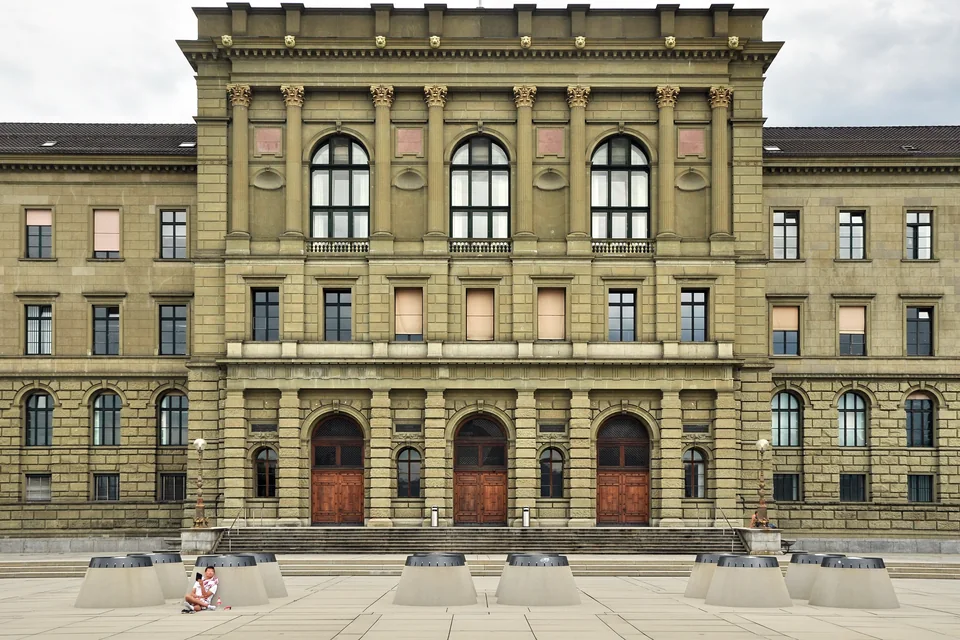
ETH Zurich is Switzerland's federal institute of technology, founded in 1855 as the "Polytechnikum". It has 16 departments covering architecture and civil engineering, engineering, computer science, mathematics, physics, chemistry, biology, earth and environmental sciences, health sciences and technology, management and economics, and humanities and social sciences. It has more than 21,000 students, 35% recruited from abroad, mostly at Master's and doctoral level. ETH is linked to 22 Nobel Prizes, and Albert Einstein began his career here. It is 11th in the THE World University Rankings 2026.
There is no law, psychology or classic humanities Bachelor's degree at ETH; for those, look at the University of Zurich, whose main building stands next door.
ETH fits you if you:
- are strong in mathematics and physics and are ready to study them in German from the first semester;
- can reach German C1 by 31 March of the application year, not "by the start of term";
- can obtain proof of admission to a university at home in the same subject, which halves the entrance exam;
- plan to take a Bachelor's degree elsewhere and come to ETH for an English-taught Master's.
Consider other options if:
- you do not speak German and do not plan to learn it: French-taught engineering is available at EPFL, and ETH has no English-taught Bachelor's;
- you want law, psychology or languages;
- you cannot fund life in Zurich yourself: non-EU/EFTA students may only start working six months into their studies and for no more than 15 hours a week.
For the wider picture, start with studying in Switzerland and our overview of universities in Switzerland.
Can you get into ETH straight from school?
It depends on your certificate. ETH, like all Swiss universities, checks foreign certificates against the country table maintained by swissuniversities and its own country list. There are three possible outcomes: admission without an exam, admission subject to the reduced entrance examination, or admission subject to the comprehensive entrance examination.
For Russia and most CIS countries (Kazakhstan, Belarus, Uzbekistan, Kyrgyzstan, Tajikistan, Armenia, Azerbaijan, Georgia), the 2026/27 rule is the same: school certificate plus a certificate of university admission in the desired subject from a recognised university in that country plus the reduced exam; otherwise the comprehensive exam. The certificate of university admission is an official document confirming that you have been admitted to the first year of the same subject at home. You do not have to study there for years; the document itself shortens the exam. ETH asks for it by 31 August of the application year.
| Your situation | Route into an ETH Bachelor's |
|---|---|
| CIS school certificate + proof of admission to a home university in the same subject | reduced exam: mathematics, physics, chemistry, biology |
| CIS school certificate only | comprehensive exam: the same four subjects + German, a second language, history, geography |
| IB Diploma with 38/42 (without bonus points), HL mathematics, HL physics, chemistry or biology, and HL language A, plus the required SL subjects | admission without exam if all ETH conditions are met |
| You already hold a Bachelor's degree | the Master's route is usually more sensible |
ETH decides whether you need an exam, and which one, only after it has your complete application in eApply. It does not assess chances in advance.
Changes from 2028. ETH is preparing new entry requirements for all Bachelor's programmes from the autumn semester 2028, expected to affect the combination of subjects studied and the subjects in the final school exams. Details are due in spring 2027. If you apply between December 2026 and March 2027 and are assigned an exam, you will start in 2028, so check the new rules in spring.
The ETH entrance examination
The exam takes place once a year, in the third and fourth weeks of January, in the ETH Main Building. The next session is 18–28 January 2027 and leads to entry in autumn 2027. Written papers run Monday to Wednesday of the first week; orals run from Thursday of the first week to Thursday of the second. Your personal oral timetable arrives a week before.
| Reduced exam | Comprehensive exam | |
|---|---|---|
| Subjects | mathematics, biology, chemistry, physics | the same four + German, a second language (English, French or Italian), history, geography |
| Fee | $660 (CHF 550) | $970 (CHF 800) |
Mathematics and physics are examined both in writing and orally, with only the listed formularies and simple calculators allowed. All papers are in German, and ETH states that command of subject terminology in German is a prerequisite. ETH offers no preparation or German courses; it publishes subject lists, a reading list and past papers (in German). Registration runs from 15 September to 15 October, the fee is paid by card in eApply, and you cannot sit the exam without an application and an admission decision. Our guide to German tests: TestDaF, DSH and Goethe helps you choose the right certificate.
Timeline: the exam adds a year
| Step | No exam (e.g. IB) | With exam (e.g. CIS certificate) |
|---|---|---|
| Application in eApply | 1 Dec 2026 – 31 Mar 2027 | 1 Dec 2026 – 31 Mar 2027 |
| German C1 certificate | by 31 Mar 2027 | by 31 Mar 2027 |
| School certificate and proof of university admission | by 31 Aug 2027 | by 31 Aug 2027 |
| Exam registration | — | 15 Sep – 15 Oct 2027 |
| Exam | — | January 2028 |
| Start of studies | 20 Sep 2027 | September 2028 |
ETH has not yet published the 2028 exam dates; the exam-route column follows its fixed annual pattern. Processing an application takes up to eight weeks.
German language requirements
The C1 certificate must be in eApply by 31 March. Applications with an invalid, insufficient or missing certificate are rejected on formal grounds after that date. C1 certificates may be no older than two years at the start of the application period; Goethe C2 and ÖSD C2 no older than five years.
| Certificate | Minimum result |
|---|---|
| Goethe-Zertifikat C1 | average of at least 80 points, all modules passed within 12 months |
| Goethe-Zertifikat C2, ÖSD C2 | all sections passed |
| TestDaF | TDN 5 in three sections and TDN 4 in one, same session |
| ÖSD Zertifikat C1 | "gut bestanden" |
| DSH-3 | registered DSH only |
| DSD II | C1 in every part |
| telc Deutsch C1 Hochschule | "gut" |
Native speakers, holders of school-leaving certificates from Germany, Austria, Liechtenstein, Luxembourg and the German-speaking parts of Switzerland, South Tyrol and Belgium, and graduates of a full-time three-year German-taught Bachelor's in Germany, Austria, Liechtenstein or Switzerland are exempt. School grades in German never replace a certificate.
Bachelor's application documents
You apply online in eApply for one programme. You need a colour photo, passport copy, CV, school-leaving certificate, school reports for the last three years, proof of university admission if required, university transcripts if you have studied, the German certificate and a signed declaration of consent. Documents not in German, English, French or Italian need an official translation into German or English. ETH does not consider motivation letters, olympiad awards, portfolios or references at Bachelor's level. After admission, the school certificate, proof of university admission and language certificate must be sent as originals; they are returned during the first semester.
The application fee for non-Swiss certificates is $180 (CHF 150), non-refundable, payable by card, PostFinance, TWINT or Google Pay. ETH warns that cards from some countries may be declined; applicants from Russia should read how to pay for studies abroad from Russia.
Master's admission
For most international applicants this is the realistic route: no entrance exam, and most programmes are in English (some require both English and German, a few are German-only).
Deadlines. Anyone with a non-Swiss Bachelor's must apply in the first window: 1–30 November 2026 for autumn 2027. The April window is only for Swiss Bachelor's graduates, and there is no spring intake. Decisions normally arrive two to three months after the deadline.
Application. You may apply to two programmes per semester, at $180 (CHF 150) each, non-refundable. You need transcripts from every university attended (including exchanges and unfinished programmes), a valid language certificate and whatever the programme asks for: CV, letter of motivation, references, portfolio and sometimes the GRE. Documents are uploaded in the original language, with official translations if they are not in German, English, French or Italian. Your degree must be completed by the start of lectures.
| English test | ETH Master's minimum |
|---|---|
| IELTS Academic (incl. IELTS Online) | 7.0 overall, 6.0 in each band |
| TOEFL iBT (incl. Home Edition) | 5.0 for tests taken from 21 January 2026; 100 for earlier tests |
| C1 Advanced | grade B, at least 193 |
| C2 Proficiency | grade C, at least 200 |
TOEFL, IELTS and C1 Advanced results must be no more than two years old. You are exempt if your entire Bachelor's was taught only in English and the university's central administration confirms this officially; if any part was taught in another language, take a test, because certificates cannot be added after the deadline.
Selection. The programme's admissions committee compares your Bachelor's with the "profile of requirements" in the programme regulations and checks your grade average against the programme minimum. Missing background can lead to conditional admission with extra courses. See also our guide to Master's degrees in Switzerland.
Security screening for applicants from certain countries
ETH screens Master's applications from countries under UN, EU or US sanctions or classed by Switzerland as proliferation risks. Its list (July 2025) includes Russia, Belarus, China, Hong Kong, Macao, Iran, Pakistan, Venezuela and others. Nationality, residence, education and the chosen programme are all considered. Screened programmes include Computer Science, Data Science, Cyber Security, Electrical Engineering, Mechanical Engineering, Robotics, Mathematics, Physics, Chemistry, Materials Science, Civil Engineering, Quantum Engineering and Nuclear Engineering. ETH also lists universities of origin that trigger screening; the Russian ones include MIPT, Bauman Moscow State Technical University, the Moscow Aviation Institute, Moscow Power Engineering Institute, Skoltech, Gubkin University and Saint Petersburg Mining University. Bachelor's applications are generally not screened unless you studied at a listed university. The outcome can affect admission, so affected applicants should keep alternatives in mind.
Tuition fees
Since autumn 2025 ETH has two fee groups. The group is set once before you start and cannot change later, not even when you move from Bachelor's to Master's.
| Group | Who | Tuition per semester |
|---|---|---|
| 1 | Swiss and Liechtenstein citizens; anyone who obtained their school-leaving certificate while resident in Switzerland or Liechtenstein; EU/EFTA citizens with a work-entitled permit before studying; refugees | $880 (CHF 730) |
| 2 | all other foreign students, including those who move to Switzerland to study | $2,650 (CHF 2,190) |
Group 2 compulsory costs per year: tuition $5,290 (CHF 4,380), compulsory semester fees (sports, scholarship fund, VSETH) $180 (CHF 148), study materials $1,210 (CHF 1,000), excursions $600 (CHF 500), or $5,800 (CHF 4,800) in architecture. One-off fees: application $180 (CHF 150); entrance exam $660 or $970. Doctoral students pay a single fee of $1,810 (CHF 1,500) before the oral examination. Students enrolled before autumn 2025 keep the old rate until they finish their current programme, which is irrelevant for 2027 entrants. For country-wide comparisons, see the cost of studying in Switzerland.
Cost of living in Zurich
ETH's estimate for international students already includes tuition, so do not add it twice.
| Item | Per year |
|---|---|
| Room incl. heating (canton of Zurich average, 2024) | $13,650 (CHF 11,300) |
| Meals, incl. university canteens | $8,700 (CHF 7,200) |
| Health insurance, non-EU/EFTA (average) | $1,590 (CHF 1,320) |
| Public transport in Zurich (age 25 or under) | $710 (CHF 586) |
| Personal expenses | $2,030 (CHF 1,680) |
| Living costs | $26,700 (CHF 22,100) |
| Total incl. study, group 2 | $33,950 (CHF 28,100); architecture $37,930 (CHF 31,400) |
The rent figure is based on 2024 data; real prices, and temporary housing in the first weeks, can be higher.
Housing
ETH does not guarantee accommodation. The joint Housing Office of the University of Zurich and ETH connects students with private landlords and flatmates, and the student housing cooperative WOKO is the other main option. Start searching as soon as you are admitted, since you need an address to register after arrival. Hönggerberg is on the edge of the city and the main building is in the centre, so choose your area by department.
Scholarships
ESOP (Excellence Scholarship & Opportunity Programme) is ETH's main Master's scholarship. For students starting in autumn 2027 it pays $16,310 (CHF 13,500) per semester (previously $14,500 [CHF 12,000]) plus a tuition waiver, for the regular duration of the programme (three or four semesters). Requirements: apply in the November window through eApply together with your Master's application; a Bachelor's result in the top 10% of your cohort (self-assessed); a self-written pre-proposal for your Master's thesis; two professors' references if your programme does not already require them; no existing Master's degree and no current enrolment in an ETH Master's. About 60 awards are planned for 2027/28; a phone or video interview may take place in February, and decisions come at the end of March. The Rector makes the final decision.
Need-based ETH scholarships for international students with a B permit are only available after the first year (Bachelor's: after passing the first-year exams; Master's without an ETH Bachelor's: after the first year and at least 40 ECTS). The 2026/27 eSTIP window runs from 1 September to 31 October 2026. These awards do not cover all costs, and ETH expects international students to seek funding at home first. Scholarship decisions are made by ETH, not by StudyU.
Visa, residence permit and work
Non-EU/EFTA nationals who need a visa apply in person for a national (D) visa at the Swiss representation responsible for their place of residence, which forwards the file to the Zurich migration office; without a study visa, no residence permit is issued. The canton of Zurich requires $25,370 (CHF 21,000) for 12 months, confirmed by a bank licensed in Switzerland, a study plan with the exact duration, a justified choice of Zurich, an assured departure after studies, and extra justification for applicants over 30. It does not approve chains of courses (for example, a language course followed by conditional university admission), limits study stays to eight years as a rule, and allows one justified change of subject. See our Swiss student visa guide.
Work. Non-EU/EFTA students may work from six months after the start of studies, up to 15 hours a week during term, with university confirmation, an employer application and prior approval from the cantonal Office for Economy. After graduation, third-country graduates of Swiss universities can get a six-month permit to look for a job matching their qualifications. Health insurance is compulsory; ETH notes that if your purpose of stay switches from study to work, the cheaper student insurance is no longer available and premiums rise by at least $300–360 (CHF 250–300) a month.
Common mistakes
- Applying without German C1 by 31 March. Late certificates are not accepted.
- Skipping the home-university admission certificate. Without it, the exam doubles from four to eight subjects.
- Expecting to sit the exam in the same year. Apply by 31 March, sit the exam the following January, start that September.
- Budgeting with the old fee. Since autumn 2025, students who move for study pay $2,650 (CHF 2,190) per semester, and the group cannot be changed later.
- Applying for a Master's in April with a foreign degree. The April window is only for Swiss Bachelor's graduates.
- Relying on a medium-of-instruction letter when part of your degree was not in English.
- Ignoring security screening if you are from a listed country and applying to a technical programme.
FAQ
Can I get into ETH Zurich with a Russian or Kazakh school certificate?
Yes, but only via the ETH entrance exam: the reduced exam (four subjects) with proof of admission to a recognised home university in the same subject, otherwise the comprehensive exam (eight subjects). The exam is in German, and you need German C1 by 31 March.
How much does ETH cost for international students?
Students who move to Switzerland to study pay $2,650 (CHF 2,190) per semester, or $5,290 (CHF 4,380) a year, plus small compulsory fees. ETH estimates study and living together at $33,950 (CHF 28,100) a year.
Does ETH offer Bachelor's programmes in English?
No. German is the main language of all Bachelor's programmes. Most Master's programmes are taught in English.
When is the Master's deadline for autumn 2027?
1–30 November 2026 for all applicants with a non-Swiss Bachelor's. ESOP applications go through the same window in eApply.
Is the GRE required?
Only for some programmes. Check the application documents for your programme.
Does ETH provide housing?
No. Use the Housing Office of the University of Zurich and ETH and the WOKO cooperative. ETH budgets $13,650 (CHF 11,300) a year for rent.
Can Russian citizens be admitted to ETH Master's programmes?
Yes, but applications to many technical programmes go through additional export-control and sanctions screening. ETH makes the decision.
How can StudyU help?
Under a service agreement we help you choose the route (entrance exam or Master's), plan language tests around the deadlines and prepare your application and documents. Admission decisions are made by ETH, and visa and permit decisions by the Swiss authorities.
Sources
- ETH Zurich: tuition fees, fees schedule (PDF), study and living costs (PDF)
- ETH Zurich: admission prerequisites, country list 2026/27 (PDF), swissuniversities country table
- ETH Zurich: entrance examination, dates, application process, German requirements
- ETH Zurich: Master's dates, how to apply, language requirements
- ETH Zurich: export control and security screening
- ETH Zurich: ESOP, scholarships for international students, housing
- ETH Zurich: history, figures, Nobel laureates
- Canton of Zurich: study stays for third-country nationals
- SEM: D visa, work during and after studies
- THE World University Rankings: ETH Zurich
- ECB euro reference rates, 24 September 2026
Dollar amounts use the ECB reference rates of 24 September 2026 (CHF 1 = $1.2081), rounded to $10.
If you want to know which ETH route is realistic for you and how to fit your language tests into the deadlines, send us a request.
During the free initial consultation, we clarify your goal, profile, timing, and budget and identify the next realistic step.
Next steps
- Universities in Switzerland: Types, Fees and Admission Routes for International Students
- University of Zurich (UZH): Admission, Fees and Requirements for International Students
- EPFL (École Polytechnique Fédérale de Lausanne): Admission, Entrance Exam and Fees
- Master's Degrees in Switzerland: 2026/27 Deadlines, Requirements, Costs and Scholarships
- Studying in Switzerland for international applicants
- German Language Tests for German Universities: TestDaF, DSH, Goethe and telc Compared (2026–2027)
