
Serbia has 9 public universities, 11 non-public universities and 13 academies of applied studies, according to the register of the National Accreditation Body (NAT) dated 22 September 2026. Most international applicants end up choosing between four large public universities — Belgrade, Novi Sad, Niš and Kragujevac — and a handful of accredited private ones. Foreign citizens pay tuition even at public universities: for 2026/27, a year of law at the University of Belgrade costs $2,802 (€2,465), and a year at the Faculty of Technical Sciences in Novi Sad costs $2,273 (€2,000). Most teaching is in Serbian; English-taught options are concentrated in master's programmes and medicine.
The one rule worth remembering: choose a faculty, not a university. In Serbia the faculty publishes the admission call, sets the entrance exam, fixes the fee for foreign citizens and decides the language of instruction. For the country overview — visas, budget and study options — see studying in Serbia; this guide focuses on choosing an institution.
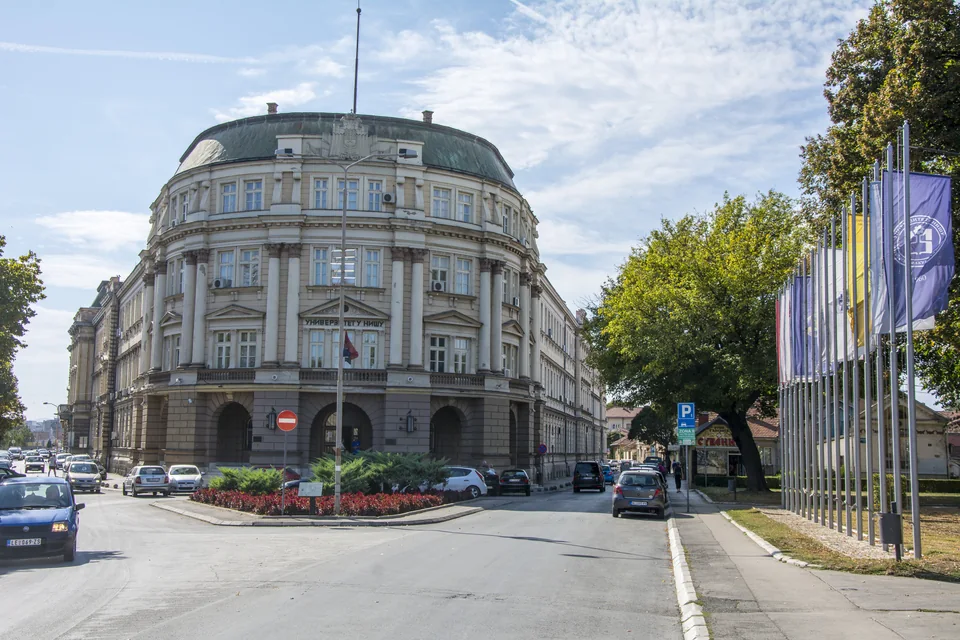
How Serbian higher education is organised
The system follows the three-cycle model (bachelor's, master's, doctorate) and counts workload in ECTS credits (ESPB in Serbian). It also runs two parallel tracks, which matters before you pick an institution.
| Institution type | What it offers | First-cycle length | Best for |
|---|---|---|---|
| University (univerzitet) and its faculties | Academic bachelor's, master's, doctorate; integrated programmes in medicine, dentistry, pharmacy, architecture | 180–240 ECTS (3–4 years) | Applicants aiming for a master's, research or a regulated profession |
| Academy of applied studies (akademija strukovnih studija) | Applied bachelor's and applied master's | 180 ECTS (3 years) | Applicants who want a practical qualification |
| Higher school (visoka škola) | Academic or applied programmes, usually in a narrow field | 180–240 ECTS | Applicants who already know their specialisation |
Under the Law on Higher Education, an applied master's requires at least 120 ECTS after a first degree of 180 ECTS, while a one-year academic master's expects a 240-ECTS bachelor's. A three-year applied degree does not close the door to further study, but it makes the route longer.
Public universities at a glance
Public universities teach most of Serbia's students and hold nearly all of its medicine, engineering and natural sciences, as well as the institutions that appear in international rankings. They publish detailed admission calls and predictable fees; the trade-off is that exams and teaching are mostly in Serbian.
| University | Location | What official sources highlight | Example fee for foreign citizens |
|---|---|---|---|
| University of Belgrade | Belgrade | Founded as a Higher School in 1808, a university since 1905; 31 faculties. Welcome to Serbia places it in the 301–400 band of the Shanghai ranking | Organisational Sciences (FON) $1,932 (€1,700); Electrical Engineering $2,273–3,410 (€2,000–3,000); Law $2,802 (€2,465) |
| University of Novi Sad | Novi Sad, Subotica, Sombor, Zrenjanin | 13 faculties plus the Academy of Arts; 16,125 first-year places across all levels announced for 2026/27 | Technical Sciences $2,273 (€2,000); Economics $2,387 (€2,100); Law $1,364 (€1,200) |
| University of Niš | Niš | Welcome to Serbia says it ranks among the world's top 500 universities in mathematics and chemical engineering | Economics $1,705 (€1,500); Electronic Engineering $2,273 (€2,000); Medicine in English $6,820 (€6,000) |
| University of Kragujevac | Kragujevac, Čačak | Welcome to Serbia notes strong results in mathematics | Economics $1,159 (€1,020); Engineering Sciences $2,046 (€1,800) |
| University of Arts in Belgrade | Belgrade | Creative disciplines with aptitude tests | Check the faculty's admission call |
| State University of Novi Pazar, University of Priština | Novi Pazar and other towns | Other public universities in the NAT register | Check the faculty's admission call |
Belgrade figures come from the university's official 2025/26 tuition table and the 2026/27 calls of the Law and Electrical Engineering faculties; Novi Sad and Niš figures come from the universities' joint 2026/27 calls; Kragujevac figures from the university's 2026/27 fee table. All are annual fees for 60 ECTS on Serbian-taught programmes.
The University of Defence and the University of Criminal Investigation and Police Studies train staff for the armed forces and police and admit under special rules, so they are not a realistic route for a typical international applicant.
For detailed profiles, see our pages on the University of Belgrade and the University of Novi Sad.
Private universities: what to check before you pay
NAT lists 11 universities not founded by the state: Singidunum, Megatrend, Privredna akademija in Novi Sad, Educons, Metropolitan, Union, Union – Nikola Tesla, Alfa BK, MB, European University and the University in Novi Pazar. A degree from an accredited private programme has the same legal standing as a public one.
In practice, private universities differ in three ways:
- One price for everyone. For 2026/27 Singidunum publishes $2,387–2,728 (€2,100–2,400) per 60 ECTS for Serbian-taught programmes, $3,410 (€3,000) for pharmacy and $4,433 (€3,900) for English-taught programmes, with current-semester textbooks included.
- Lighter admission. Entrance tests tend to be simpler or replaced by a document review, but this is each institution's own rule.
- More English at bachelor's level than at public universities.
Before signing anything, open NAT's guide to accredited institutions and programmes. Check that the specific programme is listed (programmes are accredited individually), that its seven-year accreditation has not expired, and that the institution does not appear in the section on institutions whose operating licence was withdrawn. For English-taught programmes, confirm that the English version itself is accredited: the law only allows teaching in a foreign language on a programme approved in that form.
Language of instruction
Serbian is the main language of higher education by law. Study in Serbia, the information platform run by the Tempus Foundation with the Ministry of Education, lists more than 180 programmes taught fully or partly in English across all levels, mostly master's, medicine and technical fields.
The English version of the same degree almost always costs more. From the University of Belgrade's 2025/26 table, the latest published (confirm the current fee with the faculty before you pay):
| Programme | Serbian-taught (foreign citizen) | English-taught |
|---|---|---|
| Medicine (integrated, 360 ECTS) | $2,842 (€2,500) | $9,094 (€8,000) |
| Pharmacy (300 ECTS) | $2,842 (€2,500) | $3,978 (€3,500) |
| Veterinary medicine (330 ECTS) | $3,410 (€3,000) | $5,684 (€5,000) |
| Electrical & Computer Engineering master's (60 ECTS) | $2,842 (€2,500) | $10,230 (€9,000) |
Speakers of Slavic languages often find Serbian manageable, but entrance exams and lectures require genuine B2. The Centre for Serbian as a Foreign Language at the University of Belgrade's Faculty of Philology runs semester courses with four 90-minute classes a week for $682 (€600) per semester. How to fit language study into the admission timeline is covered in our guide to applying to Serbian universities.
Matching a university to your goal
| Your goal | Where to look first | What to watch |
|---|---|---|
| Medicine, dentistry, pharmacy | Medical faculties in Belgrade, Novi Sad, Niš, Kragujevac | 5–6-year integrated programmes; English streams cost far more. See medicine in Serbia |
| IT, electrical and other engineering | Belgrade ETF and FON, Novi Sad Faculty of Technical Sciences, technical faculties in Niš and Kragujevac | Maths entrance exam in Serbian; Novi Sad FTN charges foreigners a flat $2,273 (€2,000) on most programmes |
| Economics, management | Economics faculties of public universities; private universities | The Belgrade Faculty of Economics charges foreigners $2,046 (€1,800) for 2026/27, Novi Sad $2,387 (€2,100); private options cost more but admit more flexibly |
| Law, humanities | Law, philology and philosophy faculties | Strong written Serbian needed; a Serbian law degree is tied to the Serbian legal system |
| English only | Private universities, English programmes at public faculties, master's level | Verify accreditation of the English version and the total cost for the whole degree |
| Lowest budget | Serbian-taught programmes at public universities outside Belgrade | Living costs in Novi Sad, Niš and Kragujevac are lower; Serbian must reach exam level |
| Master's after a foreign bachelor's | Faculties in your field; English programmes | The university itself recognises your degree — see master's in Serbia |
What rankings tell you — and what they don't
Serbian universities sit modestly in global tables. Welcome to Serbia places the University of Belgrade in the Shanghai ranking's 301–400 band and notes that Novi Sad entered the top 1,000 in 2023. In the 2026 CWUR Global 2000, which assessed 21,291 institutions, Study in Serbia reports Belgrade in the top 1.9%, Novi Sad in the top 5.4%, Kragujevac in the top 7.3% and Niš in the top 8.9%.
Treat rankings as background. They rate whole universities, while you will study at one faculty, so subject strength, teaching language, internships and recognition of the degree where you plan to work matter more.
Recognition of a Serbian degree
By law every Serbian diploma comes with a mandatory diploma supplement describing the programme and the national education system, and it can be issued in English. For master's admissions abroad, that package with ECTS credits is usually easy for admissions offices to read. Regulated professions (medicine, law, architecture, teaching) are different: Serbia is not an EU member, so each country applies its own rules for professional access.
Housing and dormitories
A dorm place for a fee-paying foreign student is the exception rather than the rule. Public dormitories in every university city are allocated through the Ministry of Education's annual call, and for 2026/27 eligibility is limited to state-funded students with Serbian citizenship or citizenship of a state in the region — in Belgrade and Novi Sad alike. Government scholarships include accommodation and meals; everyone else should plan to rent.
Study in Serbia estimates monthly costs including rent, food and transport at $966–2,273 (€850–2,000) in Belgrade and $853–1,648 (€750–1,450) in Novi Sad, Niš and Kragujevac. For a full first-year budget, see the cost of studying in Serbia.
How to vet a university and programme in one evening
- Find the programme in NAT's guide and note its accreditation date.
- Open the faculty website's Upis or Konkurs section and find the admission call for your year; the law requires publication at least four months before the academic year begins.
- Find the fee line for foreign citizens (za strane državljane) plus exam and enrolment charges.
- Check which language certificate is required and when — at application or at enrolment.
- Ask whether the faculty accepts proof that recognition of your school certificate has started, or needs the final decision.
- Compare the total cost of the degree, not just year one.
Common mistakes
- Choosing by the university's name. Faculties of the same university charge very different fees: in Belgrade, Physics charges foreigners $682 (€600) a year and Architecture $4,092 (€3,600).
- Assuming public means free. The law reserves the 50% tuition refund for Serbian citizens; foreign citizens pay a separate fee for the whole degree. Real routes to free study are in our article on free education in Serbia.
- Confusing applied and academic tracks. A three-year applied degree complicates entry to a one-year master's.
- Trusting an English programme title. Check that the English version is accredited and that a group actually runs this year.
- Leaving recognition to the last minute. Enrolment cannot be completed without the ENIC/NARIC decision; see diploma recognition in Serbia.
FAQ
NAT's guide of 22 September 2026 lists 9 public and 11 non-public universities, plus 13 academies of applied studies and several higher schools. Welcome to Serbia still quotes an older count of 8 public and 10 private universities.
The University of Belgrade ranks highest internationally. For an applicant, though, the specific faculty matters more — its subject strength, teaching language and fee. Engineering in Novi Sad, for example, is well regarded and cheaper for foreigners than in Belgrade.
Yes. Study in Serbia lists more than 180 programmes taught fully or partly in English, mostly at master's level and in medicine. They usually cost more: medicine in Belgrade is $9,094 (€8,000) a year in English versus $2,842 (€2,500) in Serbian.
Fee-paying foreign students generally do not: under the Ministry's 2026/27 call, places go to state-funded students with Serbian or regional citizenship, including in Belgrade and Novi Sad. Government scholarships include accommodation.
Legally, an accredited programme's degree has equal standing. What differs is the reputation of the institution and whether your specific programme — and its language version — is accredited, which you can check in NAT's guide.
Serbian-taught programmes at public universities mostly cost $1,705–3,410 (€1,500–3,000) a year; medicine and English programmes cost more. Study in Serbia gives an overall range of $853–22,734 (€750–20,000) a year.
Under a service contract we shortlist faculties for your profile and budget, check accreditation and admission terms, and plan document recognition and language preparation. The faculty decides on admission and Serbia's Ministry of Interior decides on residence.
Sources
- NAT: guide to accredited institutions and programmes, 22.09.2026 — checked 25.09.2026
- Law on Higher Education of Serbia, consolidated text (incl. Art. 71, 97, 98, 100) — checked 24.09.2026
- University of Belgrade: 2025/26 tuition table, history — checked 25.09.2026
- University of Belgrade Faculty of Law: 2026/27 admission call — checked 25.09.2026
- University of Novi Sad: 2026/27 admission call, admissions 2026/27 — checked 25.09.2026
- University of Niš: joint 2026/27 call, University of Kragujevac: 2026/27 fees — checked 28.09.2026
- Singidunum University: 2026/27 fees — checked 25.09.2026
- Welcome to Serbia: reasons to study in Serbia, living conditions while studying — checked 24.09.2026
- Study in Serbia (Tempus Foundation): requirements and English programmes, living costs, CWUR 2026 — checked 25.09.2026
- Ministry of Education: 2026/27 student dormitory call, Belgrade Student Centre: call conditions — checked 28.09.2026
- University of Belgrade Faculty of Economics: 2026/27 call — checked 28.09.2026
- Centre for Serbian as a Foreign Language, University of Belgrade — checked 25.09.2026
- Exchange rates: ECB reference rate of 24.09.2026, €1 = $1.1367; for dinars, National Bank of Serbia middle rate of 24.09.2026, €1 = 117.4420 RSD
Next steps
- University of Belgrade (Univerzitet u Beogradu)
- University of Novi Sad (Univerzitet u Novom Sadu)
- Applying to Serbian Universities: Documents, Entrance Exams and Deadlines
- Cost of Studying in Serbia for International Students in 2026/27: Tuition, Living Costs and First-Year Budget
- Study in Serbia for international students
- Free Education in Serbia for International Students: Who Qualifies and How to Get a Scholarship
