
A master's in Serbia (master akademske studije) takes one or two years, 60–120 ECTS. International applicants are admitted on the same terms as Serbian citizens: the university you apply to recognises your bachelor's degree, and Serbian-taught programmes require a Serbian language certificate. At public universities a foreign student pays roughly $1,650 to $10,230 (€1,450–9,000) a year. Most Serbian-taught programmes in Belgrade and Novi Sad cost $2,270–4,550 (€2,000–4,000); English-taught engineering and economics programmes are the most expensive. Admission runs in autumn: applications in September–October, teaching from October–November.
| At a glance | Details |
|---|---|
| Degree | master akademske studije (academic master's); also applied master's (master strukovne) and specialist studies (specijalističke) |
| Length | 60 ECTS (1 year) after a 240-ECTS bachelor's, 120 ECTS (2 years) after 180 ECTS; some 90-ECTS programmes |
| Tuition for foreign students | $1,650–10,230 (€1,450–9,000) per year at public universities |
| Language | Serbian (certificate required) or English; the University of Belgrade offers about 100 English-taught programmes across all levels |
| Degree recognition | by the university: Belgrade $320 (RSD 33,000) or $340 (€300), Novi Sad $290 (RSD 30,000) or $295 (€260), plus $145 (RSD 14,900) state fee |
| When to apply | September–October; each faculty runs its own call with several rounds |
| Scholarships | bilateral quotas for partner countries (Russia: 30 scholarships for 2026/27 across all levels and training); "World in Serbia" for Non-Aligned Movement countries |
| Residence | temporary residence on the basis of study for the programme's length |
How the master's level works
Serbia follows the Bologna system. After a bachelor's there are three second-cycle options:
| Type | What it is | Best for |
|---|---|---|
| Academic master's (master akademske studije) | research or professional programme of 60–120 ECTS; gives a master's degree and access to doctoral study | most bachelor's and specialist-degree holders |
| Applied master's (master strukovne studije) | continuation of an applied bachelor's | graduates of applied-science colleges |
| Specialist academic studies (specijalističke akademske studije) | a short 60-ECTS professional programme | those who need a qualification rather than a research degree |
Length follows your bachelor's: after four years (240 ECTS) you usually study one year, after three years (180 ECTS) two years. The faculty committee decides whether your degree fits. The University of Belgrade fee table also lists 90-ECTS programmes, such as Advanced Data Analysis and the School of Electrical Engineering's digital transformation programme.
Serbian grades run from 5 to 10, where 5 is a fail. Your bachelor's GPA is the main selection criterion for many programmes.
Where to study and what it costs
Each faculty sets its own fees, higher for foreign students than for Serbian citizens and usually stated in euros.
University of Belgrade, foreign-student fees for 2025/26 (the latest published table; confirm the current fee with the faculty)
| Faculty and programme | Language | ECTS | Per year |
|---|---|---|---|
| School of Electrical Engineering, Electrical and Computer Engineering | English | 60 | $10,230 (€9,000) |
| Faculty of Economics and Business, international master's (quantitative finance, applied economics, business informatics, taxation) | English | 60–120 | $6,820 (€6,000) |
| Faculty of Law, Master in Public Procurement Management | English | 60 | $8,180 (€7,200) |
| Faculty of Law, European Integration | English | 60 or 120 | $2,730 (€2,400) |
| Faculty of Architecture, Architecture; Integral Urbanism | English | 120 | $4,550 (€4,000) |
| Faculty of Technology and Metallurgy, chemical, materials and biochemical engineering | English | 60 | $4,550 (€4,000) |
| Faculty of Mining and Geology, Petroleum Engineering | English | 60 | $4,430 (€3,900) |
| Faculty of Medicine, Public Health | English | 60 | $3,300 (€2,900) |
| University programme, Advanced Data Analysis | English | 90 | $2,840 (€2,500) |
| Faculty of Political Sciences, Peace, Security and Development | English | 60 | $1,710 (€1,500) |
| Faculty of Forestry, Forestry and Natural Resources Management | English | 120 | $1,650 (€1,450) |
| School of Electrical Engineering, Electrical and Computer Engineering | Serbian | 60 | $2,840 (€2,500) |
| Faculty of Organizational Sciences (management, business analytics, software engineering and AI) | Serbian | 60 | $2,500 (€2,200) |
| Faculty of Economics and Business, most programmes | Serbian | 60 | $2,270 (€2,000) |
| Faculty of Mathematics, mathematics and informatics | Serbian | 60 | $4,550 (€4,000) |
University of Novi Sad, foreign-student fees
| Faculty and programme | Language | Per year |
|---|---|---|
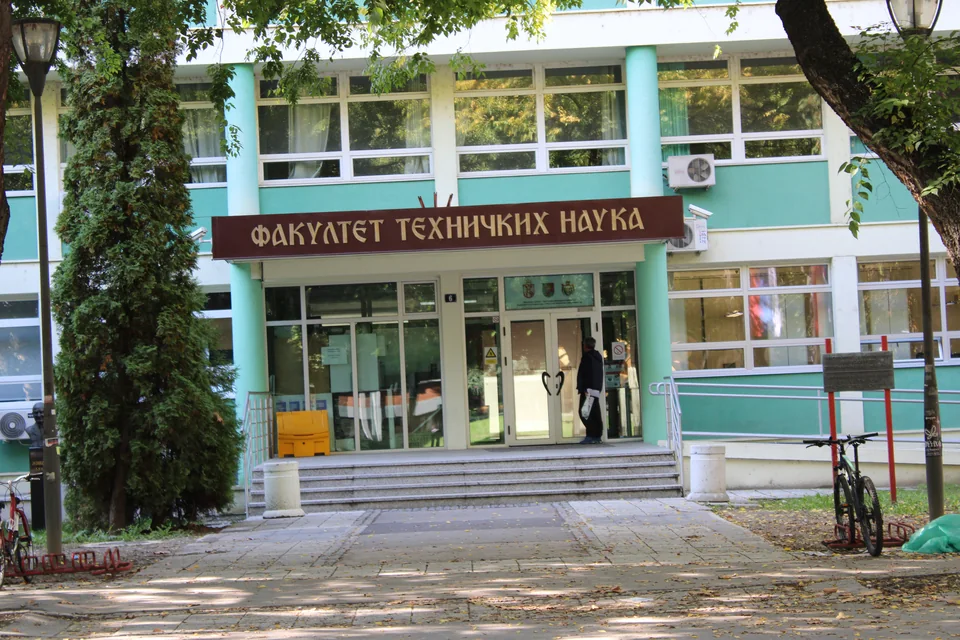
| Faculty of Technical Sciences, all master's programmes (2026/27) | Serbian | $3,410 (€3,000) |
| Faculty of Technical Sciences, same programmes in English (+50%) | English | $5,120 (€4,500) |
| Faculty of Sciences, Computer Science, Artificial Intelligence, Data Science (2026/27) | Serbian | $2,840 (€2,500) |
| Faculty of Sciences, Chemistry, Biology, Biochemistry (2026/27) | Serbian | $3,980 (€3,500) |
| Faculty of Sciences, Mathematics, Applied Mathematics (2026/27) | Serbian | $2,270 (€2,000) |
Novi Sad's English offer is broader than it looks: the Faculty of Technical Sciences has accredited all its programmes in English, the Faculty of Economics in Subotica teaches Advanced Data Analytics in Business, and the Faculty of Sciences teaches Applied Mathematics: Data Science and Artificial Intelligence. See the profiles of the University of Belgrade and the University of Novi Sad.
These are tuition fees only; application and enrolment fees, recognition, housing and insurance are extra. City living costs are in the cost of studying in Serbia.
English or Serbian?
| Criterion | English-taught | Serbian-taught |
|---|---|---|
| Choice | narrower; mostly engineering, IT, economics and sciences | almost every field |
| Language requirement | English certificate as set by the programme | Serbian certificate; Novi Sad's Faculty of Sciences, for example, accepts the test of the Centre for Serbian as a Foreign Language at its Faculty of Philosophy |
| Price | often higher: +50% at the Faculty of Technical Sciences; $10,230 (€9,000) vs $2,840 (€2,500) at Belgrade's School of Electrical Engineering | lower |
| Start | straight after your bachelor's | usually after six months to a year of language study |
| Working in Serbia later | Serbian still helps | language already in place |
University language centres teach Serbian. In Belgrade an intensive semester costs $682 (€600) and the certificate exam $171 (€150). In Novi Sad a semester course at A1–B2 costs $256–292 (RSD 26,400–30,200), depending on the semester. The call states the required level.
How to apply
Each faculty publishes its own call (konkurs za upis). The general sequence:
- Pick a programme and read the call: places, fees, criteria and dates. At the Faculty of Technical Sciences a committee first checks whether your bachelor's fits the chosen master's; the evaluation fee is not refunded if it does not.
- Have your degree recognised by the university. For further study, foreign degrees are recognised by the university, not the Qualifications Agency. Belgrade asks for two copies of the request, two copies of the diploma and supplement certified by a notary in Serbia, two translations by a Serbian court interpreter and the fee receipts. Novi Sad takes applications through its online portal priznavanje.uns.ac.rs and the paper documents before the decision is collected.
- Prove the language: Serbian for Serbian-taught programmes, English for English-taught ones.
- Apply to the call with proof that recognition has started. Foreign applicants are admitted on the same terms as Serbians, on the basis of recognised documents.
- Selection. Many programmes rank by GPA and length of previous study. Entrance exams are held only for some programmes; at the Faculty of Technical Sciences, for example, only for scenic architecture.
- Enrol and pay. Before enrolment Novi Sad's Faculty of Sciences requires the recognition decision, health insurance for the academic year and proof of Serbian.
The usual file: application, diploma and supplement with translations, recognition proof, language certificate, passport and fee receipts. International and joint programmes may ask for a motivation letter, CV and references; their calls say so.
When to apply
Master's admissions run in autumn, after Serbian bachelor's graduates receive their degrees. Novi Sad's Faculty of Sciences for 2026/27:
| Stage | First round | Second round | Third round |
|---|---|---|---|
| Applications | 23 September – 6 October 2026 | 22–23 October | 5 November |
| Final ranking | 14 October | by 30 October | 12 November |
| Enrolment, self-funded | 19 October | 3 November | 13 November |
At the Faculty of Technical Sciences, online applications for candidates whose degree first needed evaluation ran 14–23 September 2026, and until 28 September for the faculty's own graduates.
The University of Belgrade's joint 2026/27 call set the first round for 1 September–5 October, enrolment by 15 October and a second round on 19–20 October; a third round runs only for programmes with places left. One rule in that call matters for international applicants: recognition of a foreign degree must be started at least 15 days before the chosen faculty's application deadline, otherwise you can only compete the following year. Degree recognition takes time, so start it in spring or early summer.
Scholarships and free study
State-funded master's places are primarily for Serbian citizens; foreign students normally pay tuition unless an international agreement provides otherwise. Options for foreigners:
- Bilateral scholarships. The Ministry of Education runs an annual call for citizens of partner countries. For 2026/27 Russia has 30 scholarships covering bachelor's, master's and doctoral study and training; other countries mostly get shorter research or training stays. The scholarship covers tuition, dormitory housing and meals, basic health insurance, a free residence visa and free recognition of documents, plus $145 (RSD 15,000) a month. You cannot apply directly to Serbia: the competent authority of your own country nominates candidates, and renewal for the next year goes through the same channel.
- "World in Serbia" (Svet u Srbiji): a government scholarship for the full course at public universities for citizens of Non-Aligned Movement member and observer states in Africa, Asia and Central and South America; teaching is in Serbian after a free language course.
- CEEPUS: exchanges among Central and Eastern European member countries.
More in free education in Serbia.
Residence and work
You need temporary residence on the basis of study for the programme's length. Visa-free nationals (for example Russian citizens, for 30 days) apply in Serbia or online; visa nationals first obtain a visa D. See student residence permit in Serbia.
This residence lets you work without a separate permit. The law caps work during teaching periods at 20 hours a week, while the government's Welcome to Serbia portal says 16; stay within the lower figure.
Who a Serbian master's suits
| Good fit if | Consider alternatives if |
|---|---|
| you want a Bologna-system European degree for about $2,000–5,000 a year | you need an English-taught humanities programme: the choice is narrow |
| you are ready to learn Serbian, or you chose IT, engineering or economics in English | you need a fast start without degree recognition and language certificates |
| affordable living and a Slavic-language environment matter to you | your goal is a regulated profession in the EU: Serbia is not an EU member, so there is no automatic recognition |
| you plan research and a doctorate | you want a fully online format |
Common mistakes
- Starting degree recognition after the call opens. Calls last two to three weeks; without recognition or proof of it your application is incomplete.
- Choosing a Serbian-taught programme without a certificate. You will not be enrolled.
- Assuming English and Serbian versions cost the same. English can be 50% dearer, or several times dearer as at Belgrade's School of Electrical Engineering.
- Not checking programme fit. The committee may find your bachelor's unsuitable, and evaluation fees are not refunded.
- Relying on last year's prices. Fee tables are updated annually.
- Applying for a bilateral scholarship directly in Serbia. Candidates are nominated by their home-country authority, and renewal is requested again each year.
FAQ
Yes. The university you apply to recognises it: you submit the diploma, supplement and translations and pay the recognition fee and state fee. The faculty committee checks whether your field fits the programme.
About $1,650–10,230 (€1,450–9,000) a year at public universities; most Serbian-taught programmes in Belgrade and Novi Sad cost $2,270–4,550 (€2,000–4,000). Add recognition: about $463 in Belgrade including the state fee.
Yes. The University of Belgrade offers about 100 English-taught programmes across all levels, and all programmes of Novi Sad's Faculty of Technical Sciences are accredited in English. Engineering, IT, economics and sciences have the most options.
One year (60 ECTS) after a four-year bachelor's, two years (120 ECTS) after a three-year one; some programmes are 90 ECTS (three semesters).
Calls open in September; the main round closes in early October, with extra rounds in late October and November. Start degree recognition in spring.
Foreign students usually pay. Citizens of partner countries can be nominated for a Ministry of Education bilateral scholarship (Russia has 30 for 2026/27, through its own competent authority); "World in Serbia" is for Non-Aligned Movement countries in Asia, Africa and Latin America.
Most programmes select by GPA and length of previous study. Exams are held by some programmes, mainly in creative fields and architecture.
Sources
- University of Belgrade, tuition fees 2025/26 — https://www.bg.ac.rs/wp-content/uploads/2025/12/skolarine-tabela-2025-26.pdf
- University of Belgrade, recognition for further study — https://www.bg.ac.rs/recognition/
- University of Belgrade, joint 2026/27 master's call (dates, 15-day recognition rule) — https://www.bg.ac.rs/wp-content/uploads/2026/05/MAS-konkurs_opsti26.pdf
- University of Belgrade, facts and figures — https://www.bg.ac.rs/fact-and-figures/
- University of Novi Sad, English-taught programmes; recognition of foreign degrees — https://www.uns.ac.rs/index.php/en/studies/study-programs/study-program-in-english-language, https://www.uns.ac.rs/index.php/en/studies/recognition-of-diplomas/recognition-of-foreign-diplomas
- University of Novi Sad, 2026/27 call for master's, specialist and doctoral study (Faculty of Technical Sciences fees and dates) — https://www.uns.ac.rs/images/doc/upis/msd/01/konkurs_msd.pdf
- Faculty of Sciences Novi Sad, master's call 2026/27 — https://www.pmf.uns.ac.rs/wp-content/uploads/upis/konkurs-msc-1-rok.pdf
- Welcome to Serbia portal: scholarships; right to work — https://welcometoserbia.gov.rs/scholarships, https://welcometoserbia.gov.rs/right-to-work-and-income-tax
- Serbian language centres in Belgrade and Novi Sad — https://learnserbian.fil.bg.ac.rs/admissions.php?id=d, https://srpski-strani.com/organizacijanastave_eng.php
- Law on Employment of Foreigners (Articles 3, 17) — https://www.paragraf.rs/propisi/zakon_o_zaposljavanju_stranaca.html
Prices converted at the ECB rate of 24.09.2026 (€1 = $1.1367) and the National Bank of Serbia middle rate on the same date (€1 = RSD 117.4420).
Programme shortlisting, document preparation and application support are provided under an agreement with StudyU. Degree recognition and admission are decided by the university.
During the free initial consultation, we clarify your goal, profile, timing, and budget and identify the next realistic step.
Next steps
- University of Belgrade (Univerzitet u Beogradu)
- University of Novi Sad (Univerzitet u Novom Sadu)
- Cost of Studying in Serbia for International Students in 2026/27: Tuition, Living Costs and First-Year Budget
- Free Education in Serbia for International Students: Who Qualifies and How to Get a Scholarship
- Student Residence Permit in Serbia: How to Get Temporary Residence for Study
- Studying Medicine in Serbia: Faculties, Fees and Admission for International Students
