
Non-EU students in Ireland choose between seven traditional universities, five technological universities and a handful of specialist state colleges. In 2026/27 a year of an undergraduate degree at a traditional university costs from $21,050 (€18,500) for Arts at University College Cork to $33,640 (€29,570) for engineering or computer science at Trinity College Dublin, and medicine starts at $59,280 (€52,100). International applicants apply directly to each university rather than through the CAO, and entry rules for a Russian or Kazakh school certificate differ sharply between institutions.
This guide explains the three types of institution, compares fees and school-leaver requirements at the largest universities, shows what Dublin living costs look like against the regions, and gives a decision table. Figures come from official university and government pages; USD conversions use the ECB reference rate of 28 September 2026 (€1 = $1.1378), rounded to the nearest ten. For a country overview, see studying in Ireland.
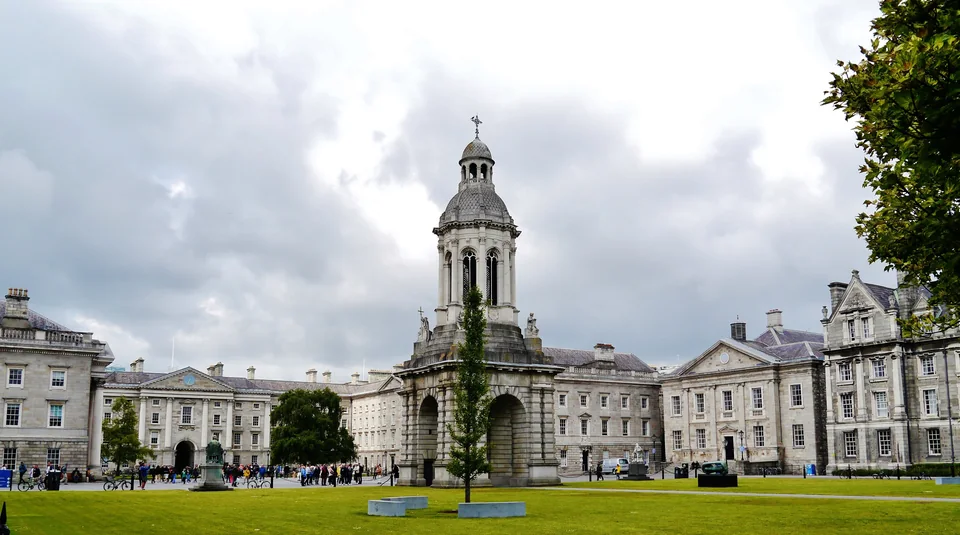
The three types of higher education institution
The Higher Education Authority (HEA) publishes the list of institutions that receive core public funding. For an international applicant they fall into three groups.
| Type | Institutions | Strengths | Best fit |
|---|---|---|---|
| Traditional universities | Trinity College Dublin (TCD), University College Dublin (UCD), University College Cork (UCC), University of Galway, University of Limerick (UL), Dublin City University (DCU), Maynooth University | research, broad bachelor's and master's portfolios, PhDs | students who want an academic degree, research or a widely known brand |
| Technological universities (TUs) | Technological University Dublin, Munster Technological University, Atlantic Technological University, South East Technological University, Technological University of the Shannon | applied programmes in engineering, IT and business, links with regional employers | students who value practical training and lower fees |
| Specialist colleges and institutes of technology | RCSI University of Medicine and Health Sciences, National College of Art & Design, Mary Immaculate College, Dundalk Institute of Technology, IADT | medicine and health, art and design, teacher education, media, applied programmes (DkIT) | applicants with a narrow professional goal |
The TUs grew out of the former institutes of technology. The HEA now keeps names such as Dublin Institute of Technology, Cork Institute of Technology and Waterford IT in an archived list, so if an older guide mentions them, look for the programme on the relevant TU website instead.
Private colleges with programmes validated by Quality and Qualifications Ireland (QQI) also recruit international students. For immigration purposes the question is not whether a college is public or private but whether the programme appears on the Interim List of Eligible Programmes (ILEP). Stamp 2 student permission is only granted to people enrolled on a full-time, daytime ILEP programme.
How Irish degrees are structured: NFQ levels
Irish awards sit on the National Framework of Qualifications (NFQ). The level matters for further study and for how long you can stay after graduating.
| NFQ level | Award | Typical full-time length |
|---|---|---|
| 7 | Ordinary Bachelor Degree | 3 years |
| 8 | Honours Bachelor Degree, Higher Diploma | 3–4 years for a bachelor's |
| 9 | Master's Degree, Postgraduate Diploma | 1 year for most taught master's |
| 10 | Doctoral Degree (PhD) | 3–4 years |
Immigration Service Delivery (ISD) ties the post-study period to these levels. A level 8 graduate gets 12 months under the Third Level Graduate Programme, while master's and PhD graduates (levels 9 and 10) first receive 12 months and may then renew for another year. See working while studying and Stamp 1G for the conditions.
The largest universities: 2026/27 fees and school-leaver entry
Fees depend on the faculty as much as on the university. Each university sets fee status itself; TCD, for example, states that it normally treats applicants from Russia as non-EU on residency rather than nationality.
| University, city | Arts, law | Business | Computer science, engineering, science | Russian school certificate |
|---|---|---|---|---|
| Trinity College Dublin, Dublin | $25,690 (€22,580) | $25,690 (€22,580) | $33,640 (€29,570) | not accepted for direct entry: A levels, IB or a US diploma with SAT/ACT, or the International Foundation Programme (attestat average of 4.0 or higher) |
| University College Dublin, Dublin | $25,710 (€22,600) | $26,360 (€23,170), Commerce | $33,570 (€29,500) | attestat plus Unified State Exam (USE/EGE) with higher-level maths: from a 58% four-subject average for Arts to 86% for Commerce, Law, Computer Science and Engineering |
| University College Cork, Cork | $21,050 (€18,500), Arts | $24,690 (€21,700), Commerce and Law | $30,720 (€27,000) | attestat plus USE: three programme bands with thresholds of 60%, 80% and 95% (Russian, maths, best optional subject) |
| University of Galway, Galway | $22,060 (€19,390) | $22,060 (€19,390), Commerce | $31,450 (€27,640) | attestat plus USE: thresholds from 58% to 96% depending on the programme band |
| TU Dublin, Dublin | — | — | level 7: $14,220 (€12,500); level 6: $13,260 (€11,650) | see the programme page |
Reading the table:
- Fees are for the first year. TCD and University of Galway note that fees for continuing students can rise each year, while UCD keeps a non-EU multi-year student on the rate of their entry year.
- Some mandatory charges sit on top. UCC adds a capitation fee of $240 (€210) a year; UCD's published fees already include its Student Centre levy, and a €5 national students' union levy is charged separately.
- Medicine is in a different bracket: $59,280 (€52,100) at UCC, $62,580 (€55,000) at University of Galway and up to $68,270 (€60,000) at TCD.
- TU Dublin publishes level 8 fees in its undergraduate brochure. As an acceptance deposit it asks for 50% of the annual fee or €6,000, whichever is greater.
Detailed profiles: Trinity College Dublin, University College Dublin, TU Dublin, University College Cork, University of Galway, Dublin City University and Maynooth University.
How the USE thresholds at UCD, University of Galway and UCC work
UCD and University of Galway publish Russia-specific requirements based on the average USE result across four subjects that must include higher-level maths. University of Galway also expects at least six subjects across the attestat and the USE combined.
| Average USE score across 4 subjects | Examples of UCD programmes for 2027 entry |
|---|---|
| 58% | BA Arts, English, History, Music |
| 76% | Economics, Philosophy Politics & Economics, Social Sciences |
| 86% | Commerce, Law, Computer Science, Engineering, Science, Architecture |
| 96% | Psychology, Human Nutrition |
| 97% plus a first university year at 8/10 or above | Actuarial and Financial Studies |
University of Galway sorts its programmes into five bands with thresholds of 58%, 67%, 76%, 86% and 96%. A threshold is the minimum for consideration, not a guaranteed offer. For Kazakhstan, UCD lists entry with the Unified National Test (UNT) and with the Nazarbayev Intellectual Schools diploma.
UCC uses its own formula: the average of Russian, maths and the best optional USE subject, plus a grade in one more attestat subject. The least competitive band needs 60% and a grade 3, the middle band 80% and a grade 4, and the most competitive band a 95% average in Russian and maths, 86% in the optional subject and a grade 5.
Applicants without the USE, or below the threshold, can look at pathway programmes: TCD runs an International Foundation Programme, UCD an International Foundation Year, UCC lists an International Foundation Year for international students, and University of Galway offers pre-sessional and pre-master's courses. The routes are covered in the guide to applying to Irish universities.
Rankings: useful for a first filter only
A global ranking can narrow a list, but it says little about a specific department, and positions change every year. University College Cork, for example, rose to 220th in the QS World University Rankings 2027 from 246th a year earlier, and UCD's international pages describe it as a top-100 university.
Three checks tell you more: whether the programme is on the ILEP, which modules are compulsory, and which NFQ level the award sits at. The level decides whether you get 12 or 24 months to look for work after graduating.
Dublin or the regions: where living costs differ
In Ireland, rent and daily costs in Dublin often weigh more than tuition. UCD estimates a student's monthly spending in Dublin at $1,970 (€1,735) at the low end, $2,780 (€2,445) at the median and $4,590 (€4,035) at the high end, excluding tuition (figures updated April 2026). TCD budgets $22,680–33,050 (€19,937–29,050) a year for undergraduate living costs, including accommodation, insurance and the immigration fee.
A place in TCD's Trinity Hall costs $8,220 (€7,227) for the academic year from September to June, and a room in Kavanagh Court $14,050 (€12,350). TCD prioritises first-year non-EU undergraduates for its own or recommended accommodation if they apply before the housing deadline.
Cork, Galway and Limerick are generally cheaper than the capital, but there is no single official city-by-city comparison. Use each university's own estimate together with current rental listings in the city. The full budget is in the cost of studying in Ireland.
The visa minimum of $11,380 (€10,000) for the first year covers only part of a Dublin budget. It is an immigration threshold, not an estimate of real spending.
How international applications work
For applicants on non-EU fees the rule is the same everywhere: you apply directly through the university's own portal. UCD notes that applicants assessed for EU fees are admitted through the Central Applications Office (CAO).
| Step | What happens | Example from official sources |
|---|---|---|
| Application fee | Each application is paid | TCD $63 (€55) per course; UCC $57 (€50) for up to two programmes; UCD graduate applications $80 (€70) |
| Deadlines | Set by each university | UCC accepted 2026 undergraduate applications until 31 May 2026, with competitive programmes closing earlier |
| Offer | Conditional or full | UCC states that a conditional offer cannot be used for a visa |
| Deposit | Often non-refundable | UCC requires a non-refundable deposit on acceptance; TU Dublin asks for 50% or €6,000 |
| Visa | After payment | Before applying you must pay the full fee if it is under €6,000, or at least €6,000 |
Visa steps are covered in the Ireland student visa and Stamp 2 guide. Russian citizens lodge applications at VFS Global centres, which forward them to the Embassy of Ireland in Moscow.
Choosing a university by profile
| Your situation | Where to start | What to check first |
|---|---|---|
| School leaver with a USE average of 86% or higher including higher maths | UCD, University of Galway, UCC | programme threshold and English requirement |
| School leaver with a weak or no USE result | TCD or UCD foundation, TU programmes | cost of the foundation year and the progression guarantee |
| Engineering or IT on a tighter budget | UCC, University of Galway, technological universities | faculty fee, placements, local rent |
| One-year master's | TCD, UCD, UCC, University of Galway, DCU | 2:1 equivalence of your degree, programme fee, NFQ level 9 |
| Medicine | UCC, University of Galway, TCD, RCSI | application channel: UCC takes medicine applications only through designated agents |
For postgraduate study see master's degrees in Ireland; for funding see scholarships in Ireland.
Common mistakes
- Comparing "average fees in Ireland". Within one university the gap between faculties can approach $8,000 a year: at TCD, law costs €22,580 and engineering €29,570.
- Choosing a programme that is not on the ILEP. No ILEP listing means no Stamp 2 and no study visa.
- Planning to use the CAO. Non-EU fee payers apply directly.
- Getting confused by old names. The HEA lists University of Galway, while ISD's Stamp 1G page still says National University of Ireland Galway (NUIG); the former institutes of technology are archived by the HEA.
- Budgeting only to the €10,000 visa minimum. UCD's Dublin median is €2,445 a month.
- Mixing up levels 7 and 8. The Third Level Graduate Programme is designed for level 8 and level 9 awards, not for an Ordinary Bachelor at level 7.
Next step
Shortlist three to five programmes and note for each the NFQ level, ILEP status, entry requirement for your school certificate or degree, the 2026/27 non-EU fee and the deadline. Then build a budget that includes accommodation and check that your first payment meets the €6,000 pre-visa rule. If paying from Russia, plan the transfer early using only legal routes; see how to pay for studies abroad from Russia.
FAQ
The HEA list includes seven traditional universities (TCD, UCD, UCC, University of Galway, University of Limerick, DCU and Maynooth) and five technological universities (TU Dublin, MTU, ATU, SETU and TUS). RCSI, NCAD, Mary Immaculate College and other colleges also award degrees.
It depends on the university. UCD, University of Galway and UCC publish USE thresholds for Russian school leavers, whereas TCD does not accept the attestat for direct entry and points applicants to its International Foundation Programme.
A common university minimum is IELTS Academic 6.5 with no band below 6.0, as stated by UCD and University of Galway; UCD also accepts TOEFL iBT 90. The immigration minimum for degree courses is lower, IELTS 5.0, but it will not get you an offer.
Not for non-EU fee payers at public institutions. University scholarships can reduce the fee, for example UCD's Global Excellence awards of 50% or 100% of tuition. The national GOI-IES scholarship excludes Russian and Belarusian nationals.
Usually. TU Dublin charges €12,500 for a level 7 year, whereas engineering at traditional universities costs €27,000–29,570. Part of the gap reflects the level of the award, so compare programmes at the same NFQ level.
NARIC Ireland, hosted by QQI, provides free online comparability statements that map foreign qualifications to NFQ levels. These are advisory; the admissions office makes the final decision. If you plan to use the Irish degree back home, check the recognition procedure with the authority responsible for your purpose there.
Sources
- HEA: list of higher education institutions — checked September 28, 2026
- ISD: FAQs for students (ILEP, Stamp 2, work, 7-year limit) — checked September 28, 2026
- ISD: Third Level Graduate Programme — checked September 28, 2026
- ISD: student finances and long-term study visa — checked September 28, 2026
- Embassy of Ireland, Moscow: visas and application centres — checked September 28, 2026
- Trinity College Dublin: undergraduate fees, requirements for Russia and cost of living — checked September 28, 2026
- UCD: non-EU fees 2026/27, requirements for Russia, for Kazakhstan, English requirements and living costs — checked September 28, 2026
- UCC: undergraduate fees 2026/27, non-EU applications, entry requirements for Russia and rankings — checked September 28, 2026
- University of Galway: fees and requirements for Russia — checked September 28, 2026
- TU Dublin: international fees — checked September 28, 2026
- HEA: GOI-IES scholarship — checked September 28, 2026
- QQI: NARIC Ireland, recognition of foreign qualifications — checked September 28, 2026
- USD conversions use the ECB reference rate of September 28, 2026: €1 = $1.1378.
Shortlisting programmes, checks of institution-specific requirements, document preparation and application submission are provided under an agreement with StudyU. Admission decisions are made by the university; visa decisions by Irish immigration authorities.
Next steps
- Working While Studying in Ireland and Stamp 1G: Hours, Pay and Staying After Graduation
- University College Cork (UCC): Admission, Fees and Life in Cork
- University of Galway (formerly NUI Galway): Admission, Fees and Housing
- Dublin City University (DCU): Admission, Fees and Housing in Dublin
- Studying in Ireland for international applicants
- Trinity College Dublin
