
University of Galway admits international school leavers directly into year one when their national exams meet the published threshold. For Russian applicants that means the Unified State Exam (USE/EGE): an average of 58% across four exams including higher-level maths opens the least competitive programmes, while medicine needs 96%. Applications from outside the EU go straight to the university, not through the CAO; the portal for September 2027 opens on 1 October 2026 and the fee is €35. Non-EU tuition for 2026/27 ranges from $22,060 (€19,390) a year for business, law and most arts degrees to $31,450 (€27,640) for computer science and engineering, with medicine at $62,580 (€55,000). Visa-required students also need to show $11,380 (€10,000) for first-year living costs.
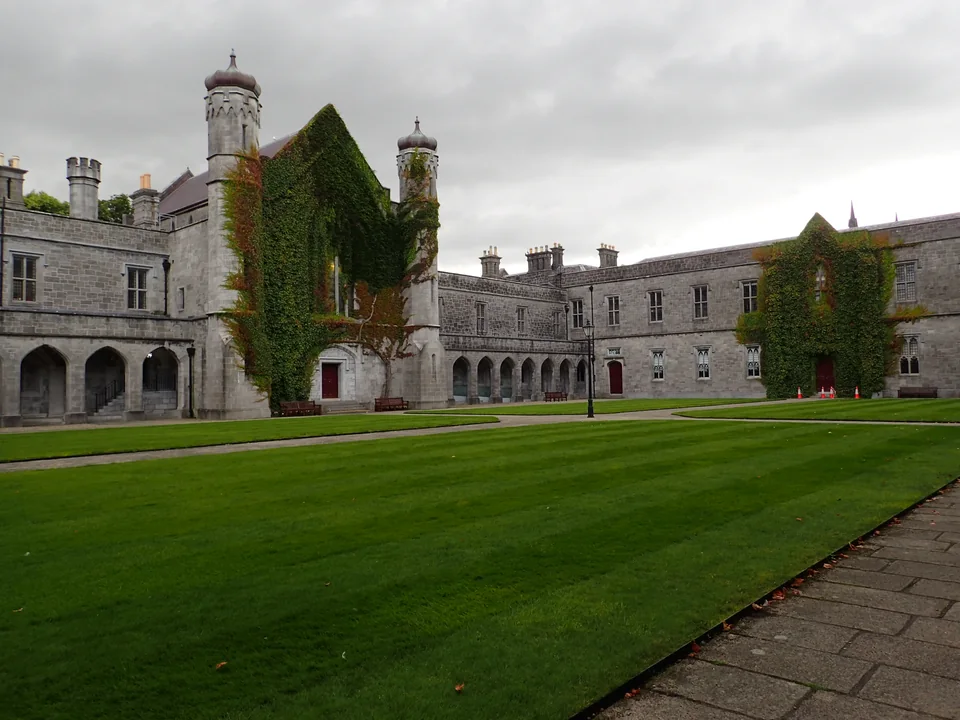
NUI Galway, NUIG and University of Galway are the same institution: the governing authority approved the new name in 2022. The old name still appears in some official lists, including the immigration service's Stamp 1G page.
| At a glance | Details |
|---|---|
| Location | Galway city on Ireland's west coast; Shannon College of Hotel Management is a separate campus near Shannon Airport |
| Founded | 1845, originally named Queen's College Galway |
| Students | over 19,000 from 110 countries (university figures) |
| Rankings | QS World University Rankings 2027: 275th; THE World University Rankings 2026: 351–400 |
| Russian school certificate | accepted with the USE; 58–96% average across four exams including higher maths, depending on the programme band |
| Applying for 2027 | direct online application from 1 October 2026; decisions usually within 4–6 weeks |
| English | IELTS Academic 6.5 with no band below 6.0; some programmes ask for more |
| Non-EU tuition, 2026/27 | undergraduate $17,800–62,580 (€15,640–55,000); most taught master's $23,370–32,590 (€20,540–28,640) |
| On-campus housing | $3,770–9,200 (€3,316–8,086) per academic year, utilities extra |
| After graduation | Stamp 1G: 12 months after an honours bachelor's, up to 24 months after a master's |
Who Galway suits, and where it is strongest
University of Galway is a research-led public university set along the River Corrib. It makes most sense for students who want an Irish degree at a lower price than Trinity or UCD and are happy to live outside Dublin.
In the QS subject rankings published in March 2026, Galway placed in the world top 100 for hospitality, nursing, and English language and literature, in the top 150 for performing arts, and in the top 200 for law and modern languages. The university also describes Galway as a global medtech hub, and its engineering school offers a dedicated biomedical engineering degree.
It is a weaker fit if:
- you specifically want to live and study in Dublin — compare the capital's universities instead;
- your national exams are below the lowest band — you would start with a foundation year, which changes the cost and timeline;
- you are aiming for medicine without top results — the Russian threshold is 96%, and medicine applications go to the School of Medicine rather than the international office.
For a wider comparison, see our guide to universities in Ireland and the Study in Ireland overview.
Entry from a Russian school: USE thresholds by programme band
Galway publishes country-specific requirements. Russian applicants need the attestat plus the USE certificate, with at least six subjects between them. The threshold is the average USE score across four exams, one of which must be higher-level (profile) maths. Every programme sits in one of five competitiveness bands.
| Band | USE average across 4 exams | Examples from the 2025–2026 band list |
|---|---|---|
| I | 58% | BA Joint Honours, History, Music, Arts with Human Rights, Government (Politics, Economics and Law), Social Sciences |
| II | 67% | Commerce, Law (BCL) and its combinations, BSc Science, Physics, Marine Science, Undenominated Engineering, Journalism, Global Media |
| III | 76% | Computer Science and IT, Financial Mathematics and Economics, Genetics, Biotechnology, Accounting, Nursing, named engineering degrees |
| IV | 86% | Psychology, Biomedical Science, Biomedical Engineering, Speech and Language Therapy, Occupational Therapy, Commerce (Global Experience) |
| V | 96% | Medicine (MB BCh BAO) |
Points to keep in mind:
- A threshold is a floor, not an offer. Some programmes add subject requirements, such as a higher maths level or a second language, listed in the university's banding and subject-requirement documents.
- Bands are reviewed. The list available at the time of checking covers 2025–2026; confirm your programme's band for 2027 entry before applying.
- What you upload: certified or original copies of school results (or current grades if you are still at school) with English translations, your passport, a personal statement of up to 800 words, and two references, ideally from a teacher or guidance counsellor. You can instead give your referees' emails and the university will contact them.
Applicants from Kazakhstan and other countries should use their own country page in the Your Country section; each national qualification has its own table.
No USE, or scores below 58%? The university lists three recognised foundation routes:
- the University Foundation Programme at Shannon College of Hotel Management, September to May 2027, $15,590 (€13,700);
- the NCUK International Foundation Year at Dublin International Foundation College, starting in September or January;
- OnCampus Ireland foundation programmes for medicine and medicine-related degrees.
Our guide to applying to Irish universities compares these routes with other Irish options.
How to apply for an undergraduate place in 2027
Non-EU applicants with non-EU qualifications apply on the Apply to University of Galway portal. Decisions are made on a rolling basis throughout the year, so applying early matters.
| Step | Timing |
|---|---|
| Choose one or two programmes and check the band and subject rules | September 2026 |
| Take IELTS or another accepted test (valid for two years) | before or shortly after applying |
| Non-EU portal opens for September 2027 | 1 October 2026 |
| Submit the application ($40 / €35 covers up to two programmes) | October 2026 to spring 2027, the earlier the better |
| Decision | usually 4–6 weeks after a complete application |
| Apply for on-campus housing | spring 2027, once you hold an offer |
| Study visa | the university warns it can take 6–12 weeks |
- Create an account and complete the form; one fee covers two programme choices.
- Upload documents: translated results, passport, personal statement, references and your English score.
- Receive a decision. School students get a conditional offer that becomes final once final results arrive.
- Accept and pay. The visa application needs proof of fee payment, so this step comes first.
- Apply for the visa and for housing in parallel.
The university warns that applications can close at short notice when a programme fills, and it does not publish a single international closing date. Aim for winter rather than summer.
English language requirements
The standard requirement for both undergraduate and postgraduate study is IELTS Academic 6.5 with no band below 6.0 (IELTS Online is accepted). Some programmes set higher bars:
| Programmes | IELTS requirement |
|---|---|
| Most Arts, Business, Law, Science and Engineering degrees | 6.5, no band below 6.0 |
| Medicine, first year | 6.5, no band below 6.5 |
| Nursing and midwifery | 7.0, no band below 6.5 |
| MSc Computer Science (AI, Data Analytics, Adaptive Cybersecurity), Software Design & Development, Biomedical Science and some others | 6.5, writing at least 6.5 |
| MA in Journalism, English, Global Media and similar | 7.5, no band below 7.0 |
Equivalents at the 6.5 level include TOEFL iBT 88 on the legacy scale, or 4.5 on the new scale for tests taken from 21 January 2026; PTE Academic 63 with at least 59 in each skill; Cambridge C1 Advanced or C2 Proficiency 176 with at least 169 per skill; and LanguageCert Academic 70. Scores are valid for two years. When sending TOEFL scores, use the university's code 8861. Completing the university's own Pre-Sessional or Pre-Masters programme with at least 70% overall (65% per module) also meets the requirement.
Tuition fees for 2026/27
Figures are the university's published non-EU fees for one academic year.
Undergraduate
| Programmes | Annual fee |
|---|---|
| Commerce (including Accounting and International), Law (BCL), BA Joint Honours, History, Business Information Systems | $22,060 (€19,390) |
| BSc Psychology | $22,630 (€19,890) |
| Journalism, Global Media, Global Languages, Government, English and Creative Writing, Film and Digital Media | $23,770 (€20,890) |
| Music | $24,620 (€21,640) |
| Computer Science and IT, all BE+ME engineering degrees, BSc Science, Physics, Genetics, Biotechnology, Financial Mathematics | $31,450 (€27,640) |
| Nursing and midwifery | $32,020 (€28,140) |
| Speech and Language Therapy, Occupational Therapy, Podiatric Medicine | $32,250 (€28,340) |
| Medicine | $62,580 (€55,000) |
| Hotel management at Shannon College | $17,800 (€15,640) |
Postgraduate
| Programme | Annual fee |
|---|---|
| MSc Business Analytics, Corporate Finance, Human Resource Management, International Management | $24,620 (€21,640) |
| MSc Digital Marketing, Fintech, Marketing Management | $23,770 (€20,890) |
| Most LLMs, MSc Health Economics | $23,370 (€20,540) |
| MBA | $20,820 (€18,300) |
| MSc Computer Science (AI, Data Analytics, Adaptive Cybersecurity), ME and MSc engineering, MSc Biomedical Science | $32,590 (€28,640) |
| MSc/HDip Software Design & Development (conversion for non-computing graduates) | $20,980 (€18,440) |
| PhD and research master's, arts and business | $16,500 (€14,500) |
| PhD and research master's, science and engineering | $17,070 (€15,000) |
Budgeting notes:
- Fees rise for continuing students. Approved inflationary increases were 5% for 2024/25 and 3.4% for 2025/26; continuing postgraduate years rise by 1.8% in 2026/27.
- Visa refusal. Fees paid are refunded minus a $220 (€190) administration charge within 60 days of formal withdrawal, with written confirmation of the refusal from the visa office.
- Repeating a year costs non-EU students $5,850 (€5,140) in 2026/27.
- Payment deadline. Registration can be cancelled if all fees are not paid by 31 January 2027.
- Taught master's deposit: usually $570 (€500), sometimes $1,140 (€1,000), deducted from the fee and non-refundable if you do not take up the place, unless you failed to meet the offer conditions.
Our cost of studying in Ireland guide compares Galway with Dublin, Cork and Limerick; payment routes from Russia are covered in how to pay for studies abroad from Russia.
Scholarships for international students
Galway's Global Scholarships programme is aimed at non-EU students; the university reports more than 280 awards last year. Awards are partial fee waivers, and each college sets its own amounts:
| School | Undergraduate | Taught master's |
|---|---|---|
| J.E. Cairnes School of Business and Economics | $5,690 (€5,000) for all first-year students | up to 50% of tuition for one student per programme |
| School of Law | $5,690 (€5,000) for all first-year students | up to 50% of tuition for high achievers |
| School of Computer Science | $5,690 (€5,000) a year for all admitted; three $11,380 (€10,000) awards a year | $2,280–5,690 (€2,000–5,000) for all admitted; three $11,380 (€10,000) awards per programme |
| School of Engineering | one $11,380 (€10,000) award a year across all programmes | $2,280 (€2,000) for all admitted; one $11,380 (€10,000) award |
| Biological & Chemical Sciences; Natural Sciences | $5,690 (€5,000) a year for all admitted; one $11,380 (€10,000) award each | $2,280–5,690 (€2,000–5,000) depending on programme |
Terms that affect your budget:
- One award per student. If you receive two, the university usually withdraws the smaller one.
- Pay half first. Scholarship holders must pay 50% of the full fee before registration; the waiver is applied afterwards.
- No deferral. An award is valid only for the intake it was offered for; multi-year awards continue if you progress each year.
- Region-based extras of $17,070–22,760 (€15,000–20,000) spread over a business or law degree are limited to citizens of India, China, Vietnam, Brazil, Mexico, Thailand, Uganda and Turkey. The CSC joint PhD scheme is for Chinese passport holders only.
- Government of Ireland International Education Scholarships (GOI-IES) exclude citizens of Russia and Belarus, according to the Higher Education Authority; other applicants need an offer for a master's or PhD programme.
See scholarships in Ireland for national and research funding.
Master's and PhD
Degree grades. For Russian bachelor's or specialist diplomas, Galway maps a GPA of 3.8/5 to an Irish 2:2, 4.2 to a 2:1 and 4.6 to a First. Many master's programmes ask for a 2:1; the programme page states the exact minimum.
Applying. Postgraduate applications are online, with a non-refundable $40 (€35) fee (higher for certain teacher-education programmes). Each programme has its own dates and offers are made in rounds, so apply to popular computing and analytics MSc programmes in autumn or winter.
Research degrees. Contact potential supervisors before applying: the university advises approaching the relevant institute or centre and using its Find a Supervisor portal. The supervisor reviews and approves the proposal, then you submit the online application.
A one-year taught master's is NFQ level 9 and leads to up to 24 months on Stamp 1G. More detail on grade conversion and master's routes is in master's in Ireland.
Housing: campus villages and private rentals
Three on-campus villages — Corrib Village, Goldcrest Village and Dunlin Village — house almost 1,900 students. They are open only to University of Galway students, with priority for new entrants. International undergraduates with an offer can apply for all three; new postgraduates can apply for Corrib and Dunlin.
| Option (2026/27) | Monthly payment × 9 | Academic year |
|---|---|---|
| Corrib Village, basic twin room | $420 (€368.45) | $3,770 (€3,316) |
| Corrib Village, basic single room | $580 (€509.89) | $5,220 (€4,589) |
| Goldcrest or Dunlin, single ensuite | $850 (€746.80) | $7,650 (€6,721) |
| Goldcrest or Dunlin, double-bed ensuite | $890 (€777.80) | $7,960 (€7,000) |
| Dunlin Village, top room type | $1,020 (€898.44) | $9,200 (€8,086) |
On top of rent you pay a refundable $280 (€250) booking deposit, a refundable rental deposit of $130–730 (€118–640), and a $510–680 (€450–600) utilities prepayment that is reconciled against actual use. The process depends on your category. New international undergraduates with an offer receive booking instructions by email and reserve with their student number; in 2026 reservations opened on 21 April and room offers went out weekly. Taught postgraduates applied between 6 May and 5 June, and rooms were then allocated by a computer-generated lottery. Demand exceeds supply, so do not miss the window.
Off campus, the university's accommodation service puts a room in a shared house at $800–1,370 (€700–1,200) a month; studios are rare, and most students share 3–5 bedroom houses. Eight private student residences sit 13–26 minutes' walk from campus. The university advises never to pay a deposit before viewing a property in person.
Visa, work and Stamp 1G
Most non-EU students need a long-stay D study visa. Russian citizens complete the AVATS online form and lodge documents at a VFS Global centre; the Embassy of Ireland in Moscow no longer accepts applications directly. The visa fee is $70 (€60) for a single-entry visa, plus the VFS service charge.
The Irish Immigration Service Delivery (ISD) requires you to:
- pay fees before applying — the full fee if under €6,000, otherwise at least $6,830 (€6,000);
- show immediate access to $11,380 (€10,000) for the first year, with six months of statements, and the same amount again for each later year on top of fees;
- prove English and hold medical insurance.
After arrival you register for an IRP card on Stamp 2 ($340 / €300). Students may work up to 20 hours a week in term and up to 40 hours in June–September and from 15 December to 15 January. See the Ireland student visa guide.
After graduating, a level 8 degree leads to 12 months on Stamp 1G; level 9 and above gives 12 months, renewable for a further 12. That time is for finding graduate work and moving to a Critical Skills or General Employment Permit. ISD, not the university, decides. More in working while studying and Stamp 1G.
Galway at a glance: pros and trade-offs
| In Galway's favour | Worth knowing first |
|---|---|
| Direct entry with the attestat and USE, thresholds published for Russia | Without the USE you need a foundation year |
| Business and law degrees at $22,060 (€19,390) a year | Computing and engineering cost $31,450 (€27,640) |
| Automatic $5,690 (€5,000) first-year awards on many programmes | Awards are partial, and 50% of the fee is due first |
| Campus rooms from $3,770 (€3,316) a year | Demand exceeds supply, with no guarantee |
| Up to 24 months of Stamp 1G after a master's | Staying longer requires an employer-backed work permit |
To compare, see University College Cork outside the capital, and Maynooth University, Dublin City University, University College Dublin and Trinity College Dublin in and around Dublin.
Costly mistakes
- Treating the band threshold as a guarantee — 76% gets you into band III's pool, not onto Computer Science.
- Leaving out profile maths — it must be one of the four exams in the average.
- Applying in summer — rolling admissions can close early, and the visa can take up to 12 weeks.
- Counting on region-based scholarships that exclude your nationality.
- Arriving without housing — campus booking opens in spring, and the university itself flags high demand for rentals.
- Mixing up names — immigration documents may still say NUI Galway.
- Paying deposits for unseen flats — a common scam the university warns about.
FAQ
Do Russian school leavers need a foundation year for Galway?
Not if they have the USE with profile maths and their four-exam average meets the programme's band. A foundation year is needed with the attestat alone or with an average below 58%.
What USE score does Galway's Computer Science degree require?
Computer Science and Information Technology (GY350) is a band III programme: at least 76% on average across four exams, including profile maths. Competition can push the real bar higher.
How much does a first year at Galway cost with housing?
A business degree at $22,060 (€19,390) plus a basic single room in Corrib Village at $5,220 (€4,589) comes to roughly $27,300 before utilities, food, insurance and the IRP fee. Science and engineering tuition adds another $9,390 (€8,250).
Can I apply without an English test?
You can start the form, but admission requires an accepted test — IELTS, TOEFL iBT, PTE, Cambridge or LanguageCert — or a completed Galway pre-sessional programme. School English classes do not count.
Does Galway offer full scholarships to Russian citizens?
No fully funded route is advertised for them. The realistic options are Global Scholarships of €2,000–10,000 a year or up to half the fee on some master's programmes.
Is NUI Galway a different university?
No. It is the former name, dropped in 2022; programmes, degrees and campus are unchanged.
How much can students work, and what happens after graduation?
On Stamp 2, up to 20 hours a week in term and 40 hours in the summer and winter breaks. Graduates then get 12 months (bachelor's) or up to 24 months (master's) on Stamp 1G to find a job.
How can StudyU help?
Under a service agreement we shortlist programmes against your USE results and budget, prepare the personal statement and document pack, and support the visa application. The university decides on admission and scholarships; Irish immigration decides on the visa.
Sources
- University of Galway: Russia entry requirements, undergraduate banding 2025–2026 (PDF), English requirements and foundation routes — checked 28.09.2026
- University of Galway: non-EU undergraduate applications, postgraduate and research applications — checked 28.09.2026
- University of Galway: undergraduate fees 2026/27, postgraduate fees 2026/27 — checked 28.09.2026
- Global Scholarships, Science and Engineering awards, Business, Public Policy and Law awards, terms and conditions, scholarships for global students — checked 28.09.2026
- Accommodation Advisory Service, campus booking information, Corrib Village, Goldcrest Village, Dunlin Village — checked 28.09.2026
- About University of Galway, QS rankings, THE rankings, 2022 renaming decision — checked 28.09.2026
- Higher Education Authority: GOI-IES — checked 28.09.2026
- ISD: long-stay study visa, student finances, student FAQ, Third Level Graduate Programme, visa fees — checked 28.09.2026
- Embassy of Ireland, Moscow: visas and VFS Global — checked 28.09.2026
Dollar amounts use the ECB reference rate of 28.09.2026 (€1 = $1.1378), rounded to the nearest $10.
If you want to know which Galway programmes your exam results reach and how to meet the 2027 timeline, send us a request.
During the free initial consultation, we clarify your goal, profile, timing, and budget and identify the next realistic step.
Next steps
- Universities in Ireland for International Students: Types, 2026/27 Fees and Entry Routes
- Applying to Irish Universities After School: Entry Routes, Exam Thresholds, Documents and Deadlines
- Cost of Studying in Ireland in 2026/27: University Fees, Dublin Living Costs and Visa Funds
- Scholarships in Ireland for International Students: Who Is Eligible, Amounts and 2026/27 Deadlines
- Studying in Ireland for international applicants
- How to Pay for Studies Abroad from Russia: What Works in 2026
