
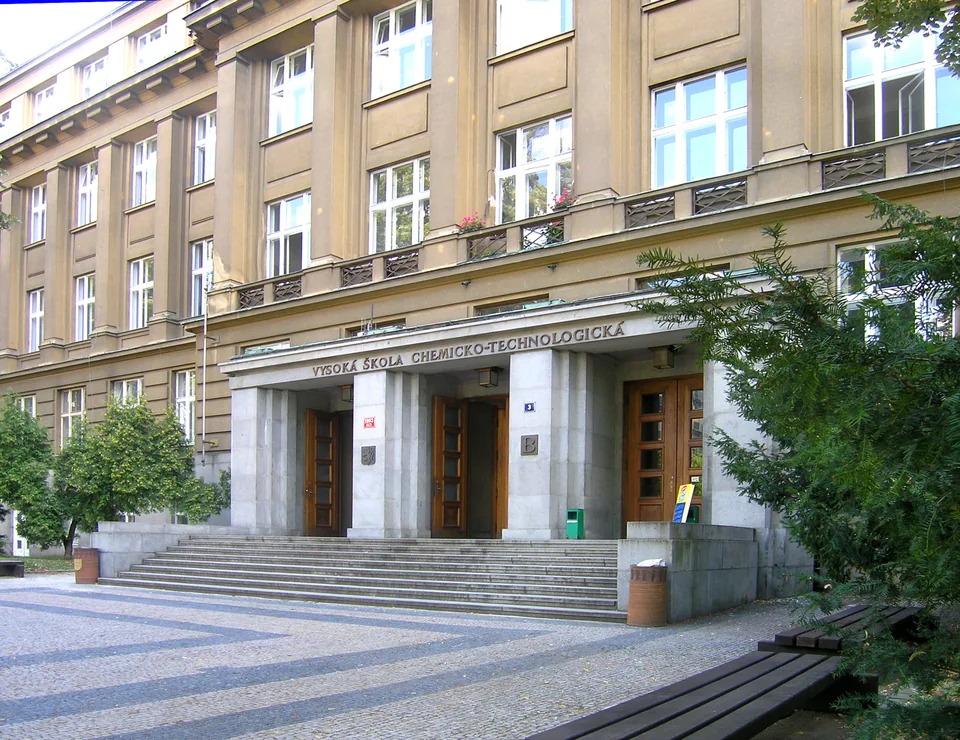
The University of Chemistry and Technology, Prague (Vysoká škola chemicko-technologická v Praze, VŠCHT; UCT Prague) is a public university specialising in chemistry, chemical engineering, food and biochemical technology, materials and environmental technology, with a School of Business teaching economics and management. Czech-taught degrees are free, and its Czech chemistry bachelor's programmes admit students on school grades in chemistry and mathematics rather than an entrance exam; international applicants must still pass an oral Czech exam at B2 level. English-taught chemistry programmes cost $3,930 (CZK 84,500) a year for students who started in 2026/27, and the English chemistry intake runs once a year, from 1 December to 31 January.
| At a glance | Details |
|---|---|
| Location | Prague 6 – Dejvice campus |
| Units | Faculties of Chemical Technology, Environmental Technology, Food and Biochemical Technology, Chemical Engineering; School of Business |
| Czech-taught degrees | free; chemistry bachelor's selection by school grades |
| Czech requirement | oral exam at B2 with a 70% pass mark |
| English tuition, 2026/27 entry | chemistry: $3,930 (CZK 84,500) a year; economics and management: $5,110 (CZK 110,000) a year |
| Application fee | English programmes: CZK 3,000 ($140); Czech programmes: CZK 650 ($30) |
| English chemistry application window | 1 December – 31 January, one intake per year |
| Halls of residence | CZK 144–251 per bed per night, about $200–350 a month |
Is VŠCHT the right choice for you?
| Strengths | Limitations |
|---|---|
| Focused on chemistry, chemical engineering, food science, materials and environment | Strong school chemistry and maths are needed on every route |
| Czech chemistry bachelor's without an entrance exam | Czech B2 and a medical fitness certificate are required |
| Tuition fixed at the rate of your starting year | One intake a year; fewer programmes in English than in Czech |
| Online tests and interviews for English programmes | Applicants to Chemistry and Technology must be 18 by mid-February of year one |
| Low-cost halls by Prague standards | Russian citizens cannot obtain a Czech study visa (see below) |
VŠCHT suits school leavers aiming at the chemical, pharmaceutical or food industries or a research career. For broader engineering or IT, look at Czech Technical University (ČVUT); for economics, the Prague University of Economics and Business (VŠE); for agriculture-related biology, the Czech University of Life Sciences. Other options are summarised in universities in Prague and on the Czech Republic page; the subject itself is described in our chemistry programme overview.
Which programmes are taught in English?
| Unit | Bachelor's | Master's |
|---|---|---|
| Faculty of Chemical Technology | Catalysis and Manufacturing of (In)organic Compounds; Inorganic / Medicinal / Organic Chemistry; Materials | Chemistry (Organic Chemistry); Chemistry, Technology and Materials; Fuel Cells and Hydrogen Engineering; Membrane Engineering for Sustainable Development; Chemoinformatics in Medicinal Chemistry (double degree) |
| Faculty of Chemical Engineering | Engineering in Chemistry; Chemistry | master's programmes |
| Faculties of Environmental Technology; Food and Biochemical Technology | — | master's programmes |
| School of Business | Economics and Management (3 years, or 4 years with a foundation-style first year) | master's programme |
Bachelor's degrees last three years and award Bc.; master's degrees last two years and award Ing.
How much does VŠCHT cost?
| Programme (English-taught) | 2026/27 rate |
|---|---|
| Chemistry bachelor's and master's | $3,930 (CZK 84,500) a year |
| Economics bachelor's and master's | $5,110 (CZK 110,000) a year |
| Fuel Cells and Hydrogen Engineering | $6,810 (€6,000) a year |
| Chemoinformatics in Medicinal Chemistry, non-EU students | $4,380 (€3,860) a year |
| Erasmus Mundus IMATEC, self-payers | $4,200 (€3,700) per semester |
| Doctoral programmes | free |
| Any Czech-taught programme | free within the standard length of study |
Fees are recalculated each year using a Ministry of Education coefficient, but the rate of the year you enrol applies until you graduate. Rates for the 2027/28 intake had not been published on the check date. The first payment is due within three months of enrolment and can be made in euros. Our guide to the cost of studying in Czechia puts these figures in context.
How do you apply to English-taught programmes?
| Step | Timing (2026/27 cycle) | Notes |
|---|---|---|
| Online application | 1 December – 31 January | fee CZK 3,000, payable in euros or US dollars, non-refundable |
| Bachelor's entrance exam | mid-February | online test in mathematics and chemistry, then an online selection interview |
| Master's interview | by end of February | subject areas published per faculty |
| Decision | by 15 March | by email |
| Confirm place, book embassy appointment | March | the university sends visa documents |
| Certified copies of diploma | by end of June | with apostille or superlegalisation and translation, or a Czech nostrification certificate |
| Enrolment | second week of September | classes start in the third week |
English requirement: B2 or above, for example IELTS 6.0, TOEFL iBT 80, Cambridge B2 First, PTE Academic 60 or Duolingo 110; a medium-of-instruction letter is accepted if your previous studies were fully in English. Economics and Management accepts applications all year round.
Medical form. Applicants to English-taught chemistry programmes upload the university's medical assessment form completed by their own doctor; it must be no older than two months at upload, and the paper original is handed in by enrolment day. School of Business applicants and the Chemoinformatics in Medicinal Chemistry master's are exempt.
The university also warns that "direct admission" without the formal procedure does not exist and advises caution with third parties that claim otherwise.
How do you study for free in Czech?
In the 2026 cycle, applications for Czech-taught bachelor's programmes ran from 15 January to 31 March, preliminary results for chemistry were released from 15 May and final results from 24 June.
- Selection. Chemistry programmes rank applicants by the average of eight grades in chemistry and mathematics (annual grades of three pre-final years plus the first half of the final year); other science grades can fill gaps.
- Czech exam. Applicants without a Czech or Slovak school-leaving exam in the language take an oral exam covering general Czech at B2 and school-level chemistry and maths terminology; the pass mark is 70%. It is held in Prague in late May or early June, with a back-up date in late August that is not a resit.
- Economics and Management in Czech requires tests in mathematics and English, with at least 30% in each.
- Documents. Certified translation of grades for the last four years, a medical fitness certificate on the university's form for chemistry programmes, and proof of secondary education.
- Fee. CZK 650 ($30).
Graduates of VŠCHT's own Czech preparatory course who pass the B2 exam within the course are tested only on terminology. See Czech preparatory courses and free university education in Czechia for alternatives.
Do you need nostrification of your school certificate?
For Czech bachelor's programmes you can prove secondary education by nostrification from Prague City Hall (slower but reusable for other universities), by VŠCHT's own assessment within the admission procedure (faster but valid only there), or by an International Baccalaureate diploma. English programmes ask admitted students for certified copies with apostille and translation for the recognition procedure. More detail: nostrification in Czechia.
What visa rules apply to Russian, Kazakh and Belarusian citizens?
Non-EU students need a long-term visa or residence permit for study and must show CZK 115,810 ($5,380) for a 12-month stay; the Ministry of the Interior decides. Our student visa guide covers the documents.
- Russian and Belarusian citizens. Under Government Regulation No. 55/2024, their residence applications at Czech embassies are inadmissible, dual nationals included; the regulation was unchanged on 1 October 2026, and the Ministry of Foreign Affairs confirmed the restrictions on 9 February 2026. VŠCHT's admissions page itself advises these applicants to check their eligibility for a visa before applying. They may still apply for Czech-taught programmes by the usual 31 March deadline, but the university warns that without a visa and arrival by enrolment day studies cannot start. Belarusian holders of specific Czech government or EU scholarships are exempt; there is no exemption for Russian students.
- Kazakh citizens apply at the Czech Embassy in Astana by appointment; see studying in Czechia for Kazakh students.
How much do VŠCHT halls of residence cost?
UCT Prague runs two student halls, Sázava and Volha. Rates valid from 1 February 2026 include internet and weekly linen change:
| Room | Sázava (CZK/night) | Volha (CZK/night) | About 30 nights |
|---|---|---|---|
| Triple room in a unit | — | 144 | $200 |
| Double room in a unit | 173 | 173 | $240 |
| Separate double room | 199 | 199 | $280 |
| Single room in a unit | 244 | 234 | $330–340 |
| Separate single room | 251 | — | $350 |
Single use of a double room adds 50% for the empty bed. Admitted English-programme students sign an accommodation pre-agreement in spring.
Which mistakes cost applicants a place?
- Applying without solid chemistry and maths, which drive selection on both tracks.
- Missing the December–January window for English chemistry programmes; there is no second intake.
- Leaving out the medical certificate for Czech chemistry programmes.
- Paying an agent for "direct admission", which the university says does not exist.
FAQ
Can I get into VŠCHT without an entrance exam?
Yes for Czech-taught chemistry bachelor's programmes, which rank applicants on chemistry and maths grades. If your school certificate is not Czech or Slovak, you still have to score 70% or more in the oral B2 Czech exam.
How much are English-taught programmes?
Students who began in 2026/27 pay CZK 84,500 a year for chemistry and CZK 110,000 for the School of Business programmes, and that rate stays fixed until graduation. Rates for the 2027/28 intake were not yet published when we checked.
When do I apply for English-taught chemistry programmes?
Between 1 December and 31 January, with a single September intake. Bachelor's applicants take an online maths and chemistry test and an interview in February, and decisions arrive by 15 March.
What English level does VŠCHT require?
B2 or above. Accepted proof includes IELTS with at least 6.0, TOEFL iBT with at least 80 and several other certificates, or an official letter confirming that your previous studies were taught entirely in English.
Can Russian citizens study at VŠCHT?
The university can admit them, but Czech embassies treat their study visa and residence applications as inadmissible under Regulation No. 55/2024, and residence decisions rest with the Ministry of the Interior. The university itself asks Russian applicants to check visa eligibility first.
How much does student housing cost?
A bed in the Sázava or Volha halls costs CZK 144–251 per night, roughly $200–350 a month, including internet and linen.
Sources
- UCT Prague tuition fees 2026/27; Admissions to English programmes; Recognition of foreign education
- Bachelor's and master's programmes in English
- Czech bachelor's admission conditions; Czech-taught study for foreigners
- Hall price list from 1 February 2026 (PDF)
- Government Regulation No. 55/2024; Czech MFA on visa services for Russian and Belarusian citizens; Ministry of the Interior portal: proof of funds
Dollar figures use ECB reference rates of 30 September 2026 (€1 = $1.1355; CZK 1 = $0.04646), rounded to $10. Facts checked on 1 October 2026.
If you want to work through your route to VŠCHT, send a request: document preparation and submission are provided under an agreement with StudyU, and the university makes the admission decision.
During the free initial consultation, we clarify your goal, profile, timing, and budget and identify the next realistic step.
Next steps
- Studying in Czechia for Kazakh Students: Tuition-Free in Czech, the Visa in Astana, Apostille and Budget
- Studying in the Czech Republic for international applicants
- Czech Technical University in Prague (ČVUT / CTU)
- Prague University of Economics and Business (VŠE)
- Czech University of Life Sciences Prague (ČZU / CZU)
- Universities in Prague: Public and Private Options, Fees and Admission for International Students
