
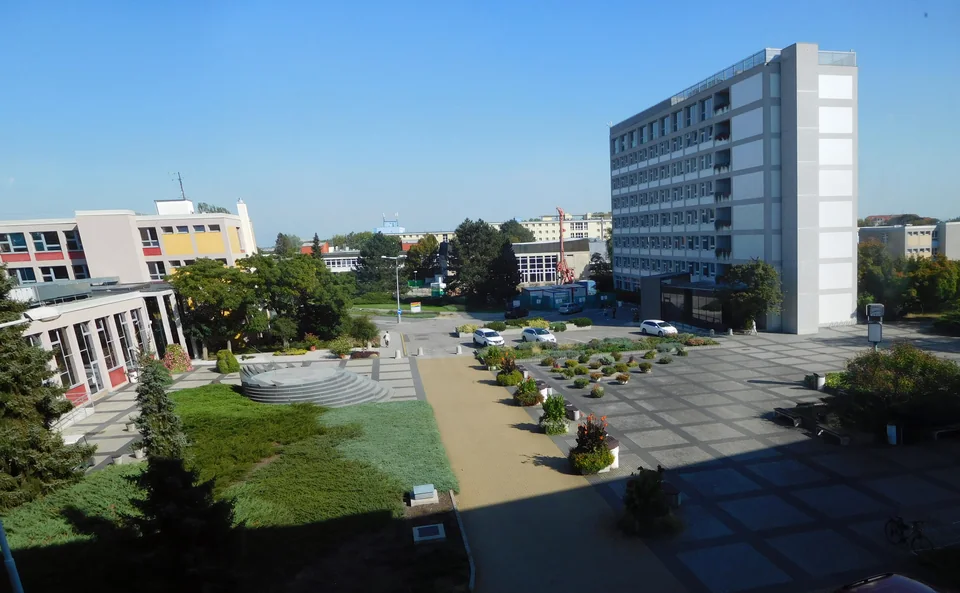
The Czech University of Life Sciences Prague (Česká zemědělská univerzita v Praze, ČZU; CZU in English) is a public university with its own campus in the Prague district of Suchdol. According to the university, it has about 20,000 students, almost 30% of them international. Despite the name, it trains far more than agronomists: it has a large economics faculty as well as engineering, environmental science, forestry and tropical agriculture. Czech-taught study is tuition-free, and English-taught study costs noticeably less than at, for example, CTU: the Economics and Management bachelor's costs non-EU citizens $2,340 (CZK 50,000) a year for the 2027/28 intake. Admissions to the economics faculty's English-taught bachelor's are already open: the first stage runs from 15 September to 29 October 2026.
| At a glance | Details |
|---|---|
| Location | Prague, Suchdol campus (about 5 km from Dejvice) |
| Founded | 1906 |
| Students | about 20,000, almost 30% international (CZU data; the QS profile gives 14,064, including 4,272 international) |
| Structure | 6 faculties and the Institute of Education and Counselling (IVP) |
| Rankings | QS World University Rankings 2027: 731–740; THE World University Rankings 2026: 601–800 |
| English-taught programmes | 10 bachelor's, 20 master's, 26 doctoral |
| Fees at the Faculty of Economics and Management (non-EU, 2027/28) | $2,340–3,740 (CZK 50,000–80,000) a year for bachelor's |
| Application fee | $40 (CZK 850) |
| Dormitories | 4 buildings on campus, $6–20 (CZK 139–433) per bed per night |
Who CZU suits
Almost one in three CZU students is international. The university offers a wide choice of programmes, a large economics faculty and a campus where dormitories, canteen and teaching buildings share one site.
| A good fit | Think twice |
|---|---|
| Students who want economics, management or informatics in Prague at a low fee | Those who need classic engineering or medicine: CTU or Charles University fit better |
| Those ready to learn Czech and study for free | Those who want to live in central Prague: the campus is on the city's edge |
| Applicants interested in ecology, forestry, food technology or tropical agriculture | Russian citizens: a Czech student visa cannot currently be obtained |
| Applicants who like a clear, multi-stage admission starting in autumn | Anyone hoping to avoid exams: the economics faculty's English bachelor's require the GAP test |
Faculties and fields
| Faculty | Abbreviation | Main fields |
|---|---|---|
| Economics and Management | PEF (FEM) | economics and management, business administration, informatics, systems engineering, public administration and regional development |
| Agrobiology, Food and Natural Resources | FAPPZ | agronomy, animal science, food quality and nutrition, landscape design, cynology |
| Engineering | TF | agricultural and transport machinery, information and control systems, waste processing |
| Environmental Sciences | FŽP | nature conservation, water management, environmental engineering |
| Forestry and Wood Sciences | FLD | forestry, wood processing, game management |
| Tropical AgriSciences | FTZ | rural development, tropical crops, agroforestry |
The Institute of Education and Counselling (IVP) runs teacher-training programmes and preparatory courses for international applicants.
English-taught master's include, among others, International Trade and Business, Global Information Security Management, Sustainable Agriculture and Food Security, Natural Resources and Environment, Forest Science in Global Change, and Tropical Crop Management and Ecology.
English-taught tuition fees
The Faculty of Economics and Management has set fees for students starting in 2027/28. Citizens of Kazakhstan, Uzbekistan and other non-EU countries pay per year:
| Programme | Bachelor's | Master's |
|---|---|---|
| Economics and Management | $2,340 (CZK 50,000) | $2,340 (CZK 50,000) |
| Business Administration | $3,040 (CZK 65,000) | $5,150 (CZK 110,000) |
| Informatics | $3,740 (CZK 80,000) | $3,740 (CZK 80,000) |
| International Trade and Business | — | $2,340 (CZK 50,000) |
| European Agrarian Diplomacy | — | $1,970 (CZK 42,000) |
| Global Information Security Management | — | $6,320 (CZK 135,000) |
EU citizens pay less, $580 (CZK 12,500) a year for most programmes. The fee is due before registration for the academic year. If a student does not get a visa, they may apply for a refund; the faculty decides case by case and keeps $115 (CZK 2,500). Other faculties list their fees on their programme pages.
Applying to the economics faculty's English-taught bachelor's for 2027/28
PEF's main distinguishing feature is an early, multi-stage admission. The required test is Scio's General Academic Prerequisites (GAP), taken online: a general aptitude test in English, not a subject exam.
| Stage | Application and fee payment | GAP registration | Test date | Stage results |
|---|---|---|---|---|
| 1 | 15 Sep – 29 Oct 2026 | by 29 Oct 2026 | 5 Nov 2026 | by 20 Nov 2026 |
| 2 | 30 Oct 2026 – 15 Jan 2027 | by 22 Jan 2027 | 30 Jan 2027 | by 13 Feb 2027 |
| 3 | 16 Jan – 5 Feb 2027 | by 12 Feb 2027 | 20 Feb 2027 | by 15 Mar 2027 |
| 4 | 6 Feb – 5 Mar 2027 | by 12 Mar 2027 | 20 Mar 2027 | by 12 Apr 2027 |
| 5 | 6 Mar – 31 Mar 2027 | by 16 Apr 2027 | 24 Apr 2027 | by 14 May 2027 |
How it works in practice:
- Application. Submitted only online at is.czu.cz. The fee is $40 (CZK 850 or €35) per application, paid by card on submission and non-refundable.
- GAP test. Paid separately at Scio's rates directly to Scio. If you took GAP in 2023–2026, you can upload the result; if you sit it again, the better score counts.
- Decision. Applicants are ranked by GAP score (0–100), and the admissions committee sets the pass mark. The decision is made no later than 14 days after each stage's results are announced.
- Education documents. You present your school certificate at enrolment, either nostrified or with CZU's decision recognising your foreign secondary education within admission. Without one of these you cannot be enrolled.
An early stage suits international applicants: the decision comes in November, leaving time for certificate recognition, housing and the visa.
Tuition-free study in Czech: what you need
Czech-taught programmes at CZU generally accept applications from November to the end of March, with deadlines, exams and requirements set per programme. The Faculty of Economics and Management accepts 2027/28 applications until 31 March 2027.
PEF's conditions for Czech-taught bachelor's (2026/27 cycle) as an example:
- entrance tests were held on 8–12 June 2026, with invitations sent by 7 May;
- exemption from the exam for national-round participants in the Logic and Mathematical Olympiads and for applicants scoring 125 or more in a Mensa Czech Republic IQ test;
- Czech at B2 is required for enrolment; international applicants who did not finish a Czech or Slovak school take the faculty's own Czech exam before the entrance tests;
- a foreign school certificate must be nostrified or recognised within the admission procedure.
At other faculties the exam may be a test or an interview; the format is listed on the programme page. See also our guide to tuition-free university education in Czechia.
Preparatory courses at CZU
The Institute of Education and Counselling (IVP) has prepared international applicants since 2010. The programme includes:
- 600–720 hours of intensive Czech (typically five hours every weekday);
- subject vocabulary and modules in mathematics, biology and economics for the entrance exams;
- "Preparation for Study at CZU I and II" courses aiming at B2;
- an advanced course for those who failed the entrance exams or did not reach B2 in the main course;
- academic English courses for applicants to English-taught programmes.
Some of the teaching can start at partner language centres in applicants' home countries, for example in Tashkent. Course prices are not published on the institute's page; check with IVP. For a comparison with other universities and private schools, see our guide to Czech language preparatory courses.
Recognition of your certificate
CZU accepts two options:
- recognition within admission, where the university assesses foreign secondary education under an internal directive; the decision is valid only for admission to CZU;
- nostrification by a regional authority (in Prague, the City Hall), valid for any university.
In the 2026/27 cycle the economics faculty set a separate late enrolment date for applicants whose recognition request had not been decided by 20 September. Do not rely on it: without the document you cannot apply for a visa. See our guide to nostrification in Czechia.
Dormitories on the Suchdol campus
CZU's Halls of Residence and Refectory service runs four buildings on campus. Prices from 1 September 2026 are per bed per night; the monthly charge equals the nightly rate multiplied by the number of days in the month:
| Building and bed type | Per night | Approx. per 30 days |
|---|---|---|
| BCD, bed in a four-bed room without own bathroom | $6 (CZK 139) | $200 |
| BCD, bed in a double room without own bathroom | $8 (CZK 166) | $230 |
| A, JIH: 2+2 suites with shared bathroom | $10 (CZK 221) | $310 |
| EFG: 2+2 suites with bathroom and kitchenette | $10 (CZK 219) | $310 |
| BCD and EFG, bed in a double room with own bathroom | $11–12 (CZK 230–257) | $320–360 |
| JIH, superior room for one person | $20 (CZK 433) | $610 |
A refundable deposit of $470 (CZK 10,000) is paid before moving in. From November to August, if there is space, you can have a double room to yourself, but the price rises by 40%. You request a dormitory place after receiving your admission letter.
Study in Czechia estimates basic student expenses in Prague at $570–910 (€500–800) a month, with the capital nearer the upper end. See the cost of studying in Czechia.
Citizens of Russia, Kazakhstan and Uzbekistan
Russia. A Russian passport currently closes the study visa route: the Czech Ministry of Foreign Affairs allows applications only on family grounds, under the Civil Society Programme or in the national interest, and the same rule applies to dual citizens. In Dean's Regulation No. 18/2026 the CZU economics faculty warns Russian and Belarusian applicants that the Czech Ministry of the Interior does not issue them new visas, although existing stays can be extended. A visa refusal does not cancel the right to enrol: the student may ask to interrupt studies. For 2027/28 the faculty lists only one "critical" programme, the Global Information Security Management master's; applicants who meet the conditions for non-critical programmes must be admitted. The regulation relies on Czech Ministry of Education instruction No. MSMT-11649/2022-1 and guidance from the Financial Analytical Office; other CZU faculties assess their own programmes separately.
Kazakhstan. The university books the study visa appointment at the Czech embassy in Astana by emailing the admission confirmation. The wait is 21–30 days. There is also the Režim Student programme (30 places a month shared by Kazakhstan and Kyrgyzstan); only a participating university can nominate a student, so ask CZU about it.
Uzbekistan. Students already admitted to a bachelor's or master's book their own appointment at the embassy in Tashkent by email. Preparatory course students go through a monthly registration with an element of chance. Study at a public university, including its courses, is decided within 60 days.
The final word on the visa belongs to the Czech Ministry of the Interior; neither the university nor StudyU can influence it. See our guide to the student visa and residence permit in Czechia.
Proof of funds and working while studying
How much money to show. The Czech Ministry of the Interior requires 15 times the subsistence minimum plus twice the minimum for each further month: $5,420 (CZK 115,810) for an academic year, $3,662 (CZK 78,250) for a semester; applicants under 18 need half. The consular fee is $117 (CZK 2,500). Together with the first year of the Economics and Management bachelor's ($2,340) and the dormitory deposit ($470), this gives a benchmark starting budget.
Work. With a visa or residence permit for study in an accredited programme you do not need a work permit, but study must remain your main purpose of stay, which the ministry checks at renewal. A visa for a course at a private language school does not carry this right.
Common mistakes
- Waiting for spring. The first stage for PEF's English-taught bachelor's closes on 29 October 2026, and the last test is in April. The earlier the stage, the more time for the visa.
- Forgetting that GAP needs its own registration. A CZU application is not enough: you register with Scio by the stated date and pay separately.
- Underestimating PEF's Czech exam. For Czech-taught programmes it comes before the entrance tests, and you cannot continue without it.
- Budgeting the dormitory as a flat monthly rate. Prices are per night, so a 31-day month costs more.
- Choosing GISM as a Russian citizen. This master's is classed as critical for 2027/28.
CZU in the rankings
| Ranking | Position | Note |
|---|---|---|
| QS World University Rankings 2027 | 731–740 | up from 761–770 in 2026 |
| THE World University Rankings 2026 | 601–800 | same band as Masaryk University |
FAQ
How much does an English-taught degree at CZU cost?
At the Faculty of Economics and Management, a non-EU citizen starting in 2027/28 pays from $2,340 (CZK 50,000) a year for Economics and Management to $3,740 (CZK 80,000) for Informatics at bachelor's level. The most expensive master's is Global Information Security Management at $6,320 (CZK 135,000).
Which exam is required for the English-taught bachelor's?
Scio's online General Academic Prerequisites (GAP) test. Dates for 2027/28: 5 November 2026, and 30 January, 20 February, 20 March and 24 April 2027.
Can I study at CZU for free?
Yes, in Czech-taught programmes. Enrolment requires Czech at B2; at the economics faculty international applicants take the faculty's own Czech exam before the entrance tests.
Are there preparatory courses?
Yes. CZU's Institute of Education and Counselling runs 600–720 hours of Czech preparation with modules in mathematics, biology and economics. The price is not published on its page; check with the institute.
How much is a CZU dormitory?
From 1 September 2026, $6 (CZK 139) to $20 (CZK 433) per bed per night. A bed in a double room costs roughly $230–360 a month, plus a refundable deposit of $470.
Can a Russian citizen study at CZU?
CZU can admit a Russian citizen to a non-critical programme, but Czech consulates do not currently process Russian citizens' study visas. Studying is realistic only if you already have a legal basis to live in Czechia.
Can StudyU help me apply to CZU?
Under an agreement with StudyU, we choose the programme and admission stage, check requirements, prepare documents and the application, help you prepare for the GAP test or the Czech exam, and support the visa stage. The university's faculty decides on admission, and the Czech Ministry of the Interior, as the migration authority, decides on the visa.
Sources
- CZU: about the university
- CZU: admission procedure (studuj.czu.cz)
- CZU: study in English
- FEM CZU: admissions — bachelor studies
- FEM CZU: Dean's Regulation No. 16/2026, English-taught bachelor's admission 2027/28 (PDF)
- FEM CZU: Dean's Regulation No. 14/2026, foreign-language tuition fees 2027/28 (PDF)
- FEM CZU: Dean's Regulation No. 18/2026, conditions for Russian, Belarusian and other applicants (PDF)
- FEM CZU: admission to Czech-taught bachelor's
- IVP CZU: preparatory courses
- CZU Halls of Residence: price list from 1 September 2026 (PDF)
- Czech Ministry of the Interior: proof of funds for residence
- Czech MFA: visa services for citizens of Russia and Belarus
- Czech Embassy in Astana: study visa registration
- Czech Embassy in Tashkent: registration for university students
- Study in Czechia: living costs
- QS: Czech University of Life Sciences Prague
- THE: Czech University of Life Sciences Prague
Dollar amounts are converted at the ECB reference rate of 29 September 2026 (€1 = $1.1355; €1 = CZK 24.411) and rounded.
For other universities and general rules, see Study in Czechia and our guide to universities in Prague; for economics, compare CZU with the Prague University of Economics and Business. To catch an early admission stage, send us a request.
During the free initial consultation, we clarify your goal, profile, timing, and budget and identify the next realistic step.
Next steps
- Free University Education in Czechia: Conditions, What You Still Pay and the Real Annual Cost
- Nostrification in Czechia: How to Get Your School Certificate and Degree Recognised
- Czech Language Preparatory Courses: University Programmes, Private Schools, Prices and Visas
- Cost of Studying in Czechia: 2026/27 and 2027/28 Tuition, Living Costs and a First-Year Budget
- Studying in the Czech Republic for international applicants
- Charles University (Univerzita Karlova)
