
The Université libre de Bruxelles (ULB) is a French-speaking research university in Belgium's capital, placing joint 252nd in the THE World University Rankings 2027. Most bachelor's teaching is in French; in English you can choose two Solvay Brussels School bachelor's programmes and a few dozen master's programmes. Most non-EU nationals pay $6,100 (€5,369) a year in 2026/27 for any bachelor's or master's programme. Non-EU applicants living outside the EU apply between 16 February and 31 March, and bachelor's applicants must also request recognition of their school diploma from the Wallonia-Brussels Federation.
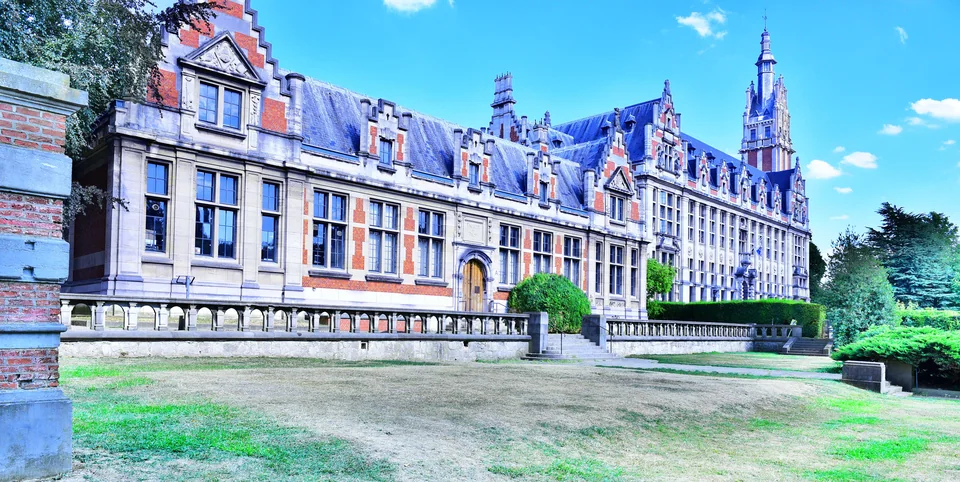
Do not confuse ULB with the Vrije Universiteit Brussel (VUB), a separate Dutch-speaking university with its own rules and fees.
| At a glance | Details |
|---|---|
| Founded | 1834, Brussels |
| Campuses | Solbosch, La Plaine and Erasme in Brussels, plus a site in Charleroi |
| Size | 12 faculties, about 40 bachelor's and 250 graduate programmes |
| International profile | 32% international students from 140 countries |
| Language | mainly French; the university cites between 23 and 30 master's programmes fully taught in English |
| Ranking | THE World University Rankings 2027: joint 252nd |
| Fee for most non-EU nationals, 2026/27 | $6,100 (€5,369) a year: $1,360 (€1,194) registration plus a $4,740 (€4,175) supplementary contribution |
| Bachelor's application fee | $230 (€200) for non-EU applicants, non-refundable |
| Application window | 16 February – 31 March for non-EU nationals living outside the EU |
| Housing | more than 2,400 rooms and flats, allocated by lottery |
Who ULB suits
ULB is a strong choice if you speak French or can reach B2: almost the whole catalogue opens up, from law and political science to engineering. Brussels adds what regional campuses cannot: EU institutions, international organisations and corporate headquarters nearby. ULB counts four Nobel Prizes in the sciences and a Fields Medal among its academic record.
Without French, the choice narrows to two English-taught bachelor's programmes and a list of English-taught master's. If you want a broad English-taught master's catalogue on a similar budget, compare ULB with UCLouvain, which charges the same rate, or with Flemish Ghent University, where arts and humanities master's cost non-EEA students $2,610 (€2,297.40).
Because the fee is the same for every programme, ULB is best value where Flemish universities charge most: engineering, economics and the sciences. The equivalent master's at KU Leuven costs $10,780 (€9,493.92) in 2026/27.
Bachelor's admission: diploma recognition and selection
First-year bachelor's admission involves two parallel procedures: diploma recognition by the Wallonia-Brussels Federation and selection by ULB's central admissions committee.
1. Diploma equivalence. Every bachelor's programme requires a decision that your school diploma is equivalent to the Belgian upper-secondary certificate (CESS). You apply to the Federation's Equivalence Service between 15 November and 15 July before the year you start, paying a non-refundable fee that was $450 (€400) in the 2026/27 cycle, or $170 (€150) for diplomas from some countries.
ULB asks for proof that you have applied:
- by 31 March if you finished school a year ago or earlier;
- by 15 July if you are in your final school year;
- after 15 July only if your programme also has an entrance exam or competition (medicine, dentistry, engineering).
While the decision is pending, you can continue your registration under a provisional enrolment contract.
2. Central admissions committee criteria for non-EU nationals.
| Requirement | What is checked |
|---|---|
| Overall average | at least 13 out of 20 on the school-leaving certificate |
| Relevant subjects | at least 12 out of 20 in subjects linked to the programme, across all assessments that led to the certificate |
| Time since school | recent graduates (last two years) are admitted if they meet the criteria, and every year of study since school must have been passed with at least 13/20; older certificates are assessed at the committee's discretion |
| French | B2 for some faculties if French was not part of your school curriculum |
| Number of applications | one first-year application per academic year |
| Fee | $230 (€200); payment is a precondition for review and is not refunded if you are refused |
Final-year pupils can be admitted conditionally, subject to their final grades.
Programmes with extra selection. Medicine and dentistry require passing the ARES entrance exam, and non-resident places are allocated by exam results. Physiotherapy, veterinary medicine and speech therapy have quotas for non-residents, with a lottery if applications exceed places. Engineering at the École polytechnique de Bruxelles has its own entrance exam.
English-taught bachelor's. Since September 2024, Solvay Brussels School has offered English versions of two three-year bachelor's programmes: Business Engineering and Economics. In both, about 80% of teaching is in English, 15% in French and 5% in Dutch or German, so a second language is part of the degree. Admission requires B2 English.
Master's programmes and documents
Master's admission requires a bachelor's degree in a related field, and the faculty jury assesses any gaps. At Solvay Brussels School, master's programmes are taught in English or in French and English depending on electives, and the Master in Management Science is taught entirely in English. Each programme page in the ULB catalogue states its teaching language.
Documents for a master's application:
- a 3 × 4 cm photo and a passport copy;
- degree certificates and transcripts bearing the institution's stamp and signature;
- your school diploma if it was obtained within the last five years;
- evidence of all academic and non-academic activities over the last five years, with start and end dates (certificates from employers or course providers; employment contracts are not accepted);
- a motivation letter and course descriptions if the jury requests them.
ULB accepts documents in French, German, Dutch, English, Spanish, Italian and Portuguese. Documents in other languages, including Russian, need a sworn translation.
Application windows
| Applicant | Bachelor's and master's | Doctorate |
|---|---|---|
| Non-EU nationals living outside the EU | 16 February – 31 March | 16 February – 31 October |
| Non-EU nationals living in an EU country | EU calendar: first year from late June to 30 September; master's from 1 April to 30 September | 16 February – 31 October |
A plan for a September 2027 start:
- October–November 2026: choose the programme and check its teaching language and admission criteria.
- From 15 November 2026: submit the diploma equivalence request if you are applying for a bachelor's.
- 16 February – 31 March 2027: apply to ULB and pay the application fee.
- Spring–summer 2027: receive the decision and enrolment authorisation, fund a blocked account or arrange a sponsor, and apply for a D visa.
- By 31 October 2027: pay at least $57 (€50) to validate enrolment, with the balance due by 1 February 2028.
Tuition fees
From 2026/27, non-EU nationals who are not exempt pay full registration of $1,360 (€1,194) plus a $4,740 (€4,175) supplementary contribution, $6,100 (€5,369) a year in total. Exemptions cover citizens of the states named in the ARES circular's Annexes 1–3 (the UN least developed countries plus a short list of countries with low human development scores) and to certain residents and scholarship holders. Neither Russia nor Kazakhstan appears in those annexes.
| Programme | Fee for most non-EU nationals, 2026/27 |
|---|---|
| Bachelor's, master's, specialised master's | $6,100 (€5,369) a year |
| Specialised master's in health, first 120 credits | $5,530 (€4,867) a year |
| Doctorate, first year | $1,360 (€1,194) |
| Individual courses | $230 (€199) for the first 10 credits plus the $4,740 (€4,175) supplement |
Payment is by card on the MonULB portal or by bank transfer. For legal ways to pay from Russia, see paying tuition from Russia.
Living in Brussels. The visa minimum for 2026/27 is $1,210 (€1,062) a month. A first year at that minimum costs about $20,570 (€18,113): $6,100 in fees plus $14,470 for 12 months. Visa fees, health insurance, translations and flights are extra.
Scholarships
For a master's at ULB, the main external funding option is the MASTER IN grant from Wallonie-Bruxelles International. It provides $11,380 (€10,020) for the year, paid monthly, which does not cover a full year's costs. Graduates of any country can apply if their last degree is no more than five years old; selection gives priority to 14 countries, and Russia and Kazakhstan are not among them. In the 2026/27 cycle the grant file went through the university by 31 March 2026, and a WBI jury picks the recipients.
Housing
ULB rents rooms in its own residences and in partner private residences on its three Brussels campuses and beyond, more than 2,400 rooms and flats in total. Housing applications for 2026/27 closed on 31 March. Applicants receive an email between late April and early May: places are allocated by lottery without ranking, and others join a waiting list.
Students without a university place are pointed to the private market, including the student housing platform set up by Brussels higher education institutions and verified listings on partner sites. ULB warns about rental scams: a suspiciously low price or pressure to pay immediately is a reason to stop.
Visa and work rights
Study stays longer than three months require a D visa; in Russia, applications go through the VFS Global visa centre, after which, per the VFS student checklist, you complete a student questionnaire in person at the Belgian Embassy in Moscow (on the day of lodging, before 16:00, if you apply in Moscow). ULB issues the enrolment authorisation, while the Belgian Immigration Office rules on the visa, and admission does not by itself mean a residence permit will be granted or renewed.
The visa file needs a financial plan: a scholarship certificate, a blocked account or an Annex 32 sponsor undertaking covering at least $1,210 (€1,062) a month. The consular fee for a study D visa is $280 (€250), and the Immigration Office's administrative fee for students at public institutions is $290 (€251) at the 2026 rate. Paid work is allowed for up to 20 hours weekly while classes run, and beyond that in official holidays. Our Belgium student visa guide covers the full procedure.
ULB, UCLouvain or KU Leuven?
| Criterion | ULB | UCLouvain | KU Leuven |
|---|---|---|---|
| Main teaching language | French | French | Dutch; many English-taught master's |
| English-taught bachelor's | two at Solvay | none | seven |
| Fee for most non-EU nationals, 2026/27 | $6,100 | $6,100 | $1,340–10,780 by programme |
| Diploma equivalence when applying | proof that you have applied is enough | a final equivalence decision is required | not required; the university assesses diplomas itself |
| Deadline for applicants living outside the EU | 31 March | 31 March | 1 March for most English-taught programmes |
| THE 2027 rank | 252 | 205 | 45 |
The studying in Belgium page gives the national overview. For every option in the country, see universities in Belgium; first-cycle study is covered in bachelor's degrees in Belgium.
Common mistakes
- Requesting diploma equivalence too late. Graduates from previous years must prove their request by 31 March.
- Planning to apply in April. For non-EU nationals living outside the EU, the window closes on 31 March.
- Applying to two first-year programmes. The committee accepts one application per year, and the $230 (€200) fee is not refunded.
- Relying on old fee figures of $950 (€835) or $4,740 (€4,175). New non-exempt non-EU students pay $6,100 (€5,369) in 2026/27.
- Leaving the housing application for later. In the 2026/27 cycle, university housing applications closed on 31 March, together with the study applications.
- Mixing up ULB and VUB. The Dutch-speaking Vrije Universiteit Brussel has its own programmes, deadlines and fees.
- Submitting untranslated Russian documents. They need a sworn translation.
Ranking
| Ranking | Position |
|---|---|
| THE World University Rankings 2027 | joint 252nd |
How StudyU can help
Eligibility checks, the diploma equivalence request, document preparation and the application itself are provided under an agreement with StudyU. The Wallonia-Brussels Federation decides on diploma equivalence, ULB on admission, and the Belgian Immigration Office rules on the visa.
FAQ
Can I apply to ULB straight after secondary school?
Yes, if your grades meet the committee's thresholds of 13/20 overall and 12/20 in relevant subjects and you request diploma equivalence on time. Final-year pupils are admitted conditionally until their final grades are confirmed.
How much does ULB cost for non-EU students?
In 2026/27, most non-EU nationals pay $6,100 (€5,369) a year for bachelor's and master's programmes: $1,360 (€1,194) registration plus the $4,740 (€4,175) supplementary contribution. Nationals of countries in the ARES exemption annexes pay only the registration fee.
Does ULB offer bachelor's degrees in English?
Yes, two at Solvay Brussels School: Business Engineering and Economics. About 80% of their teaching is in English and admission requires B2; every other ULB bachelor's is taught in French.
Do I need French for a master's at ULB?
Not always. The university cites between 23 and 30 master's programmes taught entirely in English, and several Solvay master's mix English and French. For French-taught programmes, the faculty jury sets the language requirement.
When is the ULB application deadline for non-EU students?
Non-EU nationals living outside the EU apply between 16 February and 31 March. The diploma equivalence request to the Wallonia-Brussels Federation can be submitted from 15 November.
Are ULB and VUB the same university?
No. ULB teaches in French, while the Vrije Universiteit Brussel is an independent Dutch-speaking university. They have separate application portals, rules and fees.
Sources
- ULB: about ULB
- ULB: home page key figures
- ULB: application windows
- ULB: central admissions committee criteria
- ULB: information for international students
- ULB: access conditions
- ULB: required documents
- ULB: tuition fees 2026/27
- ULB: housing
- Solvay Brussels School: bachelor's programmes
- Solvay Brussels School: master's programmes
- Study in Belgium: diploma equivalence
- Study in Belgium: bachelor's admission conditions
- Study in Belgium: quota programmes
- Study in Belgium: registration fees and exemptions
- Study in Flanders: work and study
- Embassy of Belgium in Russia: visas
- Times Higher Education: World University Rankings 2027
- Study in Belgium: MASTER IN WBI grants
- Study in Belgium: MASTER IN financial support
- Belgian Foreign Affairs: visa handling fees
- Embassy of Belgium: administrative visa fee 2026
All sources checked on 30 September 2026. Conversions to dollars use the ECB reference rate published on 29 September 2026, €1 = $1.1355. Small sums under $100 are rounded to whole dollars and the rest to the nearest $10.
Next steps
- Bachelor's Degree in Belgium for International Students: Admission After School, Language and Cost
- Belgium Student Visa: Documents, Fees and Application Steps
- Universities in Belgium for International Students: Full List, Languages and 2026/27 Fees
- How to Pay for Studies Abroad from Russia: What Works in 2026
- Studying in Belgium for international applicants
- Ghent University (UGent): Admission, Fees and English-Taught Master's
