
Sydney's main public universities for international bachelor's and master's students are UNSW Sydney and the University of Sydney (both members of the Group of Eight, Australia's leading research-intensive universities), the University of Technology Sydney (UTS), Macquarie University, Western Sydney University and the Sydney campus of Australian Catholic University. Other Australian universities and private providers also run campuses in the city. In the QS World University Rankings 2027 the six range from 19th (UNSW) to the 851–900 band (ACU). A business bachelor's costs from about $26,450 (A$37,661) a year at Western Sydney to $41,510–44,670 (A$59,100–63,600) at the University of Sydney for 2027 entry. For living costs, Home Affairs requires evidence of at least A$29,710 (≈ $20,870) a year, while UNSW estimates a share-house lifestyle at A$30,680–40,560.
This guide compares the universities, lists course prices, covers foundation options after 11 years of school, housing, nationality-based scholarships and what studying in Sydney means for the 485 graduate visa. Conversions use the ECB rate of 28 September 2026 (A$1 ≈ US$0.7024). For all Australian universities, see our guide to universities in Australia and the overview of studying in Australia.
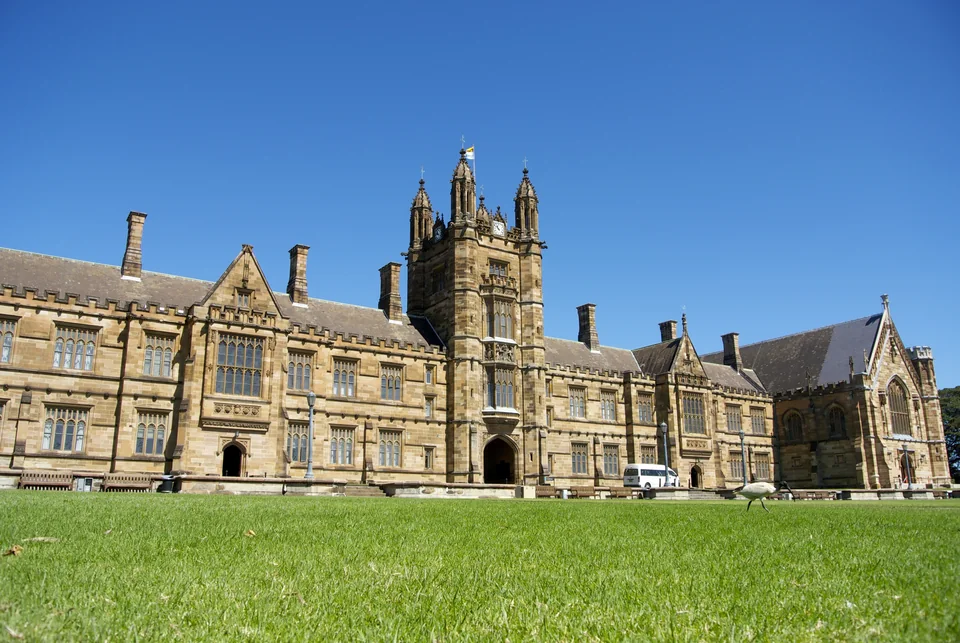
Sydney universities at a glance
| University | QS 2027 | Main location | Type and network | StudyU profile |
|---|---|---|---|---|
| UNSW Sydney | 19 | Kensington | research-intensive, Group of Eight member | UNSW |
| University of Sydney | 28 | Camperdown | research-intensive, Group of Eight | University of Sydney |
| University of Technology Sydney | =87 | Broadway | technology-focused, Australian Technology Network | — |
| Macquarie University | =126 | Wallumattagal Campus, Macquarie Park | comprehensive | — |
| Western Sydney University | =370 | Parramatta, Bankstown, Penrith, Campbelltown, Liverpool | multi-campus, Greater Western Sydney | — |
| Australian Catholic University | 851–900 | North Sydney | Catholic university with campuses in several cities | — |
Ranking is only one factor. The Group of Eight brings together research-intensive universities and, as the fee table below shows, they cost the most. UTS belongs to the ATN technology network. Western Sydney and ACU are noticeably cheaper and worth considering on a limited budget if the course content fits.
Tuition at Sydney universities
Comparing "price per year" across universities is tricky: some publish a 2027 annual guide, others a 2026 first-year figure, others charge per subject. The table therefore shows two kinds of figures: official current-intake prices where the university publishes them, and whole-course estimates from the government's CRICOS register. Every provider records an estimated total course cost for international students there; it may lag behind new-intake fees by about a year, but it is consistent across institutions.
| University | Price on the university site | 3-year commerce or business bachelor's, CRICOS estimate | Master of Information Technology, CRICOS estimate |
|---|---|---|---|
| University of Sydney | business: A$59,100–63,600 (≈ $41,510–44,670) a year, 2027 | A$175,136 (≈ $123,010) | 1 year: A$58,273 (≈ $40,930) |
| UNSW Sydney | Bachelor of Commerce: A$56,500 (≈ $39,680) first year, A$180,500 (≈ $126,780) whole degree, 2026 | — | A$122,500 (≈ $86,040) for a 122-week course |
| UTS | via the university fee calculator | A$146,445 (≈ $102,860) | 2 years: A$110,750 (≈ $77,790) |
| Macquarie | via the fee calculator; first payment A$16,000–23,500 | A$147,619 (≈ $103,690) | 2 years: A$95,246 (≈ $66,900) |
| Western Sydney | business: A$37,661 (≈ $26,450) a year, 2027 | A$108,492 (≈ $76,200) | — |
| ACU | on the course page | A$104,904 (≈ $73,680) | 2 years: A$76,192 (≈ $53,520) |
Two practical conclusions. First, the whole-course gap between the most and least expensive business bachelor's in Sydney is over A$70,000. Second, the one-year IT master's at the University of Sydney is cheaper than two-year options but does not by itself meet the 92-week study requirement for the 485 graduate visa (see below).
A full budget with visa charges, insurance and one-off payments is in our guide to the cost of studying in Australia.
After 11 years of school: foundation programmes
Direct first-year entry after 11 years of school is not always possible, so a Foundation year or a college diploma is common. Sydney's two largest universities have their own pathway colleges.
| Programme | 2027 fee | Leads to |
|---|---|---|
| UNSW College Standard Foundation Program | A$43,650 (≈ $30,660) | UNSW bachelor's if progression conditions are met |
| UNSW College Diploma (business, IT, engineering and others), 8 courses | A$38,880 (≈ $27,310) | UNSW bachelor's; credit rules are set out in the programme terms |
| University of Sydney Foundation Program (Taylors College), standard 12 months | A$49,800 (≈ $34,980) | University of Sydney bachelor's if conditions are met |
Progression requirements such as final marks, subject prerequisites and English are published by each college. School-leaver routes are covered in studying in Australia after 11 years of school.
Which university fits your situation
| Your situation | Look first at |
|---|---|
| Highest ranking, research career | UNSW and the University of Sydney; compare specific faculties and research groups |
| Applied technology course close to the city centre | UTS, an Australian Technology Network member based in Broadway |
| Limited budget for the whole degree | Western Sydney and ACU: CRICOS whole-course estimates for business of A$104,000–109,000 versus A$146,000–181,000 elsewhere |
| Foundation year after 11 years of school | UNSW College or the University of Sydney Foundation Program; compare foundation plus first-year costs together |
| Master's with a 485 visa in mind | courses of at least 92 weeks (usually 2 years), or 1.5 years if your previous study fits |
Where to live and what it costs
In Sydney the A$29,710 visa minimum sits near the bottom of real costs. UNSW gives these weekly estimates (as of May 2025):
| Housing | Rent per week | All costs per week | Per year |
|---|---|---|---|
| Room in a share house | A$290 (≈ $200) | A$590–780 | A$30,680–40,560 (≈ $21,550–28,490) |
| On-campus apartment | A$365–580 | A$555–960 | A$28,860–49,920 |
| Catered college, 44-week contract | A$435–630 | A$505–760 | A$22,220–34,440 |
| One-bedroom unit | A$470–830 (≈ $330–580) | A$785–1,335 | A$40,820–69,420 (≈ $28,670–48,760) |
The University of Sydney estimates accommodation at A$980–3,500 a month and suggests share houses in nearby Newtown, Redfern and Camperdown. Living near your campus reduces transport costs; Macquarie and Western Sydney campuses are away from the centre, so look for housing near your actual campus. Private rentals almost always require a refundable bond.
Scholarships at Sydney universities
| University | Award | Eligibility for Russian and CIS citizens |
|---|---|---|
| University of Sydney | Sydney International Student Award, 20% for the whole course, 2027 start | list includes Russia, Belarus, Armenia, Kazakhstan, Kyrgyzstan, Uzbekistan |
| UNSW | International Student Award, 20% each year | Russia, Kazakhstan and Belarus not listed; Uzbekistan and Kyrgyzstan listed |
| Macquarie | Vice-Chancellor's International Scholarship, up to A$10,000 once | merit-based: ATAR equivalent of 85 or WAM of 65 |
| UTS | awards of 15–50% of tuition | per award terms |
| Western Sydney | A$10,000 or A$5,000 for 2027 undergraduates | merit-based |
More, including RTP research scholarships, in our guide to scholarships in Australia.
Sydney and the 485 graduate visa
For the 485 visa, Sydney is a Category 1 major city with no regional incentives, so Sydney graduates cannot get a second 485; that option is for graduates of regional campuses (Categories 2 and 3) who then live regionally for at least two years on their first 485. The first 485 is the same everywhere: 2 years after a bachelor's or coursework master's, 3 years after a research master's or PhD, provided you complete at least 92 weeks of study in Australia over at least 16 months. Details are in our guide to working while studying and the 485 visa.
Common mistakes when choosing a Sydney university
- Comparing first-year fees instead of whole-course cost; three-year totals differ by more than A$70,000.
- Choosing a one-year master's and counting on a 485 visa.
- Renting "somewhere in Sydney" before checking which campus you will attend; Western Sydney has several sites across the region.
- Assuming a Foundation leads automatically to admission; progression depends on final results and programme conditions.
- Not checking scholarships by nationality: same-size awards at Sydney and UNSW are open to different countries.
FAQ
In the QS World University Rankings 2027, UNSW (19th) and the University of Sydney (28th) rank highest. The right choice still depends on your course, budget and goal: UTS may suit applied technology or design, and Western Sydney is worth a look on a tighter budget.
A business bachelor's costs from about A$37,661 a year at Western Sydney to A$59,100–63,600 at the University of Sydney for 2027, plus living costs (at least A$29,710 a year for the visa), OSHC and a visa charge from A$2,500.
Usually through a foundation programme: UNSW College's Standard Foundation costs A$43,650 and the University of Sydney Foundation Program A$49,800 for 2027. Another route is a UNSW College diploma (A$38,880) followed by progression to UNSW.
A room in a share house, estimated by UNSW at about A$290 a week in rent. Catered colleges cost A$22,220–34,440 for 44 weeks, and a one-bedroom unit A$470–830 a week.
No. Sydney is Category 1, which has no regional incentives. The standard 485 period is 2 or 3 years depending on your degree.
Yes. The Sydney International Student Award (20% for the whole course) lists Russia, and Macquarie's VCIS and merit awards at UTS and Western Sydney are also options. UNSW's International Student Award does not list Russia.
Sources
- QS World University Rankings 2027: UNSW, University of Sydney, UTS, Macquarie, Western Sydney, ACU — checked 28.09.2026
- Group of Eight: members and Australian Technology Network — checked 28.09.2026
- CRICOS open data on courses and institutions (data.gov.au) — extract of 28.09.2026
- University of Sydney: international fees, living costs, Sydney International Student Award — checked 28.09.2026
- UNSW: Bachelor of Commerce, fees and living costs, International Student Award — checked 28.09.2026
- UNSW College: 2026 and 2027 fees — checked 28.09.2026
- Taylors College: University of Sydney Foundation Program 2027 fees — checked 28.09.2026
- Western Sydney University: 2027 fees (PDF) and scholarships — checked 28.09.2026
- Macquarie: international fees and Vice-Chancellor's International Scholarship — checked 28.09.2026
- UTS: international scholarships — checked 28.09.2026
- Home Affairs: Student visa subclass 500, 485 visa and regional categories — checked 28.09.2026
- US dollar conversions use the ECB reference rate of 28.09.2026: EUR/USD 1.1378 and EUR/AUD 1.6199, so A$1 ≈ US$0.7024.
Shortlisting universities and courses for your profile and budget, requirement checks and applications are provided under an agreement with StudyU. Admission decisions are made by the university and visa decisions by Home Affairs.
Next steps
- Australian University Entry After 11 Years of School: Foundation, Diploma or a Year at a Home University
- Working While Studying in Australia and the 485 Graduate Visa in 2026: Hours, Pay, Tax and Post-Study Stay
- Scholarships in Australia for International Students in 2026–2027: What Is Actually Available
- Cost of Studying in Australia in 2026–2027: University Fees, Living Costs, Visa and a First-Year Budget
- Studying in Australia for international applicants
- University of Sydney
