
Belgrade is the registered seat of four public and eight private universities, according to the National Accreditation Body (NAT) guide of 29 September 2026. For applicants from Russia or Kazakhstan, the main options are the University of Belgrade (30 of its 31 faculties are in the city), the University of Arts, and private universities with English-taught programmes, above all Singidunum and Metropolitan. On Serbian-taught bachelor's programmes at the University of Belgrade, international students mostly pay $1,700–4,090 (€1,500–3,600) a year according to the 2025/26 fee table, and some faculties raised their rates for 2026/27. English-taught bachelor's programmes at private universities cost $4,430–5,680 (€3,900–5,000) a year in 2026/27. Under the 2026/27 call, fee-paying international students are not eligible for public dormitory places, so budget for rent from the start.
This guide maps Belgrade's institutions: where each faculty is, which private universities are registered in the city and how to check their accreditation, what living costs look like and how to choose. For other cities, see universities in Serbia; visas and budgets are on study in Serbia.
| At a glance | Details |
|---|---|
| Public universities seated in Belgrade | University of Belgrade, University of Arts, University of Defence, University of Criminal Investigation and Police Studies |
| Private universities seated in Belgrade | Singidunum, Megatrend, Metropolitan, Union, Union – Nikola Tesla, Alfa BK, MB, European University |
| Applied higher education | academies of applied studies and colleges |
| International fee, University of Belgrade bachelor's | mostly $1,700–4,090 (€1,500–3,600) a year, 2025/26 table |
| English-taught bachelor's at private universities, 2026/27 | Singidunum $4,430 (€3,900), Metropolitan $5,680 (€5,000) |
| Monthly living costs, per Study in Serbia | $970–2,270 (€850–2,000) |
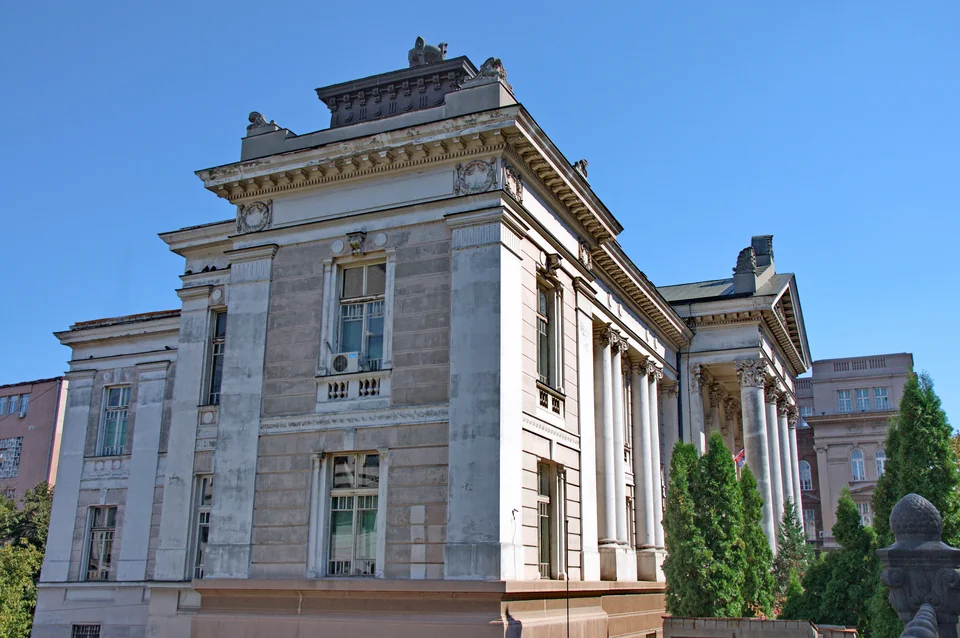
Public universities in Belgrade
The University of Belgrade is the country's oldest and largest institution: a higher school since 1808 and a university since 1905. Of its 31 faculties, 30 are in Belgrade and the Technical Faculty is in Bor. You apply to a faculty rather than to the university as a whole: the faculty publishes the admission call, sets the exam and fixes the international fee. Rates change every year: the Faculty of Economics, for example, set $2,040 (€1,800) a year for international students in its 2026/27 call, up from $1,700 (€1,500) in the 2025/26 table. The university profile with programmes and admission is at University of Belgrade.
The University of Arts brings together four faculties: dramatic arts, music, fine arts and applied arts. Besides the general ranking, applicants take an aptitude test, so preparation starts early with a portfolio or performance programme.
The University of Defence (the Military Academy and the Medical Faculty of the Military Medical Academy) and the University of Criminal Investigation and Police Studies train staff for the armed forces and police and admit under special rules. For a typical international applicant they are not a practical route. Do not confuse them with the Faculty of Security Studies, which belongs to the University of Belgrade and admits through the regular procedure.
Where University of Belgrade faculties are located
Faculties are spread across the city, and your commute affects both budget and time. Addresses below are taken from the NAT guide.
| Area or landmark | Address | Faculties |
|---|---|---|
| Students' Square, historic centre | Studentski trg 1–16 | rectorate, philology, geography, mathematics, biology, chemistry, physics, physical chemistry |
| City centre near Students' Square | Čika Ljubina 18–20; Kamenička 6; Đušina 7 | philosophy; economics; mining and geology |
| Bulevar kralja Aleksandra and nearby streets | Bulevar kralja Aleksandra 67–73; Karnegijeva 4; Kraljice Marije 16 | law, electrical engineering, civil engineering, architecture; technology and metallurgy; mechanical engineering |
| Medical cluster by the Clinical Centre | Dr Subotića 8 | medicine, dentistry |
| Voždovac and Banjica | Jove Ilića 154 and 165; Vojvode Stepe 305 and 450; Gospodara Vučića 50 | organizational sciences, political sciences; transport and traffic engineering, pharmacy; security studies |
| Zemun | Nemanjina 6 | agriculture |
| Banovo Brdo and Košutnjak | Kneza Višeslava 1; Blagoja Parovića 156 | forestry; sport and physical education |
| Other addresses | Bulevar oslobođenja 18; Visokog Stevana 2; Kraljice Natalije 43; Mije Kovačevića 11b | veterinary medicine; special education and rehabilitation; teacher education; Orthodox theology |
In practice, if you enrol at the School of Electrical Engineering or the Faculty of Architecture, look for housing near Bulevar kralja Aleksandra; future students of organizational or political sciences are better served in Voždovac. Central rents are higher than in residential districts, but savings on commuting sometimes offset them.
Private universities in Belgrade and how to check accreditation
By law, a degree from an accredited private programme carries the same legal weight as a public one. Accreditation lasts seven years, so check the latest date for each institution in the NAT guide.
| University | Registered address | Latest institutional accreditation in the NAT guide | English-taught bachelor's | English bachelor's fee, 2026/27 |
|---|---|---|---|---|
| Singidunum | Danijelova 32 | 20.05.2020 | business economics, IT, computer science, applied AI, English studies and others | $4,430 (€3,900) |
| Metropolitan | Tadeuša Košćuška 63 | 21.01.2025 | IT, software engineering, game development, design, digital business and others | $5,680 (€5,000) |
| Union | Kosančićev venac 2/5 | 14.11.2023 | no English-language version listed; offers an English Language degree | — |
| Union – Nikola Tesla | Cara Dušana 62–64 | 01.03.2021 | engineering management | see the university's fee decision for your year |
| Alfa BK | Bulevar maršala Tolbuhina 8 | 11.03.2022 | none listed | — |
| MB | Prote Mateje 21 | 25.02.2022 | none listed | — |
| Megatrend (formerly also John Naisbitt University) | Goce Delčeva 8 | 12.02.2016 | none listed | — |
| European University | Carigradska 28 | 26.08.2011 | none listed with a current date | — |
Compare these dates with your study plan. Singidunum's latest institutional accreditation is dated 20.05.2020, so its seven-year term runs out in May 2027: before signing a contract for the whole degree, ask whether re-accreditation has been applied for. For Megatrend and European University, the latest institutional accreditation dates in the guide are more than seven years old. That does not automatically mean they cannot operate, since individual faculties may hold newer dates. Before signing a contract, ask for the current accreditation decision and match the programme name against the NAT guide. The guide's section on institutions whose operating licences were revoked also includes Belgrade colleges, one of them by a ministry decision of 24.08.2026.
Belgrade also has many private colleges. Their degrees are valid when the programme is accredited, but the range of fields is narrow, and such a degree takes more explaining when you apply for a master's abroad.
Academies of applied studies
Four academies founded by the Republic of Serbia offer 180-ECTS applied bachelor's degrees in Belgrade: the Belgrade Academy of Business and Arts Applied Studies, the Academy of Applied Studies Belgrade, the Polytechnic Academy of Applied Studies and the Academy of Technical and Art Applied Studies. Fields include business, tourism and hospitality, allied health, IT, engineering, design, textiles and rail transport. The Polytechnic also offers mechatronics in English. How an applied degree differs from an academic one and what it means for a master's is explained in bachelor's degrees in Serbia.
How to choose a university in Belgrade
| Your priority | Where to look | What to consider |
|---|---|---|
| Strong subject foundations and the best-known degree | University of Belgrade faculties | exam and teaching in Serbian; language needed before admission |
| Studying only in English | Singidunum, Metropolitan, medical and some technical faculties | higher fees; check that the English group runs, see English-taught degrees in Serbia |
| Arts, music, film | University of Arts | aptitude test, portfolio |
| Getting a job fast | academies of applied studies | a master's takes longer to reach |
| Lowest budget | Serbian-taught University of Belgrade programmes or another city | living costs are lower in Novi Sad, Niš and Kragujevac, see University of Novi Sad |
| Flexible admission and online exams | private universities | check accreditation of the programme and its language version |
Living costs in Belgrade
Study in Serbia estimates a student's monthly costs in Belgrade at $970–2,270 (€850–2,000) including rent, food and transport; in Novi Sad, Niš and Kragujevac, $850–1,650 (€750–1,450). By the same estimate, a flat outside central Belgrade starts at $340 (€300) a month. A student canteen meal with a student card costs roughly $1–3 (€1–2.6); ask the student centre after enrolment whether you qualify for the card.
Fee-paying international students do not get public dormitory places. Under the Ministry of Education's 2026/27 call, places go to state-funded students with Serbian or regional citizenship whose permanent residence is outside the city of their institution. Plan your budget with rent from day one; the detailed calculation is in cost of studying in Serbia.
Admission and documents in brief
The procedure is the same for every Belgrade institution: recognition of your school certificate by the Qualifications Agency, proof of language, an entrance exam or test, enrolment and then temporary residence through the Ministry of Interior. Russian and Kazakh citizens can enter Serbia visa-free for up to 30 days, which covers the exam and enrolment. Detailed instructions are in applying to Serbian universities, diploma recognition in Serbia and student residence permit in Serbia. You can learn Serbian to exam level at the Centre at the University of Belgrade Faculty of Philology; options and prices are in Serbian language courses in Serbia.
Common mistakes
- Choosing "the University of Belgrade" in general. The faculty sets the admission call, exam and fee, and these vary widely.
- Renting before you know your faculty. Crossing the city can take more than an hour.
- Skipping the accreditation check for a private university. Look at the latest date for both the institution and the programme in the NAT guide.
- Assuming the Faculty of Security Studies belongs to the police university. It is a University of Belgrade faculty with regular admission.
- Counting on a dormitory. Fee-paying international students are not eligible for public dormitory places under the call.
FAQ
According to the NAT guide of 29.09.2026, four public and eight private universities are registered in Belgrade. The city also has academies of applied studies and private colleges.
For Serbian-taught study, most applicants choose a University of Belgrade faculty: it is the country's largest institution with the widest range of programmes. For English-taught bachelor's study, private Singidunum and Metropolitan or the medical faculties are more realistic.
Serbian-taught bachelor's programmes at the University of Belgrade mostly cost $1,700–4,090 (€1,500–3,600) a year under the 2025/26 table. English-taught bachelor's programmes cost $4,430 (€3,900) at Singidunum and $5,680 (€5,000) at Metropolitan in 2026/27. Living costs start at $970 (€850) a month.
Yes, on an English-taught programme: at private universities, in medicine and dentistry, or on selected English tracks at public faculties. Serbian-taught programmes require proof of language.
Fee-paying international students are not eligible for public dormitories under the 2026/27 call: places go to state-funded students with Serbian or regional citizenship. If you come on a scholarship or exchange, check the housing terms in your programme documents; everyone else rents, often sharing a flat with one or two classmates.
Open the NAT guide at nat.rs, find the university and the specific programme, and check the accreditation dates: accreditation lasts seven years. Also check the section on revoked licences and ask the university for a copy of its current decision.
Sources
- NAT guide to accredited institutions and programmes, 29.09.2026 (PDF) — as of 30.09.2026
- University of Belgrade: about the university, 2025/26 tuition fee table (PDF) — as of 30.09.2026
- University of Belgrade Faculty of Economics: 2026/27 admission call — as of 30.09.2026
- Singidunum: tuition fees, Metropolitan: 2026/27 international fees — as of 30.09.2026
- Ministry of Education: 2026/27 call for student dormitory places (PDF) — as of 30.09.2026
- Study in Serbia: living costs — as of 30.09.2026
- Law on Higher Education of Serbia — as of 30.09.2026
- Serbian Ministry of Foreign Affairs: visa regime for Russia and Kazakhstan — as of 30.09.2026
- Dollar figures follow the ECB rate on the check date, 29.09.2026 (€1 = $1.1355), rounded to $1 below $100 and to $10 above.
Shortlisting Belgrade faculties and private universities for your profile, accreditation checks and documents for recognition and admission are provided under an agreement with StudyU. The faculty or university decides on admission, the Qualifications Agency of Serbia on recognition of your certificate, and the Serbian Ministry of Interior on temporary residence.
Next steps
- Bachelor's Degrees in Serbia: Academic vs Applied, Duration, Fees and Outcomes
- English-Taught Degrees in Serbia: Where to Study, Fees and Admission
- Serbian Language Courses in Serbia: University Centres, Fees and Certificates
- Study in Serbia for international students
- University of Belgrade (Univerzitet u Beogradu)
- Universities in Serbia for International Students: List, Fees, Language and How to Choose
