
Medicine in Czechia is a six-year programme leading to the MUDr. title. General Medicine is taught at eight medical faculties: five at Charles University (three in Prague, one each in Plzeň and Hradec Králové), plus Masaryk University in Brno, Palacký University Olomouc and the University of Ostrava. Czech-taught programmes are tuition-free for every nationality, but international applicants need fluent Czech (a C1 certificate at three Charles University faculties) and a high score in biology, chemistry and physics tests. English-taught programmes cost from $14,190 (€12,500) a year in Olomouc to $27,540 (€24,250) at the First Faculty of Medicine in Prague in 2026/27.
Russian citizens should check one restriction before anything else. Czechia limits visa services for Russian and Belarusian nationals, and the Czech embassy in Moscow does not accept long-term study visa applications from Russian citizens, including dual nationals. Admission to a Czech faculty is possible, but you cannot start studying without a legal basis for residence. Citizens of Kazakhstan, Uzbekistan, Armenia and most other countries apply for a visa under the standard procedure.
Below: the two routes compared, a table of every faculty with places, competition and fees, exam formats, deadlines, the cost of six years and how the degree is recognised afterwards, including in Russia and Kazakhstan. The 2026/27 intake has closed, so its conditions are the latest complete set and the best guide if you plan to start in 2027. Faculties usually open applications for 2027/28 on 1 November: the Second Faculty of Medicine has already announced English-programme applications from 1 November 2026 to 30 April 2027 and a Prague exam on 3 June 2027. Data checked on 24 September 2026; US dollar figures use the ECB rate of 29 September 2026.
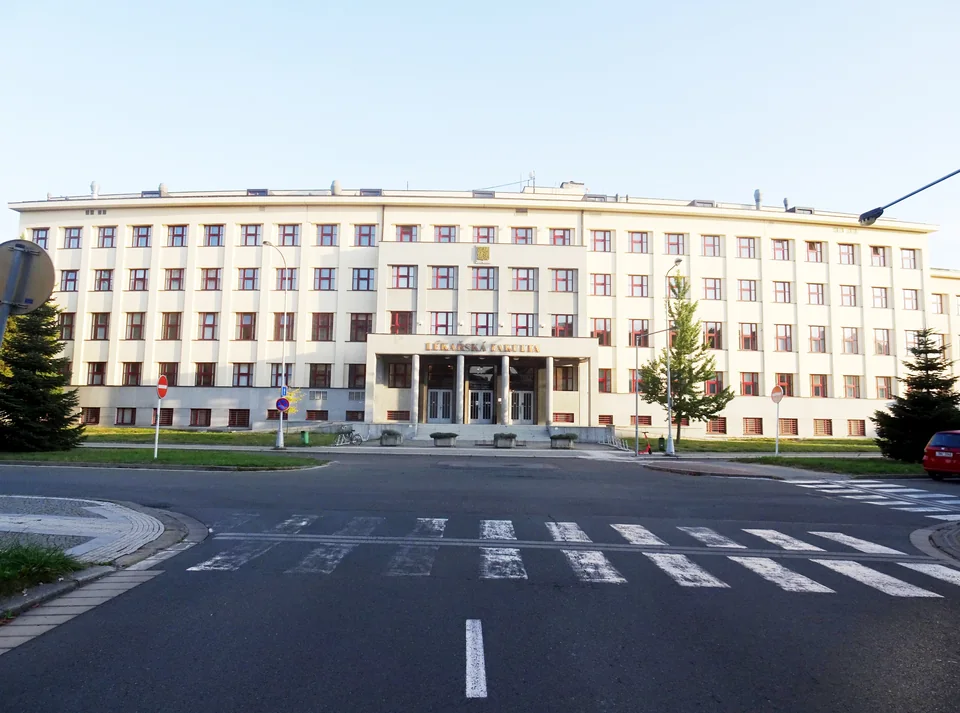
The two routes compared
| Czech-taught programme | English-taught programme | |
|---|---|---|
| Tuition | Free while you stay within the standard length plus one year | $14,264–27,672 a year in 2026/27 |
| Language | Czech: a C1 certificate at the First Faculty, Plzeň and Hradec Králové; elsewhere the exam itself tests your Czech | English; some faculties want a certificate, others run their own test |
| Application | Usually by 28 February; Olomouc by 15 March | From autumn to spring or summer, depending on the faculty |
| Exams | June, two rounds at some faculties; tests in Czech | January to September, in Czechia, abroad or online |
| Competition | High: 3 to 11 applications per admission | Usually lower; the First Faculty of Medicine is the exception |
| Patients and clinical work | In Czech from year one | You still learn Czech because patients speak it |
| Realistic start after finishing school abroad | Usually a year later, after language and science preparation | Possible in the year you finish school |
The real difference is time and risk rather than price. The free route nearly always requires a preparatory year, at the end of which you compete with Czech school leavers in their own language. The paid route starts sooner, but six years at current rates cost $85,582–166,030 in tuition alone.
Where to study: faculties, places and competition
The table shows the expected number of admissions for 2026/27 and the ratio of admissions to applications in the 2025/26 intake, from Charles University's information system and the faculties' own websites.
| Faculty | City | Czech-taught: plan and last intake | English-taught: plan, last intake and 2026/27 fee |
|---|---|---|---|
| First Faculty of Medicine, Charles University | Prague | 680 places; 631 of 3,412 | 150 places; 102 of 785; $27,540 (€24,250) |
| Second Faculty of Medicine | Prague (Motol hospital) | 207 places; 284 of 2,473 | 100 places; 257 of 679; $19,540 (CZK 420,000) |
| Third Faculty of Medicine | Prague | 211 places; 317 of 2,324 | 90 places; 90 of 436; $19,540 (CZK 420,000) |
| Faculty of Medicine in Plzeň | Plzeň | 300 places; 761 of 2,461 | 90 places; 92 of 368; $18,140 (CZK 390,000) |
| Faculty of Medicine in Hradec Králové | Hradec Králové | 340 places; 504 of 1,666 | 105 places; 208 of 377; $18,610 (CZK 400,000) |
| Faculty of Medicine, Masaryk University | Brno | Programme capacity of 430 students | $17,680 (CZK 380,000) |
| Faculty of Medicine and Dentistry, Palacký University | Olomouc | 270 places; 270 admitted from 2,948 applicants in the current intake | About 80 places; $14,190 (€12,500) |
| Faculty of Medicine, University of Ostrava | Ostrava | Programme offered | Programme offered; fee not published on the programme page |
What the numbers show. Czech-taught programmes in Prague see 5–9 applications per admission, Olomouc almost 11 applicants, and Plzeň and Hradec Králové about 3 applications. English-taught competition is lower on average: fewer than two applications per admission in Hradec Králové and about two and a half at the Second Faculty. The exception is the First Faculty, with almost 8 applications per English-taught place. Applications outnumber people, since one applicant can apply to several faculties.
Dentistry (MDDr., five years) takes fewer students: 30 English-taught places at the First Faculty, where the 2025/26 intake admitted 21 of 109 applicants and the fee equals General Medicine at $27,540 (€24,250); it is $15,900 (€14,000) a year in Olomouc and $18,610 (CZK 400,000) in Brno. Pharmacy is separate: at Charles University it is taught by the Faculty of Pharmacy in Hradec Králové, and in Brno by Masaryk University's Faculty of Pharmacy ($8,520 (€7,500) a year in English).
University profiles: Charles University, Masaryk University, Palacký University.
How the entrance exams work
Every faculty tests secondary-school biology, chemistry and physics, but formats differ so much that generic "Czech medicine" preparation is a poor strategy.
| Faculty | Czech-taught (2026/27) | English-taught (2026/27) |
|---|---|---|
| First Faculty | 150 questions, 50 each in chemistry, physics and biology; one correct answer, 1 point, no penalty; 12 June 2026 | Single-best-answer test in biology, chemistry and physics plus a logical and critical reasoning section; scores rescaled to percentages; those above the threshold sit online multiple mini-interviews (five short interviews, up to 100 points); one attempt per academic year |
| Second Faculty | Two rounds: 75 questions in biology, physics and chemistry (possibly several correct answers) and 30 aptitude questions; interview for at least the top 450 | 75 questions in 90 minutes: 20 each in biology, chemistry and physics and 15 in logic, up to 225 points; interview for top scorers, up to 90 points |
| Third Faculty | 90 questions, 30 each in biology, physics and chemistry; then an interview built on a popular-science text for at least the top 550 | 60 questions in biology and chemistry; then a 10-minute interview: read a text, retell it to the panel and answer a question; in 2026 the Prague exam was on 29 May, with sessions abroad and online from February to July |
| Plzeň | 75 questions, 25 each in physics, chemistry and biology, 135 minutes | 75 questions, 25 each in chemistry, biology and physics, at UK A-level standard |
| Hradec Králové | 80 questions: 20 each in biology, somatology (human anatomy and physiology), chemistry and physics; a wrong answer costs 0.25 points | Biology and chemistry 25 points each, physics or maths 10, then an interview in English worth up to 40 points; the test is taken in person through partner agencies or online via Scio |
| Masaryk University | Three 40-question tests, 50 minutes each, no penalty; 11–12 June 2026 | Tests in biology, chemistry and physics; the faculty publishes sample tests |
| Palacký University | 60 questions, 20 each in physics, chemistry and biology, 60 minutes; 9 June 2026 | Test in biology, chemistry and physics or maths; English via FCE, IELTS 6, TOEFL 87 or PTE 59, otherwise the faculty's own test |
Two details are easy to miss. First, plan for one attempt a year: Masaryk and Palacký schedule no alternative dates, and the First Faculty states that its English-programme exam can be taken once per academic year. Second, bonus points mostly reward Czech and Slovak schooling: the First Faculty adds 15 points for Czech school maths grades, the CERMAT exam or olympiads, and Masaryk counts olympiads and school exams only for applicants who finished school in Czechia or Slovakia. Two exceptions are open to international applicants. At Masaryk, IELTS 7+, TOEFL iBT 95+ or CAE adds 4 points for General Medicine, and a C1 certificate in German, French or Spanish adds 3. The First Faculty's English programme grants a 10% bonus for strong IB, A-level or German Abitur results.
How much Czech you need
For Czech-taught programmes, language is a separate admission condition, not just a tool for the test.
- First Faculty: a C1 Czech exam taken in Czechia at Charles University's ÚJOP or at a language school authorised to hold state exams. Not required from applicants who passed a Czech or Slovak school-leaving exam.
- Plzeň and Hradec Králové: C1 from a full member of ALTE or a state exam; in Plzeň the certificate must be dated no earlier than 30 June 2024 and submitted by enrolment.
- Second and Third Faculties, Masaryk and Palacký: the published 2026/27 first-year conditions name no separate certificate, but the tests, interviews and all teaching are in Czech. The Third Faculty asks for C1 only from students transferring from another medical faculty.
Even on English-taught programmes you cannot avoid Czech. Palacký University, for example, teaches compulsory Czech for the first three years because ward nurses and patients may speak only Czech.
Deadlines: why school leavers usually lose a year
| Stage | Czech-taught | English-taught |
|---|---|---|
| Application | 1 November to 28 February (Charles, Masaryk); to 15 March (Palacký) | In the 2026 intake: Third Faculty by 15 April; Second Faculty, Plzeň and Hradec Králové by 30 April; Palacký two weeks before your chosen exam date (dates ran from January to August); First Faculty by 5 September for applicants from visa-free countries |
| Application fee | $37–44 (CZK 790–940) | From $44 (CZK 940) to $325 (€285) |
| Exam | 6–17 June | January to September; abroad and online |
| Proof of secondary education | Brno: certificate recognised in Czechia by late June (25 June in 2026); elsewhere by enrolment | After the exam, before enrolment |
This creates a practical problem for school leavers from Russia or Kazakhstan. Certificates are issued at the end of June, but Masaryk University wants the recognised document by 25 June; you also need to apply by February and sit tests in Czech in June, with a C1 certificate at three faculties. That is why most applicants from abroad enter a Czech-taught programme after a preparatory year, when the certificate is already in hand and can be recognised in time. See our guides to nostrification in Czechia and applying to Czech universities.
English-taught programmes have their own trap: the visa. Palacký advises non-EU applicants to choose an exam no later than May because a residence permit can take up to three months, and its late-August dates are open only to EU citizens and holders of a Czech residence permit. At the First Faculty, applicants from visa-requiring countries may apply only through the faculty's official representatives, who run exams abroad.
The cost of six years
| Faculty | 2026/27 annual fee | Six years at this rate |
|---|---|---|
| Palacký University, Olomouc | $14,190 (€12,500) | $85,582 |
| Masaryk University, Brno | $17,680 (CZK 380,000) | $106,702 |
| Plzeň | $18,140 (CZK 390,000) | $109,510 |
| Hradec Králové | $18,610 (CZK 400,000) | $112,318 |
| Second and Third Faculties, Prague | $19,540 (CZK 420,000) | $117,933 |
| First Faculty, Prague | $27,540 (€24,250) | $166,030 |
These totals are indicative: the First Faculty states that $27,540 (€24,250) applies to students starting in 2026/27, with later intakes priced separately. Add living costs: Study in Czechia suggests $570–910 (€500–800) a month, or $41,000–66,000 over six years. A line-by-line budget is in our guide to the cost of studying in Czechia.
On a Czech-taught programme tuition stays at zero unless you exceed the standard length by more than a year; for medicine that means seven years. After that, the university charges for every started half-year ($1,120–2,370 (CZK 24,000–51,000) at Masaryk University in 2026/27).
Preparation offered by the universities themselves
- ÚJOP Charles University, one-year Medicine and Pharmacy programme in Czech: $7,860 (CZK 169,000) from zero, $5,670 (CZK 122,000) from B1. The from-zero course targets B1–B2, below the C1 that three Charles University medical faculties require. A medical Czech exam up to C1 is an optional extra, and for speakers of non-Slavic languages ÚJOP suggests a two-year plan: the from-zero course, then the B1 course.
- Masaryk University runs a foundation programme for its English-taught medicine and dentistry, plus three online courses in biology, chemistry and physics at $115 (€100) each.
- Third Faculty runs a PREMEDICAL course from January to May for its English-taught programme, and two-day monthly sessions from January to April for the Czech one.
- First Faculty runs a biology, physics and chemistry course for Czech-taught applicants from October to April.
For a Russian citizen, a preparatory course in Czechia runs into the same visa barrier, so start with the question of your residence basis, not with paying for the course.
After graduation
In Czechia. Graduates hold a Czech medical degree that needs no recognition at home. Working with patients requires fluent Czech, so English-programme graduates must bring theirs up to working level.
In the EU. On request, the Czech Ministry of Health issues a certificate confirming that the basic medical qualification complies with Directive 2005/36/EC. The fee is $23 (CZK 500) and it takes about 30 days. For non-EU nationals, the right to practise in another EU country also depends on that country's immigration and licensing rules, so the certificate does not replace the local procedure.
In Russia. Under Article 69 of the Federal Law on the Fundamentals of Health Protection (as amended 4 August 2026), a person with foreign medical education may practise after three steps: recognition of the education under education law, confirmation by Roszdravnadzor that the qualification meets the requirements, and specialist accreditation. Recognition needs no expert review if the university is on the list approved by Government Order No. 186-r or a treaty applies; otherwise Rosobrnadzor recognises the degree on application. Two Czech universities are on the list: Charles University (since 2023) and Masaryk University (added by Order No. 126-r of 27 January 2025; the latest amendment, No. 298-r of 19 February 2026, left the Czech section unchanged). For both, the list names the Bakalář, Inženýr, Magistr and PhD qualifications but not the MUDr. title that medical graduates receive. Before you enrol, ask Rosobrnadzor whether recognition without expert review covers a medical degree, and allow time for a recognition procedure. Palacký University is not on the list.
In Kazakhstan. Foreign degrees are recognised by the National Center for Higher Education Development (ENIC-Kazakhstan). You apply via eGov.kz or a public service centre (TsON) with a notarised translation and, unless a treaty waives it, an apostille. Processing takes 15 working days via eGov.kz and 25 via TsON, or 35 and 45 if the centre has to send an international enquiry. The centre states plainly that recognition does not grant the right to practise: access to practice, internship, residency and specialist certification are regulated separately. If you plan to return, check Kazakhstan's health-sector requirements for foreign medical graduates before choosing a faculty.
Choosing your route
| Your situation | Realistic option |
|---|---|
| Russian citizen with no other basis for residence in Czechia | Czechia is not currently accessible; compare medicine in Germany, Italy, Turkey or Slovakia, checking the visa rules for your passport |
| Citizen of Kazakhstan or another country with a year to spare and willingness to learn Czech | Preparatory year: Czech to the level your faculty requires plus biology, chemistry and physics; apply to two or three faculties by the end of February. Starting from zero, allow for the risk of a second year |
| Strong biology and chemistry in English, budget from $15,000 a year | English-taught programme; apply early to leave time for the visa |
| You want dentistry | Keep a backup: English-taught places are scarce |
| You plan to practise in Russia | Charles and Masaryk are on the Order No. 186-r list, Palacký is not; confirm how an MUDr. degree is treated with Rosobrnadzor before applying |
Common mistakes
- Assuming free Czech medicine is available straight after school and ignoring nostrification deadlines and Czech-language requirements.
- Preparing from one question bank for every faculty, although test formats and the weight of logic differ.
- Choosing an August exam while needing a visa, and running out of time for the residence permit.
- Paying for courses or housing before checking the visa route, especially with a Russian passport.
- Counting on bonus points awarded for Czech olympiads and exams.
FAQ
Yes, on Czech-taught programmes, provided you succeed in the regular admission process. Fees apply only if you exceed the standard six years by more than a year. International applicants need fluent Czech (a C1 certificate at three faculties) and strong test results in biology, chemistry and physics.
In 2026/27, from $14,190 (€12,500) a year at Palacký University to $27,540 (€24,250) at Charles University's First Faculty of Medicine. The Second and Third Faculties charge $19,540 (CZK 420,000), Masaryk University $17,680 (CZK 380,000).
C1, confirmed by an exam, at the First Faculty, Plzeň and Hradec Králové. Only applicants who passed a Czech or Slovak school-leaving exam are exempt. The Second and Third Faculties, Masaryk and Palacký name no separate certificate in their 2026/27 conditions, but exams and teaching are in Czech.
Formally they can be admitted: in April 2025 the Czech Ombudsman reminded universities that nationality alone cannot justify refusing an applicant. But the Czech embassy in Moscow does not accept study visa applications from Russian citizens, so without another legal basis for residence they cannot start.
For English-taught programmes, yes: Hradec Králové offers an online test via Scio, Palacký runs online and overseas sessions, and the Prague faculties test abroad through partners. Exams for Czech-taught programmes are held in person in Czechia.
It can be, but to practise you must also have Roszdravnadzor confirm the qualification and pass specialist accreditation. Charles and Masaryk universities are on the Order No. 186-r list, but the MUDr. title is not named in their entries, so check with Rosobrnadzor in advance how a medical degree is treated. Graduates of Palacký and other universities need a recognition procedure.
Under a service agreement we shortlist faculties that fit your citizenship, language and budget, build a preparation and application plan and check the visa route. Admission is decided by the faculty and visas by the Czech Ministry of the Interior. For a country overview, see studying in Czechia.
Sources
- Charles University information system, 2026/27 admission conditions: First Faculty, Czech and English; Second Faculty, Czech and English; Third Faculty, Czech and English; Plzeň, Czech and English; Hradec Králové, Czech and English; First Faculty dentistry in English — checked 24 Sep 2026
- First Faculty: admissions 2026/27, who can still apply, 2026/27 fee — checked 24 Sep 2026
- Second Faculty: fees, entrance exam, 2027/28 dates, EU professional recognition — checked 24 Sep 2026
- Charles University: entrance exams and Czech requirements, application deadlines — checked 24 Sep 2026
- Masaryk University Faculty of Medicine: 2026/27 admission conditions (PDF), General Medicine, tuition fees, study-related fees 2026/27 — checked 24 Sep 2026
- Palacký University Faculty of Medicine: Czech programmes and General Medicine in English — checked 24 Sep 2026
- University of Ostrava Faculty of Medicine: General Medicine in English — checked 24 Sep 2026
- ÚJOP Charles University: foundation programmes and Medicine and Pharmacy programme — checked 24 Sep 2026
- Czech Foreign Ministry: limited visa services for Russians and Belarusians, Czech embassy in Moscow: study visa and restrictions — checked 24 Sep 2026
- Czech Ombudsman on admission of Russian and Belarusian nationals (8 Apr 2025) — checked 24 Sep 2026
- Russian Federal Law No. 323-FZ, Article 69 (as amended 4 Aug 2026), Federal Law No. 273-FZ, Article 107, Government Order No. 186-r with the list (PDF), amendments No. 126-r of 27 Jan 2025 (PDF) and No. 298-r of 19 Feb 2026 (PDF) — checked 24 Sep 2026
- ENIC-Kazakhstan: FAQ on recognition of education documents — checked 24 Sep 2026
- Study in Czechia: living costs — checked 24 Sep 2026
- Exchange rate: ECB reference rate of 29 Sep 2026, EUR 1 = USD 1.1355 and EUR 1 = CZK 24.411, i.e. USD 1 ≈ CZK 21.50
Next steps
- Nostrification in Czechia: How to Get Your School Certificate and Degree Recognised
- Applying to Czech Universities for 2027/28: Step-by-Step Plan, Deadlines, Documents and Exams
- Cost of Studying in Czechia: 2026/27 and 2027/28 Tuition, Living Costs and a First-Year Budget
- Masaryk University in Brno (Masarykova univerzita, MUNI)
- Studying Medicine in Germany as a Non-EU Applicant: Quotas, Selection, TMS, German C1 and Approbation
- Studying Medicine in Italy in English: IMAT, Non-EU Places and the 2026/27 Rules
