
In Malta, English is taught by private schools licensed and inspected every year by the government's ELT Council; on 1 October 2026 the council's website lists 33 schools. A week of a 20-lesson course in 2026 costs $264 (€234) at Maltalingua and $294 (€260) at AM Language, and a homestay room with breakfast and dinner adds $345–577 (€305–511) a week. Non-EU students who need a visa, including Russian citizens, take a Schengen visa for a course of up to 90 days and a national D visa for a longer one; the D visa is issued by Malta's Identità agency on documents lodged through VFS Global.
| At a glance | Rules and prices checked on 1 October 2026 |
|---|---|
| Who oversees schools | The ELT Council under Malta's Ministry for Education: licensing and yearly inspections |
| Course up to 90 days | Short-stay Schengen visa (type C) if you need a visa |
| Course over 90 days | National D visa via VFS Global, lodged at least 9 weeks before the start; required even for visa-exempt non-EU nationals |
| D visa fee | $113 (€100) for an appointment within three weeks, $169 (€150) for a next-day appointment |
| Funds for a D visa | 75% of the minimum wage per month of the course, about $843 (€746) a month |
| Work | Only on courses over 90 days, from month four, max 20 hours weekly, with a Jobsplus permit |
| Course price, 2026 | 20 lessons: $264 (€234) a week at Maltalingua, $294 (€260) at AM Language; long bookings cost less per week |
| Accommodation | Homestay $345–577 (€305–511) a week; a bed in a shared school-flat room from $153 (€135) |
Why Malta for English
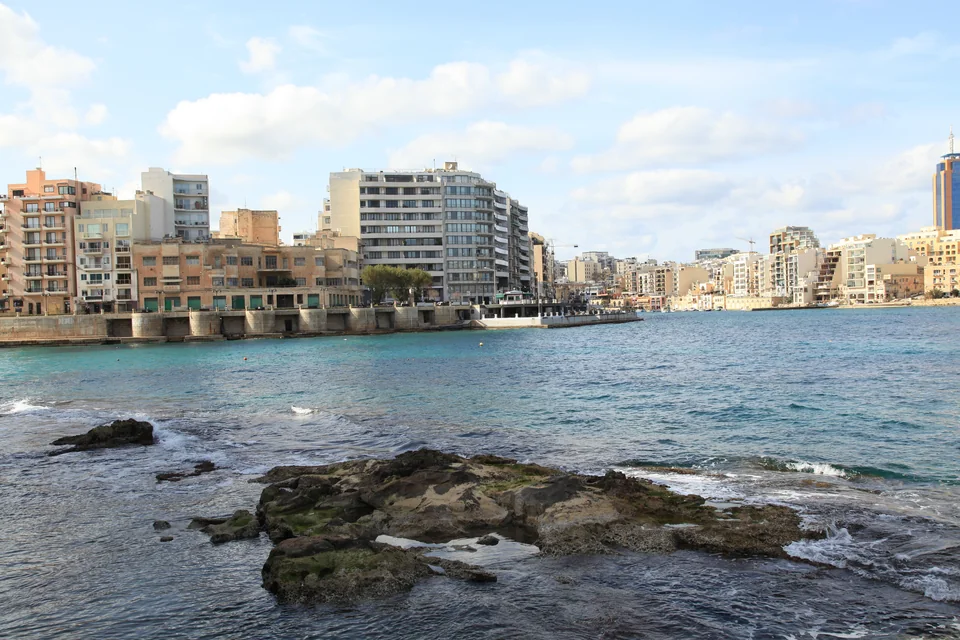
English is one of Malta's two official languages, used in shops, banks and public offices, so practice starts the moment you leave the classroom. Courses and housing cost less than in England, and a Schengen visa lets you combine the trip with other Schengen countries within its validity.
There are trade-offs. In summer the schools fill with European teenagers, and in the busy districts of St Julian's and Sliema a class can end up with several students sharing a first language. Malta works as well as England for serious exam preparation, but choose the school by class size and exam courses rather than by beach access.
Universities, admission and living costs are covered on our Study in Malta page. If the course is a step towards a degree, see our overview of universities in Malta, the guide to applying to Maltese universities and the breakdown of the cost of studying in Malta.
How quality control works: the ELT Council
Only schools licensed by the ELT Council may teach English to foreign language students in Malta. Regulation started in 1996, when the Minister of Education set up a monitoring board for English as a foreign language through subsidiary legislation. Today the council inspects schools annually, runs its own proficiency examination for prospective teachers and publishes the list of licensed schools with a map.
How to use this:
- Find the school on the ELT Council list. If it is not there, do not book a course for visa purposes.
- Check where classes take place. Some chains run several buildings; the address in the enrolment letter must match the school's licensed premises.
- Extra quality marks such as membership of the FELTOM federation, EAQUALS accreditation or Cambridge and IELTS test-centre status are useful but do not replace the licence.
Course types
| Format | Weekly load | Best for |
|---|---|---|
| General English | 20 lessons, usually 45 minutes each, morning or afternoon | holidays, speaking practice |
| Intensive | 30 lessons | fast progress, long programmes |
| IELTS or Cambridge preparation | 20–30 lessons, usually from B1 | university entry, work |
| Business English | 20–30 lessons, groups of up to 8 | professionals from Intermediate |
| 30+ and 50+ clubs | 20 lessons, separate groups | adults who prefer peers |
| One-to-one lessons | from 5 lessons a week | specific goals: interviews, professions |
Courses start every Monday, and a placement test on the first day sets your level. Most schools accept bookings from one week. Junior programmes are mainly summer schools with supervised homestay or residence; adult courses usually accept students from 16, which is Maltalingua's minimum age for IELTS preparation.
Course prices at two ELT Council schools
AM Language (Sliema), 2026 price list
| Course, weekly price | Price |
|---|---|
| General English, 20 lessons of 45 minutes | $294 (€260) |
| Same course booked for 8 weeks | $279 (€247) |
| Same course booked for 12 weeks | $264 (€234) |
| Same course booked for 24 weeks | $250 (€221) |
| Intensive English, 30 lessons | $407 (€360) |
| IELTS preparation, 20 lessons | $294 (€260) |
In July and August a $51 (€45) weekly supplement applies, and the course book costs $45 (€40). Classes average 10 students, with a maximum of 12. If a student visa is refused, the school keeps $136 (€120) for registration and administration. Students on a visa must keep attendance at 85% or higher, and the school reports absences to the immigration authorities.
Maltalingua (St Julian's), 2026 price list
An adults-only school with a maximum of 12 students per class and 45-minute lessons.
| Standard General English, 20 lessons | 1 week | 4 weeks | 12 weeks | 24 weeks |
|---|---|---|---|---|
| Total price | $264 (€234) | $990 (€876) | $2,874 (€2,544) | $5,613 (€4,968) |
From 22 June to 28 August 2026 a $56 (€50) weekly supplement applies. Intensive English with 30 lessons costs $388 (€343) for one week and IELTS preparation $394 (€349); the IELTS exam itself is extra at $305 (€270). The school charges nothing extra for course materials, and 2027 courses booked by 31 October 2026 keep 2026 prices outside the summer weeks.
A four-week budget
| Scenario | Course and fees | Four weeks of housing | Total before flights |
|---|---|---|---|
| AM Language, 20 lessons and course book, homestay single room, low season | $1,220 (€1,080) | $1,378 (€1,220) | $2,599 (€2,300) |
| Maltalingua, 20 lessons, homestay single room, low season | $990 (€876) | $1,645 (€1,456) | $2,635 (€2,332) |
Both totals rise in summer: the course by $51–56 (€45–50) a week and the homestay by $106–166 (€94–147). Insurance, transport and Malta's eco-contribution are extra; at Maltalingua the eco-contribution is €1.50 a night, capped at €22.50 per stay.
Where to live
- Homestay. A single or twin room with breakfast and dinner. At AM Language a single room costs $345 (€305) a week, or $451 (€399) in July and August; at Maltalingua $411–577 (€364–511) depending on the week.
- School apartments and residences. A private or shared room with a kitchen shared by several students. At AM Language a bed in a shared room of a school flat costs $153–288 (€135–255) a week depending on the season, and a single room $305–576 (€270–510); a single room in Maltalingua's apartments costs $340–498 (€301–441).
- Private rental. Possible on a long course, but a D visa still requires confirmed accommodation for the first 14 nights.
Visas for language courses
Malta is part of the Schengen area. Both short-stay C visas and national D visas are decided by the Central Visa Unit of Malta's Identità agency; the school only issues the enrolment letter.
Course up to 90 days: Schengen C visa
Visa-required nationals apply for a standard Schengen visa for study through VFS Global, with the school's letter showing dates and payment, proof of accommodation, a bank statement, Schengen travel medical insurance and a return ticket. The visa is issued by the country of your main destination, so if the trip is for a Maltese course, apply for a Maltese visa. A valid Schengen visa from another country allows entry, but border guards may ask why your main stay is elsewhere.
Russian citizens face general EU restrictions: the visa facilitation agreement has been suspended since 2022, and a European Commission decision of 6 November 2025 limited multiple-entry C visas for them. The ETIAS travel authorisation that school websites mention concerns only visa-exempt travellers and does not apply to anyone who needs a visa.
Course over 90 days: national D visa
All non-EU nationals need this visa, including those who can enter the Schengen area visa-free. The Identità checklist (version 2.1 of 13.08.2025) sets out the steps:
- Book a VFS Global appointment and lodge the application at least 9 weeks before the course starts.
- Passport valid for at least 10 months, application form and photo.
- A school letter showing course title and length, weekly hours, holiday periods, the teaching address and proof of payment.
- Three months of bank statements and a recent bank certificate showing at least 75% of the national minimum wage for every month of study. With the 2026 minimum wage of $259 (€229.44) a week, that is about $843 (€746) a month, or roughly $5,057 (€4,476) for six months. A sponsor provides their statements, a signed declaration and a copy of their passport.
- A copy of the international bank card you will use in Malta.
- Schengen medical insurance with at least $33,894 (€30,000) cover for the whole stay.
- A flight arriving no more than two weeks before the course; for a course shorter than six months, a return ticket too.
- Accommodation for the first 14 nights: a school letter, a registered lease or a booking.
- For minors, a legalised and translated birth certificate, copies of the parents' passports and their consent.
All documents must be in English, and translations must come from Identità's list of authorised translators. The fee is $113 (€100) for a standard appointment and $169 (€150) for a next-day one. The D visa and residence permit are covered in detail in our Malta student visa guide.
Can you work?
Under Identità rules, a student on a course of more than 90 days that is not a higher-education programme may work only after the first three months of study, for up to 20 hours a week, with a permit from the Jobsplus employment agency, which also sets the sectors. The ministry responsible for Jobsplus may change these conditions. Short courses carry no work rights. Do not count on part-time work to fund the stay: the visa requires proof of money for the whole period in advance.
Paying from Russia
Schools invoice in euros and expect payment in advance; for a D visa, proof of payment goes with the school letter. From Russia, use only lawful routes: a transfer from a bank that can send euros, or payment by a relative from an account abroad with a clear origin of funds. Options are explained in our guide on how to pay for studies abroad from Russia.
Step-by-step plan
- 4–5 months ahead. Decide on the length: up to 90 days or longer. This determines the visa, the timeline and the funds required.
- 3–4 months ahead. Choose a school from the ELT Council list, book the course and housing, pay, and get the enrolment letter.
- 3 months ahead. Prepare three months of statements, insurance, a flight booking and translations.
- At least 9 weeks before the course for a D visa, or 4–6 weeks for a C visa. Book VFS Global and lodge the documents.
- After the visa. Book flights that land within 14 days of the start date; on a long course, follow the school's registration instructions after arrival.
Common mistakes
- Booking a school that is not on the ELT Council list. The trip cannot then be documented as study.
- Applying for a D visa a month before the start. The checklist requires at least nine weeks.
- Showing funds without history. A three-month statement is needed, not a single deposit the day before.
- Buying insurance for the first weeks only. For a language course the policy must cover the entire stay.
- Going in summer for peace and quiet. From June to August schools are full of teenagers and prices peak.
FAQ
Maltalingua charges $264 (€234) and AM Language $294 (€260) for one week of 20 lessons in 2026. Four weeks with a single homestay room come to roughly $2,599–2,635 (€2,300–2,332), excluding flights and the visa.
A stay of 90 days or less needs a short-stay Schengen visa if you are visa-required; anything longer needs a national D visa lodged through VFS Global. The Central Visa Unit of Identità decides D visa applications, so the school letter and bank statements must match its checklist exactly.
You can enter on a valid Schengen visa if its validity and permitted days cover the course. However, visas are issued by the main destination country, and a long study stay in Malta may prompt questions at the border, where the border guard decides on entry.
Adult courses usually start at 16, and some schools teach adults only. Teenagers join summer programmes with supervised accommodation. A minor needs parental consent and a legalised birth certificate for the visa, and Identità decides whether to issue it.
Not on a short course. On a long course, work becomes possible from the fourth month, part-time and only once Jobsplus approves it. You still prove funds for the whole stay when applying, and the work permit comes from the state agency, not the school.
A homestay gives more speaking practice and includes breakfast and dinner, but may be farther from school. School apartments cost less per week and give independence, though you have to seek out English conversation yourself.
Malta is cheaper, but the visa is a Schengen one and summers are crowded with teenagers. England costs more but offers a wider choice of schools and exam centres. Prices and visas are compared in our guide to English courses in England.
Sources
- ELT Council Malta: the industry and the list of licensed schools — checked 01.10.2026
- Identità Central Visa Unit: courses exceeding 90 days and student employment — checked 01.10.2026
- Identità: student national visa checklist, version 2.1 of 13.08.2025 (PDF) — checked 01.10.2026
- AM Language: 2026 adult price list (PDF) — checked 01.10.2026
- Maltalingua: 2026 course and accommodation prices and course details — checked 01.10.2026
- DIER: 2026 national minimum wage of €229.44 a week — checked 01.10.2026
Dollar amounts use the ECB reference rate of 01.10.2026: €1 = $1.1298.
If you want to work through your route, send a request: document preparation and submission are provided under an agreement with StudyU, the school makes the enrolment decision, and the consulate decides on the visa.
During the free initial consultation, we clarify your goal, profile, timing, and budget and identify the next realistic step.
Next steps
- Studying in Malta for international applicants
- Universities in Malta for International Students: Which Institutions Exist and Where You Can Realistically Apply
- Applying to Maltese Universities: Routes After School and After a Degree, Documents, English and Deadlines
- Cost of Studying in Malta in 2026/27: University Fees, Living Costs and a First-Year Budget
- Malta Student Visa for University Study: D Visa, Residence Permit and Work Rights
- How to Pay for Studies Abroad from Russia: What Works in 2026
