
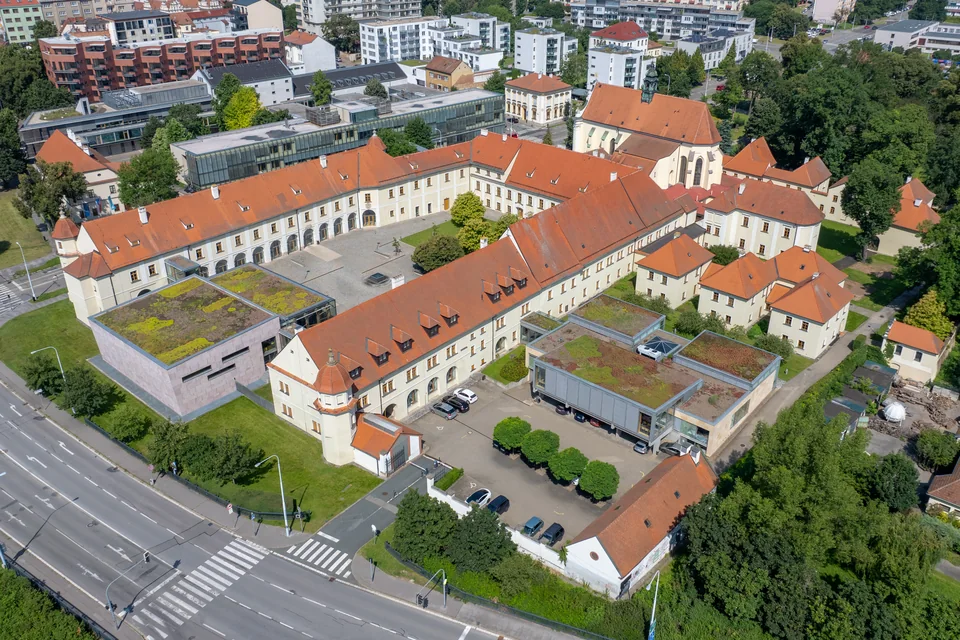
Brno University of Technology (Vysoké učení technické v Brně, VUT, also abbreviated BUT) is a large technical university founded in 1899, with 8 faculties, 3 university institutes and about 18,000 students. Czech-taught degrees are tuition-free for anyone who can prove knowledge of Czech. English-taught degrees are fee-paying: for non-EU citizens starting in 2026/27, annual fees range from $3,420 (€3,000) for a master's at the Faculty of Information Technology to $5,710 (€5,000) at the Faculty of Business and Management. Applications for 2027/28 open in autumn 2026; the Faculty of Electrical Engineering and Communication starts accepting them on 1 October.
| At a glance | Details |
|---|---|
| Location | Brno, Czechia's second-largest city |
| Founded | 1899 |
| Students | about 18,000 |
| Structure | 8 faculties and 3 institutes, including CEITEC BUT |
| Rankings | QS World University Rankings 2027: =588; THE World University Rankings 2026: 1201–1500 |
| Czech-taught degrees | tuition-free; proof of Czech required |
| English-taught degrees (non-EU, 2026/27) | FIT master's $3,420 (€3,000) a year; FEEC $5,130 (€4,500); FBM $5,710 (€5,000) |
| Preparation | one-year Czech course at VUT, $2,810 (CZK 60,000) |
| Dormitories | 4 residence halls and the Starý pivovar guesthouse, $6–10 (CZK 129–216) per bed per night |
How VUT compares with CTU in Prague
Engineering applicants usually choose between Brno and Prague. The degrees are comparable; the differences lie in the details:
| Criterion | VUT (Brno) | CTU (Prague) |
|---|---|---|
| Profile | engineering, IT, chemistry, architecture, plus business and fine arts | engineering, IT, architecture, transport, biomedical engineering |
| English-taught fees | $3,420–5,710 (€3,000–5,000) a year for non-EU citizens; the rate depends on citizenship | $5,150–6,180 (CZK 110,000–132,000) a year regardless of citizenship |
| One-year Czech course at the university | 560 teaching hours, $2,810 (CZK 60,000) | 700 hours, $4,740 (€4,150) |
| Dormitory | $6–10 (CZK 129–216) per bed per night | $4–13 (CZK 92–280) per bed per night |
| City | compact; rent and everyday costs lower than in the capital | more jobs and internships, higher costs |
| QS 2027 | =588 | =432 |
If the widest choice of programmes and the capital's job market matter most, see our CTU profile. If a compact campus with dorms, canteens and faculties close together matters more, look at Brno. English-taught fees are similar, but at VUT they depend on citizenship, and the FIT master's is noticeably cheaper.
Who VUT suits and where it can be harder
A good fit for:
- school leavers ready for a year of Czech followed by tuition-free engineering study;
- bachelor's graduates looking for an affordable English-taught master's in IT, electrical or mechanical engineering;
- students who want dorms, canteens and faculties close together (the Pod Palackého vrchem campus);
- applicants who want to combine technology and business: VUT has its own Faculty of Business and Management.
Compare alternatives if:
- you want an English-taught bachelor's in IT: FIT VUT teaches in English only at master's and doctoral level;
- you are counting on a large network of internships with international firms in the capital;
- you are a Russian citizen: a student visa cannot currently be obtained; see the visa section below.
Faculties and fields
| Faculty | Abbreviation | Fields | English-taught degrees |
|---|---|---|---|
| Civil Engineering | FAST (FCE) | civil engineering, geodesy, building architecture | Civil Engineering bachelor's and master's |
| Mechanical Engineering | FSI (FME) | mechanical and aerospace engineering, mechatronics, applied sciences | bachelor's and master's |
| Electrical Engineering and Communication | FEKT (FEEC) | electronics, communications, automation, power engineering, biomedical technology | bachelor's and master's |
| Architecture | FA | architecture and urbanism | master's |
| Chemistry | FCH | materials chemistry and technology, food chemistry, medicinal chemistry | doctoral only |
| Business and Management | FP (FBM) | economics and management, entrepreneurship, information management | bachelor's and master's |
| Fine Arts | FaVU (FFA) | painting, sculpture, graphic and product design | master's |
| Information Technology | FIT | IT, AI, security, computer graphics | master's and doctoral |
Three university institutes complete the picture: the Institute of Forensic Engineering (ÚSI) trains experts in transport, real estate and risk; CEITEC BUT runs materials and nanotechnology research; and the Centre of Sports Activities (CESA) handles physical education.
English-taught tuition fees
Each dean sets the fees, and they depend on citizenship. Citizens of Kazakhstan, Uzbekistan and other non-EU countries pay the higher rate:
| Faculty | Level | EU citizens | Non-EU citizens |
|---|---|---|---|
| FEEC (electrical engineering) | bachelor's and master's | $1,140 (€1,000); the same rate applies to Ukrainian citizens | $5,130 (€4,500) |
| FBM (business) | bachelor's | $2,850 (€2,500) | $5,710 (€5,000) |
| FBM | master's | $3,990 (€3,500) | $5,710 (€5,000) |
| FIT (information technology) | master's | $3,420 (€3,000) | $3,420 (€3,000) |
Amounts are per academic year for students starting in 2026/27. Fees for 2027/28 are set by separate faculty decisions; at FBM the rate in force when you start applies for the standard length of study. For the Faculties of Civil Engineering, Mechanical Engineering, Architecture and Fine Arts, check the dean's decision on English-taught fees for your year: there is no single VUT-wide rate. FIT offers a partial refund: if a student passes all enrolled courses (at least 20 credits per semester), 25% of the fee is refunded for a grade average up to 3.0, 50% up to 2.0 and 75% up to 1.5 (in the Czech system 1 is the best grade).
The application fee is $33 (CZK 700, or €28) at FEEC and $32 (€28) at FIT.
How to apply to VUT: step-by-step plan for 2027/28
- October–December 2026: choose a faculty and language. VUT's e-application shows which programmes are already open. FEEC accepts 2027/28 applications from 1 October 2026.
- At the same time: prepare your education documents. Certificate or diploma with signatures and stamps authenticated according to the rules of the issuing country, translation and, if required, a description of subjects.
- By the faculty deadline: apply and pay the fee. In the 2026/27 cycle FIT and FBM closed their English-taught programmes on 31 March 2026; FIT required payment of the fee by 15 April.
- Spring to early summer 2027: entrance exam. The format is set by the faculty: a written test in core subjects, or creative tasks and a portfolio in architecture and fine arts.
- After admission: recognition and visa. The Letter of Acceptance arrives once documents are complete, with details of the first tuition payment. Apply for the student visa straight away.
- September 2027: arrival, housing and Welcome Week. VUT runs an orientation week for international students.
For the general Czech admissions process, see our guide to applying to Czech universities.
Recognition of your certificate or diploma
As an institutionally accredited university, VUT can assess foreign education itself as part of admission. There are two routes.
- Assessment within admission. You submit the request to the faculty together with the e-application and attach a certified copy of your certificate or diploma, with signatures and stamps authenticated as required by the issuing country. The fee is charged per application: $35 (CZK 750, or €30) at FEEC. The result applies only to admission to VUT.
- General recognition (nostrification). If the faculty does not accept your document, it will ask for nostrification. School certificates are recognised by the regional authority where you live; in Brno this is the South Moravian Regional Authority. Foreign university degrees are recognised by the rectorate of a university with a similar programme, for a fee of $140 (CZK 3,000).
Graduates of schools in Slovakia, Hungary, Poland, Germany and Slovenia are exempt: their documents are recognised automatically under equivalence agreements. See our guide to nostrification in Czechia.
Language of instruction and the preparatory course
VUT states that international students in Czech-taught programmes study on the same terms as Czechs, without fees, but must prove knowledge of Czech. The level and form of proof are set in each faculty's admission conditions; aim for B2, which is what you need to follow lectures and pass exams.
VUT's Continuing Education and Counselling Centre runs a one-year course for future students:
| Item | 2026/27 course |
|---|---|
| Name | Preparatory language course — Czech for foreigners |
| Dates | 1 October 2026 – 30 June 2027 |
| Volume | 2 semesters, 560 teaching hours |
| Price | $2,810 (CZK 60,000) |
It costs noticeably less than the one-year courses at CTU ($4,740, or €4,150) or Palacký University ($4,070, or CZK 87,000). The course does not replace the faculty entrance exam, so maths, physics or chemistry need to be prepared in parallel. For other options, see our guide to Czech language preparatory courses.
English-taught programmes require a B2 certificate; each faculty publishes its list of accepted tests.
Dormitories and a student budget in Brno
Housing is run by VUT's Halls of Residence and Refectories service. Prices from 1 September 2026, per bed per night:
| Residence | What it offers | Per night | Approx. per month |
|---|---|---|---|
| Pod Palackého vrchem | 2,500 places on campus; single, double and triple rooms with own bathroom and kitchen | $7–10 (CZK 155–215) | $220–300 |
| Purkyňovy koleje | double and triple rooms; bathroom and kitchen shared by several rooms | $6–7 (CZK 129–139) | $180–200 |
| Listovy koleje | single and double rooms; shared bathroom and kitchen | $6–7 (CZK 137–142) | $190–200 |
| Mánesovy koleje | cluster rooms with shared hallway and facilities | $7–8 (CZK 145–167) | $200–230 |
| Penzion Starý pivovar | single and double cluster rooms, with or without a kitchen | $8–10 (CZK 165–216) | $230–300 |
Prices within a residence depend on the room type; check the VUT price list for your category. Study in Czechia estimates a basic student budget of $570–910 (€500–800) a month with a dormitory, including $170–260 (€150–230) for food. See also the cost of studying in Czechia.
Citizens of Russia, Kazakhstan and Uzbekistan: visas and restrictions
Russia. The Czech Ministry of Foreign Affairs list contains no study ground for Russians: consulates take applications only from family members of EU citizens or of foreigners living in Czechia, Civil Society Programme participants, and in cases of Czech national interest. According to the Czech embassy in Astana, this also applies to Russians who hold a second citizenship. In addition, Czech universities apply the EU ban on "technical assistance" in areas linked to dual-use technology, energy, transport, telecommunications, aviation and space. Universities follow Czech Ministry of Education instruction No. MSMT-11649/2022-1, and neighbouring universities show how this works in practice: CTU publishes a list of "critical" programmes, and CZU's economics faculty has classed one of its master's programmes as critical. Almost everything at VUT is technical, so before paying the application fee ask the faculty's study office for a written answer on whether it can admit a Russian or Belarusian citizen to your programme.
Kazakhstan. At the Czech embassy in Astana, the admitting university books the student visa appointment by emailing the admission confirmation. The embassy reports a wait of 21–30 days. University students can also be included in the Režim Student programme (30 places a month shared by Kazakhstan and Kyrgyzstan), with the university nominating the student.
Uzbekistan. An admitted bachelor's or master's student emails tashkent.visa@mzv.gov.cz directly (passport number only in the subject line; scans of the passport and admission letter attached). Preparatory course students use a monthly online registration with limited places. Applications to study at a public university, including its courses, are decided within 60 days.
Visa decisions are made by the Czech Ministry of the Interior. See our guide to the student visa and residence permit in Czechia.
Proof of funds, fee reductions and working while studying
How much money to show. The Czech Ministry of the Interior requires 15 times the subsistence minimum plus twice the minimum for each further month. For an academic year that is $5,420 (CZK 115,810), for a semester $3,662 (CZK 78,250); applicants under 18 need half. The consular fee is $117 (CZK 2,500).
How to lower an English-taught fee. FIT refunds part of the fee for good results (see above). At the Faculty of Business and Management, a non-EU bachelor's student who has completed all first-year requirements may apply for a reduced fee when registering for the second year; the faculty decides.
Work. With a visa or residence permit for study in an accredited programme you do not need a work permit, but study must remain your main purpose of stay, which the ministry checks at renewal.
Mistakes that cost applicants a year
- Looking for an English-taught IT bachelor's. FIT VUT does not offer one; English is available only at master's level, so the bachelor's route is in Czech.
- Mixing up EU and non-EU fees. Faculty tables list both; citizens of Kazakhstan or Uzbekistan need the non-EU column.
- Expecting the language course to replace the entrance exam. The course teaches Czech; the subject test is separate.
- Leaving certificate recognition for the summer. If the faculty does not accept your document, you will need nostrification at the regional authority, which adds weeks.
- Waiting for every paper before booking a visa appointment. Book as soon as you receive the admission letter.
VUT in the rankings
| Ranking | Position | Note |
|---|---|---|
| QS World University Rankings 2027 | =588 | =575 a year earlier |
| THE World University Rankings 2026 | 1201–1500 | band, no exact place |
Rankings describe the whole university. For engineering, it is more useful to check which companies a faculty works with and whether the programme includes a compulsory placement; this is shown on the programme page on the VUT website.
FAQ
Can I study at VUT for free?
Yes, in Czech-taught programmes. No tuition is charged to Czechs or foreigners, but you must prove knowledge of Czech and pass the faculty's entrance exam.
How much does a year in English cost for a Kazakh citizen?
For non-EU citizens starting in 2026/27: $5,130 (€4,500) at FEEC, $5,710 (€5,000) at the Faculty of Business and Management and $3,420 (€3,000) for a master's at FIT. Housing and living costs are extra.
When do 2027/28 applications open?
Faculties open online applications in stages from autumn 2026; FEEC starts on 1 October 2026. In the last cycle FIT and FBM English-taught programmes closed on 31 March.
Does VUT run a Czech preparatory course?
Yes. The VUT Continuing Education Centre runs a two-semester "Czech for foreigners" course of 560 hours, from 1 October 2026 to 30 June 2027, for $2,810 (CZK 60,000).
Do I need nostrification?
Not always. VUT can assess a foreign certificate during admission; you apply through the faculty (the fee at FEEC is $35). If the faculty does not accept the document, you will need nostrification at a regional authority.
How much is a VUT dormitory?
From 1 September 2026 a bed costs $6–10 (CZK 129–216) per night depending on the residence and room type, roughly $180–300 a month. The cheapest option is a triple room at Purkyňovy koleje.
How can StudyU help with VUT?
Under an agreement with StudyU, we shortlist faculties and programmes by language and budget, check requirements, prepare documents for assessment and the application, and plan language preparation and the visa stage. At the university, the faculty decides on admission; the Czech Ministry of the Interior as the migration authority issues visas.
Sources
- VUT: university profile
- VUT: degree studies in Czech
- VUT: degree studies in English — study information
- VUT: recognition of foreign education
- FEEC VUT: fees for studies in English
- FBM VUT: Dean's Decision No. 10/2025 on English-taught fees 2026/27 (PDF)
- FIT VUT: degree programme in English
- FBM VUT: admission procedure
- VUT e-application: open programmes
- VUT Continuing Education Centre: Czech courses for foreigners
- VUT Halls of Residence: price list from 1 September 2026 (PDF)
- VUT: residence halls
- Czech Ministry of the Interior: proof of funds for residence
- CTU list of critical study programmes (PDF)
- Czech MFA: visa services for citizens of Russia and Belarus
- Czech Embassy in Astana: study visa registration
- Czech Embassy in Tashkent: registration for university students
- Study in Czechia: living costs
- QS: Brno University of Technology
- THE: Brno University of Technology
Dollar amounts are converted at the ECB reference rate of 23 September 2026 (€1 = $1.1411; €1 = CZK 24.383) and rounded.
For all universities and general rules, see Study in Czechia. Masaryk University, in the same city, covers medicine, law and the humanities. Choosing a realistic route into VUT for your citizenship and background is provided under an agreement with StudyU; to start, send us a request.
During the free initial consultation, we clarify your goal, profile, timing, and budget and identify the next realistic step.
Next steps
- Nostrification in Czechia: How to Get Your School Certificate and Degree Recognised
- Czech Language Preparatory Courses: University Programmes, Private Schools, Prices and Visas
- Applying to Czech Universities for 2027/28: Step-by-Step Plan, Deadlines, Documents and Exams
- Cost of Studying in Czechia: 2026/27 and 2027/28 Tuition, Living Costs and a First-Year Budget
- Studying in the Czech Republic for international applicants
- Czech Student Visa and Residence Permit: Who Can Apply, Documents, Funds and Timing
