
If you want an English-taught degree at a public university in Latvia, the shortlist usually comes down to three institutions in Riga: the University of Latvia (LU), Riga Technical University (RTU) and Rīga Stradiņš University (RSU). LU covers the widest range, from IT and business to medicine; RTU is the engineering and computing university; RSU is built around medicine and dentistry. For 2026/27, an English-taught bachelor's year at these universities starts at about $3,750 (€3,300), while medicine costs $13,460 (€11,850) at LU and $15,330 (€13,500) at RSU.
Your passport matters as much as your grades. Citizens of Russia and Belarus can still obtain a residence permit for full-time study under Latvian law, but an entry visa is issued only after the migration authority has approved the permit, and universities close applications for them months earlier. Citizens of Kazakhstan, Uzbekistan and Kyrgyzstan follow the standard visa route; citizens of Georgia, Moldova and Ukraine can enter visa-free.
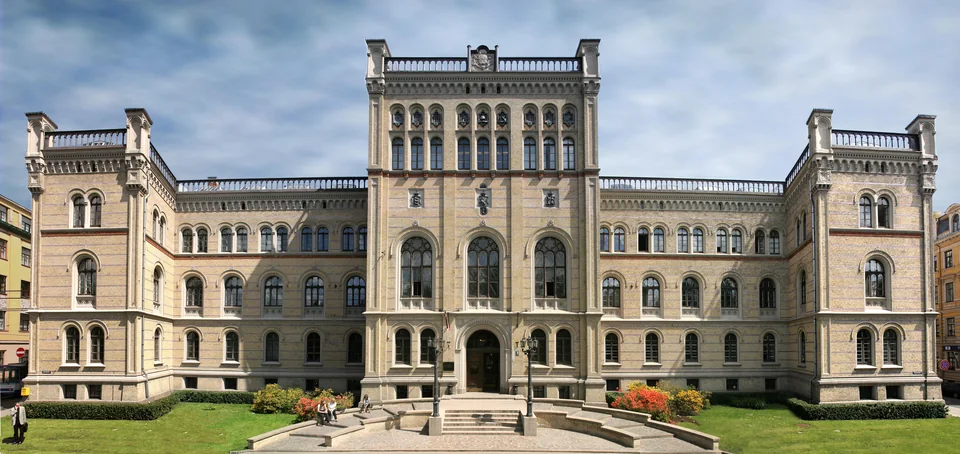
Latvian higher education at a glance
| Question | Answer |
|---|---|
| Language of instruction | Latvian or English; no degree programmes in Russian |
| Credits | 1 Latvian credit point = 1.5 ECTS; one academic year = 60 ECTS |
| Grading | 10-point scale, 4 is the lowest pass |
| Bachelor's | 3–4 years (academic), at least 4 years (professional) |
| Medicine / dentistry | 6 years, 360 ECTS / 5 years, 300 ECTS |
| English-taught bachelor's fee, 2026/27 | roughly $3,750–5,710 (€3,300–5,030) a year at LU, RSU and RTU |
| Work while studying | 20 hours a week in term, 40 in holidays; no hour limit for full-time master's and doctoral students |
| Residence document | temporary residence permit for studies, issued by PMLP (OCMA) |
Types of institutions and why they matter
Latvia follows the Bologna model, but a few distinctions affect which programme you should pick.
Academic vs professional degrees. An academic bachelor's (3–4 years) leans towards theory and research. A professional bachelor's lasts at least four years, includes a compulsory placement and also awards a professional qualification. Colleges offer short-cycle professional higher education lasting 2–3 years, and medicine and veterinary science are long-cycle programmes of 5–6 years.
Public vs private. For students from outside the EU, study is fee-paying at both. State-funded places are reserved for Latvian and EU citizens and equivalent categories. The real differences are the range of English-taught programmes, price and experience with international students.
Programme accreditation. A study residence permit requires full-time study at an accredited university or college in an accredited study field. Look at the accreditation period of the specific programme, not only at the institution's licence: RSU's medicine and dentistry are accredited until 28 May 2030, and RTU's BSc Computer Systems until 30 November 2029.
LU, RTU and RSU compared
| University of Latvia (LU) | Riga Technical University (RTU) | Rīga Stradiņš University (RSU) | |
|---|---|---|---|
| Profile | comprehensive: IT, business, economics, philology, biotechnology, optometry, medicine, dentistry | engineering, computer systems, architecture, materials, management | medicine, dentistry, health, international relations, business |
| English bachelor's, per year 2026/27 | Computer Science $3,790 (€3,340); Business Administration $3,750 (€3,300) | $4,030 (€3,550) to $5,710 (€5,030); BBA at RTU Riga Business School $8,570 (€7,550) | International Business and Start-up Entrepreneurship $3,750 (€3,300) |
| Medicine / dentistry, per year 2026/27 | $13,460 (€11,850) / $19,660 (€17,310) | not offered | $15,330 (€13,500) / $17,600 (€15,500) |
| Medicine places for international students | 35 fee-paying places in 2026/27 | — | 380 for September 2026, 240 for February 2027 |
| Selection for school-leavers from outside the EU | SAT 1200+, subject grades, online interview | motivation letter, reference, video interview; online maths test for bachelor's | school grades, motivational interview on Zoom, recognition of documents |
| Application fee | $190 (€170) | $190 (€165) plus a $570 (€500) deposit for Russian and CIS citizens | $110 (€100) |
| Intakes | September | September; January for selected programmes | September; February as well for medicine and dentistry |
| Deadline for Russian citizens in the past cycle (September 2026) | passed on 1 May 2026 | passed on 1 May 2026 | passed on 1 April 2026; for September 2027 it is 1 April 2027 |
All fees come from the universities' programme pages and fee tables for 2026/27 and apply to non-EU citizens. Housing, insurance and migration fees are not included; see our full breakdown of the cost of studying in Latvia.
University of Latvia: the widest choice
LU suits applicants who have not yet settled on a field or want a subject the specialised universities do not teach. For 2026/27 it lists English-taught bachelor's programmes in business administration, computer science, international economics, finance, optometry, biotechnology and philology, and master's programmes ranging from international business to mathematics and data science.
Key programme facts:
- Computer Science: eight semesters (240 ECTS), $3,790 (€3,340) a year, 100 fee-paying places. Non-EU citizens need at least 8/10 in mathematics and an overall school average of at least 6/10 after conversion to the Latvian scale.
- Medicine: 12 semesters, 360 ECTS, $13,460 (€11,850) a year, only 35 places for 2026/27.
- Dentistry: 10 semesters, $19,660 (€17,310) a year, 15 places.
The SAT is LU's distinctive hurdle. If you finished school outside the EU, EEA or Switzerland, Computer Science, Business Administration and Medicine require an SAT total of at least 1200 plus an online interview. Book a test date well ahead of the application window; our guide to SAT or ACT explains the format.
LU is also stricter on payment: the full first year must be paid before you apply for a visa or residence permit. If PMLP approves the permit but the embassy refuses the visa, the university says it refunds the tuition paid.
RTU: engineering, computing and a January intake
RTU describes itself as the oldest technical university in the Baltics and advertises more than 30 English-taught programmes. The main campus is on Ķīpsala island in Riga, with further campuses in Liepāja and Rēzekne and more than 13,000 students from over 100 countries.
| RTU programme | Length | Fee per year, 2026/27 |
|---|---|---|
| BSc Computer Systems | 3 years, 180 ECTS | $5,710 (€5,030) |
| BSc Civil Engineering | 3 years | $4,220 (€3,720) |
| BSc Smart Electronic Systems | 4 years | $4,030 (€3,550) |
| BSc Entrepreneurship and Management | 3 years | $4,200 (€3,700) |
| MSc Cybersecurity Engineering | 2 years | $6,350 (€5,590) |
| MSc Architecture | 2 years | $10,560 (€9,300) |
Bachelor's applicants submit a motivation letter and one reference, record a video interview and take a 10-question online maths test. The academic threshold is 60% of the maximum grade at the previous level, and English starts at IELTS 5.5 or TOEFL iBT 72. Several programmes also admit students in January, with classes starting on 25 January 2027. More in our RTU profile.
RSU: English-taught medicine with two intakes
RSU grew out of the Riga Medical Institute, which opened on 1 September 1950, and today 27% of its students come from abroad. Medicine takes six years (MD) and dentistry five (DDS). There is no entrance exam: selection is based on school grades, a Zoom motivational interview and document checks.
For medicine RSU requires at least 70% in English, mathematics and either biology or chemistry; for dentistry the bar is 80% in biology and chemistry. For a Russian school certificate the minimum grade in required subjects is 4 on the 5-point scale. Medical and dental students also pay a one-off, non-refundable registration administration fee of $2,040 (€1,800). Programmes, both intakes and discounts are covered in our RSU profile.
Other universities: what to check before paying
Latvia has other public institutions, such as the Latvia University of Life Sciences and Technologies (LBTU) in Jelgava and Daugavpils University, as well as private ones. Among private providers, international applicants most often look at RISEBA, a business school, and the Transport and Telecommunication Institute (TSI). Smaller institutions offer fewer English-taught options, so start from the programme list rather than the name.
Three questions to settle before sending money:
- Does the programme's accreditation cover your whole study period? Without it there is no basis for a study residence permit.
- What does applying cost, and is it refundable? RISEBA charges non-EU applicants a $230 (€200) registration fee; TSI charges applicants from outside the EU $340 (€300) for full-time bachelor's and master's programmes.
- What is the grade threshold? RISEBA expects non-EU applicants to have an average of at least 60% of the maximum grade in their previous qualification.
Language of instruction and Latvian
Section 56 of the Law on Higher Education Institutions requires programmes to be taught in Latvian. A programme may be taught entirely in English or another official EU language only in the cases the law lists: under international agreements and EU programmes, in joint programmes with foreign universities, or where the same programme also runs in Latvian. That is why many English-taught programmes have a Latvian twin. Russian is not an official EU language, so it appears only in programmes that study the language and culture themselves.
In practice:
- You do not need Latvian to enrol on an English-taught programme, but Latvian language study is a compulsory part of the curriculum for international students staying longer than six months or taking more than 30 credit points.
- Medical students need it at the bedside. RSU teaches compulsory Latvian in the first two semesters and Latvian medical terminology later, because students work with local patients from year three.
Choosing by goal
| Goal | Start by comparing | What to look at |
|---|---|---|
| EU medical degree | RSU and LU | places (380 vs 35 for September 2026), fees, biology and chemistry thresholds, clinical language |
| Dentistry | RSU and LU | $17,600 vs $19,660 a year; RSU includes dental materials in the fee |
| IT and programming | RTU Computer Systems, LU Computer Science | about $1,900 a year difference; RTU has a January intake, LU requires the SAT |
| Engineering and architecture | RTU | four-year programmes; the architecture master's is the most expensive option in the table |
| Business | LU, RSU, RTU, RISEBA | around $3,750–4,200 a year at public universities; BBA at RTU's business school $8,570 |
| English-taught master's | LU, RTU, RSU | e.g. LU's MBA International Business at $3,630 (€3,200) a year; no weekly hour limit on work for master's students |
How citizenship affects your choice
The university decides on admission, the Office of Citizenship and Migration Affairs (PMLP) on residence, and the embassy on the entry visa. The route depends on your passport.
- Russia. The new Immigration Law, in force since 15 September 2026, does not remove the right of Russian citizens to request a residence permit for full-time study at an accredited university. Latvian embassies accept visa applications from Russian citizens only in the categories set by Cabinet Regulation No. 123; a student falls under the category of persons already granted the right to reside in Latvia. Russia is on Latvia's list of countries subject to additional checks, which is why RSU, RTU and LU set earlier deadlines for its citizens. A biometric passport is mandatory.
- Belarus and Tajikistan are also subject to additional checks; Belarusian citizens face separate limits on where visa applications are accepted.
- Kazakhstan, Uzbekistan, Kyrgyzstan, Azerbaijan, Armenia: standard visa procedure and the general university deadlines.
- Georgia, Moldova, Ukraine: visa-free entry, with the residence permit requested in Latvia.
The step-by-step procedure is in our guide to the student residence permit in Latvia, and the application process in applying to Latvian universities.
Is a Latvian degree recognised?
Within the EU, a Latvian degree is assessed like any European one: ECTS credits and the Lisbon Recognition Convention apply. RSU's medicine and dentistry follow EU Directive 2005/36/EC on professional qualifications, and RSU is accredited by an agency recognised by the World Federation for Medical Education (WFME), so its graduates are eligible for the USMLE.
Outside the EU, recognition follows the rules of the country where you plan to work, and national authorities decide. For doctors this is a separate licensing process worth researching before you enrol. For a comparable EU procedure, see our guide to nostrification in Czechia.
Common mistakes
- Choosing by ranking rather than programme. Fees, clinical language and the number of places differ far more than any league table suggests.
- Paying non-refundable fees before checking the migration route. Application fees and RSU's registration fee are not refunded; Russian citizens should first confirm they can meet the early deadline and hold a biometric passport.
- Looking for a programme in Russian. Teaching is in English or Latvian.
- Ignoring a private programme's accreditation period. No accredited study field means no study residence permit.
- Confusing proof of funds with a real budget. You show $890 (€780) per month for the permit, while RSU advises budgeting at least $1,360 (€1,200) per month including housing.
FAQ
There is no single winner; the programme decides. RSU is strongest for medicine, with hundreds of places for international students and two intakes a year; RTU leads in engineering and computer systems; LU offers the broadest choice of bachelor's programmes at moderate fees.
For non-EU students on English-taught programmes, practically no: state-funded places are for Latvian and EU citizens and equivalent categories. Latvian state scholarships administered by VIAA are open to citizens of partner countries such as Kazakhstan, Uzbekistan, Kyrgyzstan, Tajikistan, Azerbaijan, Georgia, Moldova and Ukraine, but not Russia or Belarus.
No. The law allows Latvian and official EU languages; Russian is used only in programmes studying the language and culture themselves, such as philology.
The law still allows them to apply and to request a study residence permit. Entry is on a long-stay visa issued after PMLP approves the permit. The university, PMLP and the embassy each decide their own stage, so no one can predict the outcome in advance. Cabinet Regulation No. 123 is set to run until 31 December 2026, so check whether it has been extended or replaced before you apply.
For English-taught programmes, usually yes. RSU accepts IELTS 6.0 or TOEFL iBT 80, RTU IELTS 5.5 or TOEFL iBT 72. LU additionally requires an SAT score of 1200 or more from school-leavers educated outside the EU. If your whole previous education was in English, RSU and RTU accept a medium-of-instruction letter.
Yes. Under the Immigration Law, a full-time student with a study residence permit may work 20 hours a week during term and 40 in holidays for any employer. Full-time master's and doctoral students have no hour limit as long as there is no break in their studies.
Most applicants compare RTU Computer Systems at $5,710 (€5,030) a year with LU Computer Science at $3,790 (€3,340). LU is cheaper but asks non-EU school-leavers for SAT 1200+ and at least 8/10 in maths; RTU asks for 60% of the maximum grade, IELTS 5.5 and a short maths test, and offers a January start. For a country overview, see study in Latvia.
How StudyU can help
Comparing LU, RTU and RSU programmes against your profile, checking school-certificate and language requirements, preparing documents and supporting your application are provided under an agreement with StudyU. Admission is decided by the university, the residence permit by PMLP and the visa by the Latvian embassy. If you want to know which of the three is realistic for your passport and budget, send us a request.
Sources
- University of Latvia: international admissions and 2026 deadlines; programmes Computer Science, Medicine, Dentistry, Business Administration, MBA International Business
- RTU: admissions portal and programme pages, institution profile
- RSU: tuition fees 2026/27, deadlines, general requirements, Admissions Procedure 2026/27 (PDF), FAQ, history
- RISEBA: terms of enrolment, TSI: admission
- Study in Latvia: higher education system
- Law on Higher Education Institutions, Section 56 (likumi.lv)
- Immigration Law in force from 15.09.2026 (likumi.lv), Cabinet Regulation No. 123, Cabinet Regulation No. 554: additional-check countries
- Latvian MFA: acceptance of visa applications from Russian citizens
- VIAA: Latvian state scholarships 2026/27
ECB rate of 29.09.2026: €1 = $1.1355. Rounding step: $1 below $100, otherwise $10. Information checked on 29.09.2026.
During the free initial consultation, we clarify your goal, profile, timing, and budget and identify the next realistic step.
Next steps
- Cost of Studying in Latvia for International Students, 2026/27
- Riga Technical University (RTU): English Programmes, Admission and Fees
- Rīga Stradiņš University (RSU): Medicine in English, Admission and Fees
- Student Residence Permit in Latvia: Documents, Timing and Rules by Citizenship
- SAT or ACT: Which Test to Take for US Admission in 2026–27
- Nostrification in Czechia: How to Get Your School Certificate and Degree Recognised
