
An international student who does not speak Armenian has three realistic groups of universities in Armenia: Russian-taught institutions (the Russian-Armenian University, the Yerevan branch of Lomonosov Moscow State University and the Yerevan branch of the Plekhanov Russian University of Economics), universities teaching in English or French (the American University of Armenia and the French University in Armenia), and medical schools with Russian- and English-taught streams, led by Yerevan State Medical University (YSMU). The large state universities, including Yerevan State University, teach mainly in Armenian and admit foreigners through preparatory courses. Annual tuition in 2026/27 ranges from $1,380 (AMD 500,000) at the Russian-Armenian University to $13,080 (AMD 4,750,000) for international students at AUA.
| University | Language for international students | Degree awarded | Tuition per year | Accreditation |
|---|---|---|---|---|
| Russian-Armenian University (RAU) | Russian | Russian and Armenian state diplomas | $1,380–4,960 (AMD 500,000–1,800,000), 2026/27, full-time bachelor's | Russian state accreditation; interstate university |
| Lomonosov Moscow State University, Yerevan branch | Russian | Moscow State University diploma | $4,130–4,960 (AMD 1,500,000–1,800,000), 2025/26 figures | part of Moscow State University |
| American University of Armenia (AUA) | English | AUA degree | $11,700–13,080 (AMD 4,250,000–4,750,000) for international undergraduates, 2026/27 | WSCUC (US); ANQA until 6 Mar 2033 |
| Yerevan State Medical University (YSMU) | Russian, English, Armenian | MD, dentistry or pharmacy qualification | $5,510 (AMD 2,000,000) in Russian, $7,160 (AMD 2,600,000) in English, 2026/27 | ANQA until 24 Dec 2026 |
| French University in Armenia (UFAR) | Armenian, French, English | Armenian and French diplomas | available from the university | ANQA until 12 Aug 2028 |
| Yerevan State University (YSU) | Armenian, after a preparatory year | YSU degree | set by the university's board of trustees | ANQA until 10 Jun 2028 |
The sections below compare universities by language, degree, price and accreditation, then show how to shortlist for a specific goal.
Types of universities in Armenia
The type of institution decides the language of teaching, the admission route and the diploma you take home.
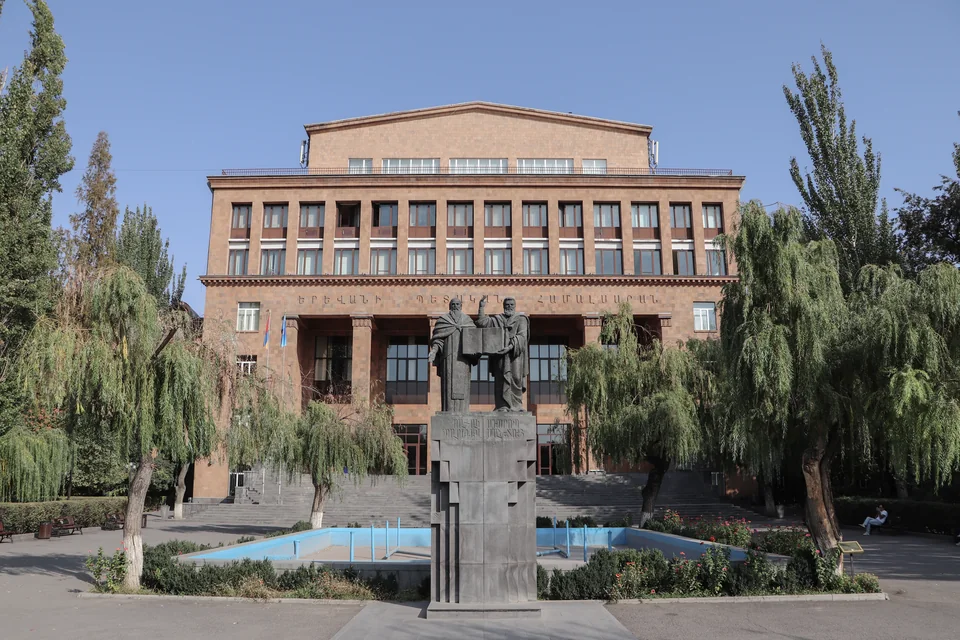
State universities. Yerevan State University, the National Polytechnic University, the Armenian State University of Economics (ASUE), Brusov State University and Khachatur Abovyan Armenian State Pedagogical University. The main language is Armenian. Foreign nationals apply through the general procedure of Armenia's Ministry of Education, Science, Culture and Sport; those without Armenian go through a preparatory course first.
An interstate university. The Russian-Armenian University was set up under a 1997 agreement between the Russian and Armenian governments and teaches in Russian. The education ministries of both countries act as its founders, and graduates of the Russian-language division receive state diplomas of both Russia and Armenia.
Branches of Russian universities. The Moscow State University branch opened in Yerevan in 2015 and runs bachelor's and master's programmes in Russian. The Plekhanov Russian University of Economics also has a Yerevan branch: for 2026/27 it admitted bachelor's students in applied informatics, economics (finance and banking) and management. International applicants for fee-paying places sit mathematics and Russian; Russian citizens and applicants for state-funded places also take a subject test. The branch council sets the fee each year, and the branch has no dormitory of its own.
Foreign and international universities. AUA teaches entirely in English and holds US accreditation from the WASC Senior College and University Commission (WSCUC). The French University in Armenia was founded under an intergovernmental agreement between Armenia and France and works with Jean Moulin Lyon 3 University.
Medical universities. Besides state-run YSMU, the national quality agency ANQA lists medical institutions with current accreditation such as the Armenian Medical Institute, Erebuni Medical Academy and the University of Traditional Medicine. Our guide to studying medicine in Armenia covers them in detail.
Russian-taught universities
For graduates of schools in Russia, Kazakhstan or other CIS countries, this is the shortest path: there is no new language to learn before the first year.
Russian-Armenian University
RAU is a multidisciplinary Russian-language university with eight institutes covering mathematics, physics and high technology, law, economics, media, oriental studies and more. In 2026/27, full-time bachelor's tuition in the Russian division starts at $1,380 (AMD 500,000) for philology and electronics, rises to $2,750 (AMD 1,000,000) for applied mathematics, management and economics and to $3,030 (AMD 1,100,000) for law. The highest rate on the price list, $4,960 (AMD 1,800,000), applies to one of the advertising and communications programmes.
RAU also has state-funded places paid for by the Russian federal budget. Under the 2026 admission rules, citizens of Armenia, Russia, other CIS countries and Georgia may compete for them. For fee-paying places the university accepts Russian or Armenian unified state exam (EGE) results or Belarus centralised testing; everyone else sits RAU's own entrance exams. One restriction matters: a Russian citizen with a Russian school certificate competes for state-funded places only with Russian EGE results, and can replace the EGE with RAU's internal exams only for a fee-paying place.
Moscow State University branch in Yerevan
The branch offers seven bachelor's fields: applied mathematics and computer science, law, international relations, journalism, linguistics, economics, and public administration. Graduates receive a Moscow State University bachelor's diploma. Applicants sit two written exams, a subject test and Russian, remotely on the university's "University Without Borders" platform. EGE scores are not counted.
The branch's fee page shows 2025/26 rates: $4,130 (AMD 1,500,000) for applied mathematics, $4,410 (AMD 1,600,000) for journalism and linguistics, $4,960 (AMD 1,800,000) for the other fields. State-funded places in its table are marked for Armenian citizens, so other nationals should budget for a fee-paying place.
YSMU and programmes with Russian-taught groups
YSMU admits international students to Russian-taught general medicine, dentistry and pharmacy. ASUE and Brusov University also list Russian among their languages of instruction, but only for some programmes, so check the language of the specific programme.
English- and French-taught options
American University of Armenia. Every programme is taught in English. For international students in 2026/27, the business and economics bachelor's degrees cost $13,080 (AMD 4,750,000) a year and all other bachelor's programmes $11,700 (AMD 4,250,000). Armenian citizens, holders of the Armenian special passport and ethnic Armenians who document their heritage with a legalised birth or baptism certificate receive an automatic subsidy of $5,510 (AMD 2,000,000) a year. International students can apply for merit scholarships covering up to 50% of tuition. Students without Armenian citizenship need health insurance; through the university's provider it costs about $28 (AMD 10,000) a month.
French University in Armenia. Teaching is in Armenian, French and English, and graduates receive both Armenian and French state diplomas. Master's applicants need a French-language diploma, DELF B2 or DALF. The main fields are law, management, marketing, finance and computer science.
YSMU, English-taught stream. English-taught medicine costs $7,160 (AMD 2,600,000) a year in 2026/27, and English-stream applicants take an additional English test.
Armenian-taught state universities
YSU states on its page for international students that it admits foreign bachelor's applicants who are fluent in Armenian and pass the faculty's entrance exams. Others can join its preparatory department for a full academic year, studying Armenian and school subjects, and enter a faculty after passing the final exams. Government rules make this model general: a preparatory course lasts at least six months, and its final exams replace the entrance exams.
This route suits students who plan to live and work in Armenia and applicants of Armenian heritage. The ministry reserves free bachelor's places for the Armenian diaspora in Armenian studies, pedagogy and the arts; in 2026 applications ran from 22 June to 24 August.
How to check accreditation
Institutional accreditation in Armenia is granted by the National Center for Professional Education Quality Assurance (ANQA), whose public register shows each decision and its validity. The register on 30 September 2026 showed:
| University | ANQA decision | Valid until |
|---|---|---|
| American University of Armenia | positive | 6 Mar 2033 |
| Armenian State University of Economics | positive | 23 Feb 2032 |
| Erebuni Medical Academy | positive | 11 Jun 2031 |
| Armenian Medical Institute | positive | 15 Aug 2029 |
| French University in Armenia | positive | 12 Aug 2028 |
| Yerevan State University | positive | 10 Jun 2028 |
| Brusov State University | positive | 15 Feb 2028 |
| Armenian-Russian International University "Mkhitar Gosh" | positive | 16 Nov 2027 |
| Yerevan State Medical University | positive | 24 Dec 2026 |
An expired date in the register does not mean the institution has closed; renewal may be under way. Ask the admissions office where the procedure stands and get the answer in writing. RAU and the Moscow State University branch are accredited under Russian rules, so look for their status on their own "information about the educational organisation" pages rather than in the ANQA register.
Which diploma you receive and where it counts
This matters more than any ranking if you plan to work in your home country after graduating.
| Where you study | What you graduate with | What to check at home |
|---|---|---|
| RAU, Russian division | Russian and Armenian state diplomas | a Russian diploma needs no recognition in Russia |
| Moscow State University branch | Moscow State University diploma | an MSU diploma is Russian, so no recognition is needed |
| Accredited Armenian university | Armenian state diploma | Russia and Armenia signed a mutual recognition agreement on 15 Sep 2001; other countries apply their own recognition rules |
| UFAR | Armenian and French diplomas | recognition of each diploma follows the rules of the country where you use it |
| Medical university | MD qualification | licensing in the country where you want to practise |
Russian education law (Article 107 of Federal Law 273-FZ) recognises foreign qualifications covered by a mutual recognition treaty. The 2001 agreement with Armenia covers state-format diplomas from accredited institutions, so make sure your university's accreditation will still be valid when you graduate. Citizens of Eurasian Economic Union states can use an Armenian degree for employment elsewhere in the union without recognition procedures, except in medicine and pharmacy (Article 97 of the EAEU Treaty).
How to choose a university for your goal
| Your goal | Start with | Why |
|---|---|---|
| A Russian diploma and teaching in Russian | RAU or the Moscow State University branch | Russian state diploma, no language switch |
| A state-funded place as a Russian or CIS citizen | RAU | federal-budget places are open to CIS and Georgian citizens |
| English-taught study and an international career | AUA | all teaching in English, WSCUC accreditation |
| Medicine in Russian or English | YSMU | separate streams and a fee fixed for the whole programme |
| French and a second diploma | UFAR | Armenian and French diplomas |
| Life in Armenia and fluency in Armenian | YSU, ASUE or the Polytechnic via a preparatory course | wide choice of subjects, diaspora places |
Once your shortlist is narrower, move to the practical side: our step-by-step guide to applying to Armenian universities covers documents and deadlines, and the cost of studying in Armenia collects tuition and housing prices. For a master's, RAU and the Moscow State University branch teach in Russian, AUA in English and UFAR in French.
After that, compare programmes rather than institutions: check the curriculum, the language of each course, internships and the total cost of the full degree. At YSMU and AUA the contract fixes the fee for the whole programme; elsewhere, ask whether it can change after the first year.
Common mistakes
- Assuming a whole programme is taught in Russian because the university lists Russian among its languages. Check each programme and each course.
- Comparing prices from aggregator sites. AUA charges international students 1.7–1.9 times the rate for Armenian citizens, and many sites still show outdated figures.
- Ignoring accreditation dates. Some institutions' ANQA decisions have expired or will expire before you graduate.
- Counting on a state-funded place at the Moscow State University branch. Its state-funded places are for Armenian citizens.
- Forgetting residence status. Visa-free visitors may stay up to 180 days a year; for a full academic year you need temporary residence status, which is free for students.
FAQ
Yes. The Russian-Armenian University and the Moscow State University branch in Yerevan teach entirely in Russian, and the Plekhanov University branch teaches Russian curricula. YSMU has a Russian-taught medical stream, and ASUE and Brusov University offer some programmes in Russian.
Yes. The American University of Armenia teaches all its bachelor's and master's programmes in English, and YSMU runs an English-taught stream in medicine, dentistry and pharmacy. Other universities offer individual English-taught programmes; confirm the language of the exact programme before applying.
Most international students pay tuition. The exceptions are RAU's state-funded places for citizens of Armenia, Russia, other CIS countries and Georgia, and the ministry's free places for the Armenian diaspora in Armenian studies, pedagogy and the arts. AUA's automatic subsidy is for Armenian citizens and ethnic Armenians, while international students can apply for merit scholarships of up to 50% of tuition.
Not for programmes taught in Russian, English or French. For Armenian-taught state programmes, such as most of YSU's, you need to be fluent or complete a preparatory course of at least six months with final exams.
Among published 2026/27 fees, RAU has the lowest starting point: $1,380 (AMD 500,000) a year for some bachelor's programmes. State universities quote fees for foreigners on request, and their programmes are in Armenian, so a preparatory year adds to the budget.
If you study for more than 180 days a year, apply for temporary residence status at the Migration and Citizenship Service. It is free for foreign students, and the card is valid for up to one year and can be renewed; it is usually issued within 30 days of applying.
Sources
- Armenia Ministry of Foreign Affairs: studying in Armenia, universities and languages of instruction, visa regime and length of stay — checked 30 Sep 2026
- RAU: tuition fees 2026/27, bachelor's admission rules 2026, history and status — checked 30 Sep 2026
- Moscow State University branch in Yerevan: bachelor's admission, places and fees — checked 30 Sep 2026
- AUA: undergraduate tuition rates 2026/27 — checked 30 Sep 2026
- YSMU: admission of foreign citizens 2026/27, English stream, Russian stream — checked 30 Sep 2026
- Plekhanov Russian University of Economics: admission to the Yerevan branch in 2026/27 — checked 30 Sep 2026
- YSU: foreign students — checked 30 Sep 2026
- UFAR: master's admission conditions 2026/27 — checked 30 Sep 2026
- ANQA: state register of institutional accreditation — checked 30 Sep 2026
- Armenia Ministry of Education: admission of foreign applicants for 2026/27 — checked 30 Sep 2026
- Temporary residence status in Armenia (Migration and Citizenship Service) — checked 30 Sep 2026
- Russian Ministry of Science and Higher Education: mutual recognition treaties, Treaty on the Eurasian Economic Union — checked 30 Sep 2026
- Central Bank of Armenia. AMD amounts are converted at the Central Bank of Armenia official rate for 29 Sep 2026, $1 = AMD 363.18; amounts under $100 are rounded to the dollar and larger ones to the nearest $10.
University and programme selection, accreditation checks, document preparation and support until enrolment are provided under an agreement with StudyU. The university decides on admission, and Armenia's Migration and Citizenship Service decides on residence status.
Next steps
- Studying Medicine in Armenia: Universities, Entry Exams and Fees for International Students
- Applying to Armenian Universities as an International Student: Steps, Documents and Deadlines
- Cost of Studying in Armenia in 2026/27: Tuition, Housing and Required Extras
- Studying Abroad as a Russian Citizen in 2026: Where You Can Go, Where to File Your Visa, How to Pay and How to Get Your Degree Recognised
