
A Swiss bachelor's takes three years (180 ECTS credits). At public universities it is taught almost always in the regional language: German, French or Italian. Whether you can enter straight from high school depends on your certificate. Many EU certificates, the IB and A-levels give direct entry if subjects and grades meet the rules. Holders of Russian, Kazakh and several other CIS certificates need two years of recognised university study at home for cantonal universities, or the ETH Zürich or EPFL entrance exam in German or French; studies then begin roughly a year to eighteen months after applying.
Private institutes teach bachelor's programmes in English and accept school leavers, mainly in hospitality and business (EHL, Glion, Les Roches, BHMS and others). Tuition for a public bachelor's costs $3,620–28,990 (CHF 3,000–24,000) over three years plus living costs; a private one runs to $140,000–280,000 with all compulsory charges.
| At a glance | Public university | Private institute |
|---|---|---|
| Language | German, French or Italian (C1, or B2–C1 for French) | English (usually IELTS or equivalent) |
| Straight from a non-EU high school | often not: prior university study or the ETH/EPFL exam | yes, under the school's own rules |
| Length | 3 years | 3–4 years, often with paid internships |
| Tuition over 3 years | $3,620–28,990 (CHF 3,000–24,000) | $140,000–280,000 with all compulsory school charges; housing and insurance are not always included |
| Start | autumn (ETH: autumn only) | spring or autumn |
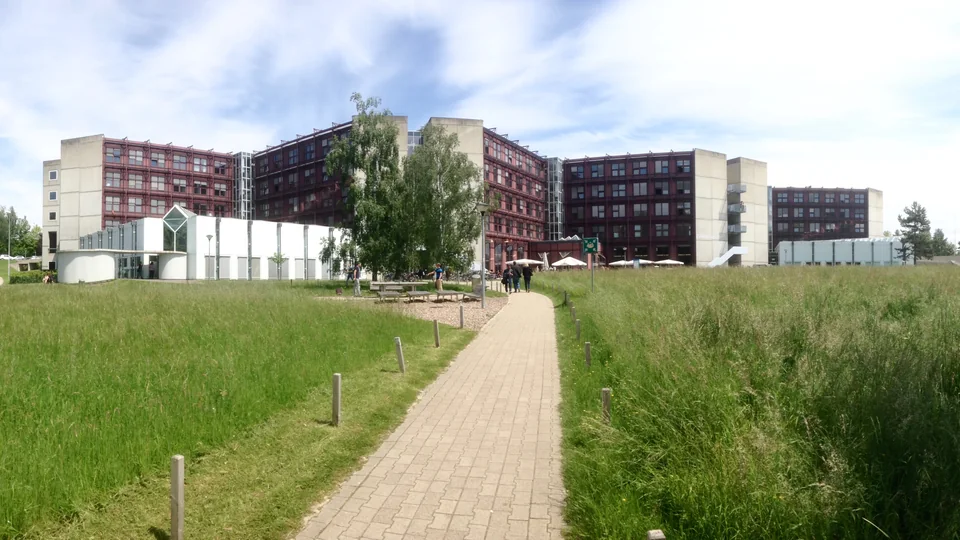
How the Swiss bachelor's works
A bachelor's covers six semesters and 180 ECTS credits. The academic year starts in September, with the second semester in spring; new ETH students can only start in autumn.
The workload at research universities is heavy. ETH says openly that only the very best students pass the rigorous exams of the first years, and EPFL estimates a student week at 50–60 hours including independent study.
The language follows the region, not the student body:
- German: ETH Zürich, Zurich, Basel, Bern, Lucerne, St. Gallen;
- French: EPFL, Geneva, Lausanne, Neuchâtel;
- bilingual: Fribourg teaches in French and German;
- Italian and English: USI in Lugano, depending on the programme.
Fully English-taught bachelor's programmes at public universities are few. Search the official swissuniversities database at studyprogrammes.ch with the language filter.
Which route fits your situation?
| Your situation | Realistic route | When you could start in Switzerland | What to do now |
|---|---|---|---|
| EU certificate, IB or A-levels with the right subjects | direct application | straight after school | check subjects and grade thresholds; EPFL caps first-year places |
| Non-EU certificate, strong in maths and physics, willing to learn German or French | ETH or EPFL entrance exam | EPFL: about 8–12 months after registering; ETH: about 18 months after applying | reach C1 (German) or B2–C1 (French); prepare the exam syllabus |
| Already enrolled at a university at home | two years in the matching field, then a cantonal university, or ETH with the reduced exam | after year two | keep the same field, collect transcripts, learn the language |
| School leaver who wants to study in English | private institute (hospitality, business, luxury) | spring or autumn of the next year | IELTS, school choice, budget |
Check your own country on the swissuniversities map first: requirements differ widely. For example, holders of certificates from Armenia, Georgia and Moldova need only the certificate plus proof of admission to a home university, while Uzbekistan requires a three-year degree for cantonal universities.
Universities of applied sciences (Fachhochschule, HES) are rarely the first option for international school leavers. By law they require a vocational baccalaureate, or a general one plus a year of relevant work experience. EHL, part of HES-SO, builds a preparatory year into its bachelor's for international students.
Bachelor's at ETH Zürich and EPFL
| ETH Zürich | EPFL | |
|---|---|---|
| Language | German, C1 by 31 March | French, B2 (C1 recommended) |
| Non-EU certificates | admitted directly, via the reduced exam or via the comprehensive exam, depending on the country table | CMS preparatory year for listed countries, otherwise the entrance exam |
| Exam | reduced: maths, biology, chemistry, physics; comprehensive: eight subjects | full or reduced, decided by EPFL |
| Dates | apply 1 December – 31 March; exam the following January | register 1 October – 1 December 2026; exam 18–22 January and summer 2027 |
| Exam fee | $660 (CHF 550) or $970 (CHF 800) | $180 (CHF 150) + $660 (CHF 550) or $970 (CHF 800) |
| Tuition per semester | $2,650 (CHF 2,190) + $90 (CHF 74) fees | $2,650 (CHF 2,190) + $60 (CHF 50) fees |
| Notes | one programme per application; motivation letters and awards are not considered; new requirements from autumn 2028 | first year capped at 3,000; those who pass the exam are entitled to a place |
For exam candidates, EPFL is currently faster: pass in January and summer 2027 and you start in September 2027. At ETH the exam comes about ten months after the application deadline, so applying in spring 2027 means starting in September 2028. ETH offers no language courses and does not assess individual chances before receiving a complete application.
Bachelor's at cantonal universities
For Russia, Kazakhstan, Belarus, Kyrgyzstan and Tajikistan the 2026/27 conditions are identical: the school certificate, two years of recognised university study in the field and proof of admission. St. Gallen adds its own selection procedure; Geneva does not require the proof of admission to be subject-specific.
Practical details:
- Deadlines. UZH accepts autumn applications until 30 April, but applicants who need a visa must apply by 28 February and need a decision three months before entry.
- Language. Aim for C1 for German-taught programmes (Goethe-Zertifikat C1, TestDaF, DSH) and B2–C1 for French-taught ones (DELF, DALF). Each university publishes its accepted certificates. See our guides to German language tests and French language tests.
- Credit transfer. Some courses from your home university may be credited, but do not count on it.
- ECUS. If a university decides your preparation falls short, it may assign the ECUS supplementary exam, held in August for about $1,270–1,280 (CHF 1,050–1,060).
Medicine is closed to applicants without a Swiss residence permit, and it is taught only in German and French.
English-taught private bachelor's programmes
Private institutes accept school leavers and teach in English. At many schools the compulsory bill covers food and often campus housing and insurance too, and paid internships are built into the programme. Check the status on the official swissuniversities list: EHL is accredited as part of HES-SO; Glion, Les Roches and César Ritz Colleges as institutes of applied sciences.
| School | Structure | Full bill with compulsory charges | Status under Swiss law |
|---|---|---|---|
| EHL (Lausanne) | preparatory year + 3 years; intakes September 2027 and February 2028 | $222,140 (CHF 183,874) excl. housing | part of HES-SO (university of applied sciences) |
| Glion (Glion/Bulle) | experiential year + 3-year BSc; 8 semesters, 3 of them internships | $280,160 (CHF 231,900) incl. housing, food and insurance | institute of applied sciences |
| Les Roches (Crans-Montana) | experiential year + 3-year BSc | $273,000 (CHF 225,975) incl. housing and board | institute of applied sciences |
| BHMS (Lucerne) | 3-year BA | year one $46,630 (CHF 38,600) incl. room and meals for 24 weeks | not on the HEdA accreditation list; ask who awards the degree |
Before paying, ask the school three things: who awards the degree, how that degree is recognised in Switzerland and in your home country, and what the deposit refund terms are if your visa is refused. Our guide to hospitality management in Switzerland compares the schools; StudyU profiles Glion and BHMS.
What a whole bachelor's costs
Three years of tuition and compulsory fees for international students at public universities:
| University | 3 years |
|---|---|
| University of Geneva | $3,620 (CHF 3,000) |
| University of Lausanne | $4,200 (CHF 3,480) |
| University of Basel | $6,160 (CHF 5,100) |
| University of Zurich | $9,270 (CHF 7,674) |
| ETH Zürich | $16,410 (CHF 13,584) |
| EPFL | $16,240 (CHF 13,440) |
| University of St. Gallen | $24,240 (CHF 20,061) |
| USI | $28,990 (CHF 24,000) |
Add living costs. ETH puts a year in Zurich at about $28,480 (CHF 23,572) excluding tuition, roughly $85,000 over three years; the University of Fribourg budgets $1,930–2,300 (CHF 1,600–1,900) a month excluding insurance. Every year the canton will ask for proof of funds: in Zurich, $25,370 (CHF 21,000) in an account in your name. For the full calculation see our guide to the cost of studying in Switzerland.
Government scholarships for international bachelor's students are practically non-existent, so families usually fund the degree.
Working during and after the bachelor's
Non-EU/EFTA students may work from six months after the start of their studies, up to 15 hours a week during term. The employer applies for the permit and the university confirms that the job does not delay your studies. In year one, especially at ETH or EPFL, do not count on a job.
After graduating you have three options:
- A Swiss master's. Graduates of a Swiss university with 180 credits in the same field are entitled to a place in the consecutive master's at EPFL, though extra credits may be required; ETH graduates continue into ETH master's programmes. See our guide to master's degrees in Switzerland.
- Job search. Non-EU graduates of Swiss institutions can get a six-month permit to look for a job matching their qualifications; a work permit is granted if the job is of overriding scientific or economic interest.
- A master's elsewhere with a Bologna-compatible Swiss bachelor's.
Plan for students in their last two years of school
- Two years before graduation: decide between direct entry (if your certificate qualifies), the ETH/EPFL exam, prior study at home or a private institute. Check the swissuniversities country table.
- Over the following year: reach B2 in German or French (for the exam route) or take IELTS (for a private school).
- Final year, October–November: register for the EPFL exam by 1 December; apply and interview for private schools.
- Final year, winter–spring: sit the EPFL exam in January or apply to ETH by 31 March (exam a year later); keep a home university place in the same field as a backup and possible route.
- After admission: open the account for proof of funds, book the visa appointment and start looking for housing. If you are under 18 when applying, Swiss representations may ask for a birth certificate and legalised parental consent.
Common mistakes
- Assuming English-taught public bachelor's programmes are easy to find. There are few; search early.
- Enrolling at home in any field to "transfer later". Swiss universities want proof of admission and study in the same field.
- Underestimating the exam language. The ETH exam is in German; EPFL requires French.
- Paying a private school deposit before checking status and refund terms.
- Forgetting age rules. Minors need extra visa documents, and parents sign leases and contracts.
FAQ
With an EU certificate, the IB or A-levels that meet the subject and grade rules, often yes. With many non-EU certificates, cantonal universities require two years of prior university study, while ETH and EPFL offer an entrance exam in German or French. Private institutes accept school leavers with good grades and English.
Some, but not many; the main language is the regional one. Search studyprogrammes.ch, run by swissuniversities. Private hospitality and business institutes teach in English.
Three years and 180 ECTS credits. Private hospitality programmes often take 3.5–4 years because of a preparatory or experiential year and internship semesters.
At a public university, three years of tuition and compulsory fees cost from $3,620 (CHF 3,000) in Geneva to $28,990 (CHF 24,000) at USI, excluding living costs. At private schools the full bill ranges from about $140,000 to $280,000 depending on the school.
Swiss public universities admit on the basis of your school-leaving certificate and the country-specific conditions, not on standardised tests. For some certificates, proof of admission to a home university stands in for competitive entry and decides between the reduced and the comprehensive ETH exam.
Non-EU graduates can get a six-month permit to look for work matching their qualifications. A work permit then requires the job to be of overriding scientific or economic interest, so many graduates first complete a master's.
Under a service agreement we help you choose a route (direct entry, exam, prior study or a private institute), shortlist programmes and prepare documents and the visa file. Admission decisions are made by the university; visa decisions by the cantonal migration office and the Swiss representation.
Sources
- swissuniversities: admission requirements by country, 2026/27; fees 2026/27; accredited institutions; admission to universities of applied sciences; medical school
- ETH Zürich: applying with a non-Swiss certificate, entrance exam, admission prerequisites, master's admission, budget
- EPFL: bachelor's criteria, entrance exam, master's criteria, working while studying
- UZH: deadlines; University of Fribourg: budget
- ECUS: rules and fees
- EHL: bachelor's fees; Glion: fees 2027; Les Roches: fees 2027; BHMS: fees 2026
- SEM: working during and after studies; Canton of Zurich: students from non-EU countries
- Swiss Embassy in Russia: student D visa leaflet
- Dollar amounts use the ECB reference rates of 24.09.2026 (€1 = $1.1367 = CHF 0.9409, so CHF 1 ≈ $1.2081), rounded to $10.
The general procedure is covered in our guide to applying to Swiss universities; for the country overview, see studying in Switzerland. Help choosing a realistic route for your school year, language and budget is provided under an agreement with StudyU; to start, send us a request.
Next steps
- Hospitality Management in Switzerland: Schools, Degrees, Fees and Paid Internships
- Master's Degrees in Switzerland: 2026/27 Deadlines, Requirements, Costs and Scholarships
- Applying to Swiss Universities: Routes, Documents and Deadlines for International Students
- Cost of Studying in Switzerland in 2026/27: Tuition, Living Costs and a Full Student Budget
- DELF, DALF and TCF: Which French Test You Need to Study in France and Where to Take It
- German Language Tests for German Universities: TestDaF, DSH, Goethe and telc Compared (2026–2027)
